Jurors in Retrial of Palisades Arson Suspect May Not Hear about Los Angeles Firefighters' Missteps
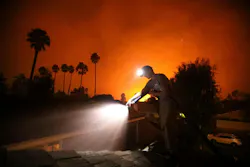
LOS ANGELES — A federal judge indicated Thursday that jurors in the upcoming retrial of a man accused of an arson that sparked the Palisades fire will not be allowed to consider whether Los Angeles firefighters adequately extinguished the blaze that prosecutors say later reignited and spread, devastating the community.
U.S. District Judge Anne Hwang tentatively granted prosecutors' request for her to instruct the jury to disregard inadmissible evidence about the adequacy of the Los Angeles Fire Department's fire suppression efforts, but deferred a final decision until after the new trial begins Nov. 2.
The issue drew attention after Jonathan Rinderknecht's first trial, when a juror questioned why Rinderknecht was being held solely responsible for the Palisades fire, given that it erupted days after firefighters left the scene of the initial blaze he stands accused of starting. Hwang had barred Rinderknecht's attorney, Steve Haney, from raising allegations of negligence by the fire department.
Jurors deadlocked 10 to 2 in favor of acquittal in June, resulting in a stunning mistrial. Prosecutors vowed to retry Rinderknecht and later obtained a revised indictment that narrows the scope of one charge to focus solely on damage from the initial Lachman fire, which began on on Jan. 1, 2025, while a second count still seeks to hold him responsible for the Lachman and Palisades fires. A third charge of setting timber afire, which was part of the original case, has since been dropped.
Rinderknecht, 30, who has remained in federal custody since the June mistrial, has pleaded not guilty to the revised charges against him. Earlier this month, Hwang ordered that there be no reference to the first trial during the retrial scheduled for Nov. 2.
During Rinderknecht's first trial, prosecutors called more than 30 witnesses, who painted a picture of a man spiraling mentally and seeking vengeance against the wealthy when he hiked to a clearing overlooking Pacific Palisades and allegedly used a lighter to set the Lachman fire.
Prosecutors said the fire smoldered underground for a week before exploding into the deadly Palisades fire. The secondary inferno erupted on Jan. 7, 2025, killed 12 people, destroyed 6,500 structures across the Palisades and Malibu, and cost billions of dollars in damage and insurance claims.
In a civil lawsuit against the city and the state, Los Angeles firefighters testified about a series of communication failures and questionable decisions by higher-ups that led crews to leave the area of the New Year's Day fire prematurely.
Fire crews were ordered to roll up their hoses, despite complaints that a more thorough mop-up was needed. One firefighter picking up hoses on Jan. 2 found crackling red-hot coals in the dirt. A captain cautioned his chief that it was too soon to pick up the hoses. And crews did not walk the entire perimeter of the burn scar after a report of smoke in the area on Jan. 3.
Prosecutors argued that jurors' post-trial statements confirmed that the issue of the Fire Department's response "is baked into the case."
"If the jury is never told that they cannot consider this evidence, another mistrial is all but inevitable," prosecutors wrote in a court filing.
Hwang on Thursday said she was not relying on juror statements, but expressed concern about whether jurors could distinguish questions about the adequacy of firefighting efforts from evidence challenging whether the initial blaze continued smoldering.
After the hearing, Rinderknecht's attorney said he wasn't concerned about the jury instruction.
"It's going to be largely the same evidence in the second trial, with I think some very, very strong evidence in the second trial that will erode their theory of how that fire even started," Haney said.
Haney said he believes the second trial "will be largely similar" to the first.
"I think even better for the defense," Haney said. "There'll be evidence that comes out in trial too that I think will be overwhelmingly helpful for the defense that we didn't see in the first trial."
Haney declined to detail what that evidence was. When asked about an additional prosecution experiment that involves the lighter prosecutors believe ignited the blaze, Haney said that testing "will be central in trial two."
"I don't know why they didn't test the lighter before they charged my client, but they did 11 months later, after the fire," Haney said. "It's going to be a big issue at the second trial."
During the first trial, Haney called several witnesses in an attempt to undercut the prosecution's theory of the fire. A Palisades resident said he saw several teens leaving the hill behind his house after the fire started, acting "boastful." A Los Angeles firefighter testified that he saw flashes of light and heard loud noises that sounded like fireworks around midnight near the neighborhood closest to where the blaze sparked. A defense expert told jurors the most likely cause of the blaze was fireworks and cast doubt on exactly where it originated.
Haney said Rinderknecht "is positive, feeling good about where we are."
"He's in a good frame of mind, I am too," he said. "I think we're all looking forward to the second trial."
©2026 Los Angeles Times. Visit latimes.com. Distributed by Tribune Content Agency, LLC.