What is Methyl Methacrylate and Why Did it Spark a Mass Evacuation in CA?
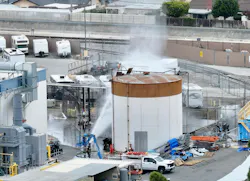
Before I begin with some explanation, let’s set the stage with at least some foundational knowledge regarding the hazardous materials incident that began May 21 in Garden Grove, CA, that had received national attention.
There was an overheating bulk storage tank of a product called Methyl Methacrylate (MMA) at an aerospace manufacturing facility. This situation has caused the governor to declare a state of emergency and issue an evacuation order to nearly 50,000 residents.
The remainder of this article will be written about the potential hazards themselves and not always so specifically about this incident.
As firefighters, we are going to tackle this incident in four phases: What? Why? How? and What? We must ask: What is it? Why is this happening? How could it hurt us? And what can we do to stop it?
What it it?
Methyl Methacrylate (MMA) is a colorless, liquid chemical known to be used in the production of plastics, but more specifically the production of military-grade aerospace windows. It is highly flammable and toxic, but most relevantly it is a type of chemical called a “monomer."
The hazardous materials responders out there may have already caught on to what may be the issues, but if you haven’t, let me break it down for you.
A monomer liquid is like a bag filled with chain links that are not attached to one another, they are all there but there independently. The primary way to maintain that is through a chemical additive called an “inhibitor,” which can be added to make sure things stay that way, other times chemicals are kept refrigerated to some degree to make things more stable. Sometimes those measures fail.
Why is this happening?
In the case of the specific incident in Garden Grove, CA, the refrigeration system failed causing those loose chain links (monomers) to start linking together to form polymers in a process called “polymerization." In that process, the loose links become a connected chemical chain and heat is produced due to an exothermic chemical reaction. Unfortunately for responders and civilians alike, that heat only furthers the polymerization reaction making it a self-sustaining and unstoppable runaway event. Without getting too nerdy, that heat causes internal tank pressures to rise which leads us to the real crisis.
How could this hurt us?
Thr growth in the internal pressure of this container caused by this reaction reaching its breaking point is the real concern here. When internal pressures overcome the containment vessel and cause the rupture of that container, it quite literally creates a bomb. In this case, not just a bomb, but one that would likely ignite its highly flammable contents in the process, too. If that’s not already enough it also is toxic.
What can we do?
To formulate an operational plan for fire/rescue department, we must identify the problem specifically, which we have already done: a rise in internal pressure is raising concern that this container may rupture in a devastating fashion.
Step one is removing the life safety concern as rapidly and completely as possible, hence the evacuation orders being given.
Step two is figuring out a way to decrease the internal pressure to a point where explosion is no longer a concern. This can be accomplished in a few ways.
To over simplify it, you can release the pressure, inhibit the reaction or cool the container.
In this context, freely releasing the product is an unsultry ending due to its potential flammability and toxicity concerns. Transferring the product to another container could allow for further expansion without risking the integrity of the containers, but those operations offer their own risks and may require specialized equipment.
An inhibitor could potentially slow or stop the continuation of the reaction, but the effectiveness of this technique is dependant on the availability of the needed inhibitor and the characteristics of the specific monomer that is having the runaway reaction.
That brings us to our final and most readily available option, cooling the container. If heat is the process causing the increase in pressure then inversely a reduction in that heat will cause a reduction in that pressure and thus a reduction in the potential danger.
The easiest way to accomplish this is to use a firefighter's favorite tool: a hoseline. The power of water is never to be underestimated in these scenarios. A well directed fog stream or two can effectively hold the rising temperatures in a container at bay for quite some time. In an ideal world, that water can manage the temperature until the reaction runs its course and you effectively create a giant block of plastic.
In closing
Unfortunately, that may all take some time, potentially days—even weeks—in the best case this is not going to be a quick process. If it ends up being a quick process, you have a big problem.
In other words, today is the day to thank your local hazardous materials guy that it’s not you. If it is you, hopefully you have been paying attention in class.
About the Author
 Jake Ryks
Jake Ryks
Jake Ryks is a firefighter/EMT/hazmat specialist with the Saint Paul, MN, Fire Department (SPFD). His involvement in department training includes engine, truck and squad company functions, advanced automobile extrication and RIT. Ryks serves as an assistant hazmat coordinator for the SPFD and is a trustee for IAFF Local 21. He was awarded the MN100 Firefighter of the Year Award in 2024 for his efforts in rescuing three children from a house fire. Ryks has been involved with paid-on-call, part-time and career departments. He has taught hazmat training for fire departments locally, regionally and on a national level. In May 2024, Ryks began working for The HazMat Guys, where he manages its online learning platform and social media accounts. Most recently, he launched his own podcast, HAZARD CLASS.