Bridging the Gap: Lessons Learned Louisville Fire Department's Multiple High-Angle Bridge Rescues
Key Takeaways
- With 14 months, Louisville firefighters responded to two incidents where tractor-trailer drivers were trapped in their cabs dangling over the Ohio River.
- The rescues involved high-angle rigging, stabilization, and precise communication to safely extract the trapped driver from a semi hanging over a bridge.
- Lessons learned included the importance of equipment capacity, load distribution, staged tools, and clear work zones to enhance safety and efficiency during high-risk rescues.
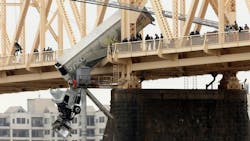
“Attention T1, E2, R2, B2, T2 and E5; Respond to the Clark Memorial Bridge on a special-high-angle rescue with a semi hanging over the bridge. Cab is hanging over the water, driver is unable to get out. There are three other vehicles involved on the bridge.”
That was the radio traffic at 12:05 p.m. that kicked off a uniqe response for the Louisville, KY, Fire Department (LFD) on March 1, 2024. The lessons from this event would be utlilized a year later by the same crews.
At first, the call seemed routine. LFD responds to “vehicle over the edge” reports fairly often, and more often than not, the vehicles have simply struck the railing. But, when the first companies arrived, it quickly became clear this was anything but routine.
Initial scene size-up
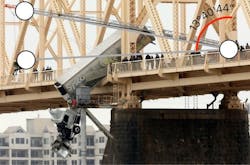
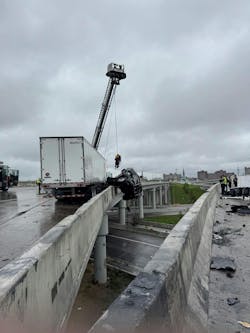
Engine 5 and Truck 2 reported a multi-car accident with injuries on top of the bridge, and a semi-truck left hanging halfway over the Ohio River with the driver still inside. The trailer, a Sysco-branded refrigerated unit, had wedged against the bridge in just the right way that the tractor cab was suspended roughly 15 from the edge of the bridge. From the driver’s seat, the dashboard window overlooked the river below, giving the woman driver a direct view of fast-moving floodwater while her cab sat at a near-vertical angle against the bridge.
The Clark Memorial Bridge spans one of the Ohio River’s widest points, stretching 1.08 miles across. This complicates response due to a confined work area and the ability to get resources to the scene and staged. On that day, the water level had just entered flood stage and churned 75 feet below the roadway.
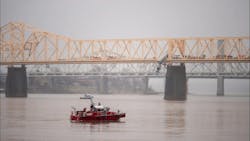
After the initial company update, Truck 1 was enroute to pick up Rescue 2, the department’s primary water, rope, and dive unit. They requested an additional water resource and Engine 6/Rescue 6, responded with a 21-foot Zodiac boat. Truck 1 also reported that, together with Engine 2—their partner in the two-piece rescue company—they would assist on top of the bridge after deploying members alongside Marine 1, a 40-foot fire boat. Marine 1 and Rescue 6 were staged below the bridge to provide standby divers and support for any surface water rescues. From the water level, members noted an active diesel fuel leak into the river coming from the semi. River traffic was stopped, and the U.S. Coast Guard was notified of the incident.
Meanwhile, members of Engine 5 were treating patients from the three vehicles involved in the crash.
Preparing for rescue operations
Truck 2 positioned its apparatus and began setting up the aerial ladder for use as an artificial high directional (AHD). An Arizona Vortex as an AHD was considered but quickly abandoned because the position of the cab, protruding so far from the edge, would have required the rescuer to free climb onto the truck.
When Truck 1 and Engine 2/Rescue 2 arrived, they quickly set up a two-rope, twin-tension system that utilized Truck 2’s aerial ladder tip as the AHD. They then suggested using their bumper-mounted winch or chains to help stabilize the tractor-trailer. After reviewing the risks, command decided against it. The concern was twofold: placing members beneath the trailer created a mousetrap hazard, and adding weight or vibration on the bridge could cause the trailer to break loose altogether.
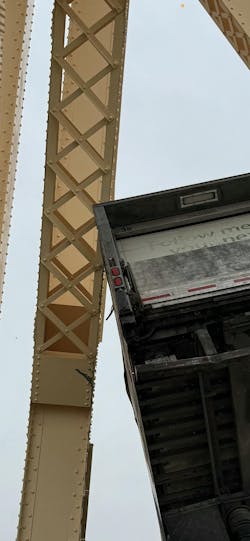
As rigging neared completion, the crew chose to anchor directly to the bridge instead of the apparatus, avoiding potential rope contact with the aerial waterway and to avoid pulleys from the haul system snagging on rungs of the ladder. A wrap 3/pull 2 scenario using 1-inch webbing connected to the bridge's super structure was used.
Meanwhile, a rescuer prepared a harness for the driver and staged the connections for a rapid extraction. After a safety check, the ladder operator lifted the rescuer into position, navigating a small window through the bridge superstructure—a tight space that required precision to avoid contact with beams and supports.
Rescue operations begin
The captains of Rescue 2 and Truck 2 stood side by side, each independently guiding rope and ladder movements. The ladder operator carefully adjusted the aerial tip’s height, inching it closer to the cab while constantly watching for sway, while the Truck 2 captain monitored rope tension, calling out adjustments to keep the rescuer stable. At the same time, the Rescue 2 captain ensured the system remained perfectly aligned with the cab’s window, avoiding contact with the bridge and trailer.
Crew members on the roadway stayed alert for any shifting loads or changes in the bridge’s angle, ready to relay warnings instantly. Every movement was deliberate and every call precise because one misstep could have had catastrophic consequences. Communication flowed seamlessly, short, clear commands over the noise of traffic and rushing water, combined with hand signals for confirmation, allowing the entire team to operate as a single, coordinated unit.
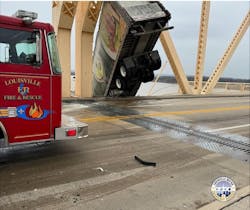
Inside the cab, the rescuer found the driver suspended in her seatbelt, one foot still pressing the brake—terrified that letting go might send the truck plummeting into the river. The rescuer secured the harness to her, then cut the seatbelt with nothing more than the pocketknife he carried daily. The moment the brakes released, a loud hiss echoed across the bridge, startling everyone on scene. Working quickly, the rescuer helped guide the driver out through the window and safely secured her onto the rope system. He then gave the signal to haul them both back to the roadway.
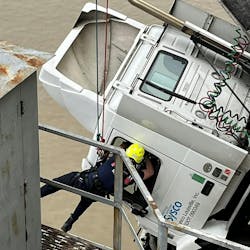
Across the bridge, every crew member held their breath as the team worked in perfect synchrony. When the driver finally reached solid ground, a collective exhale swept through the scene—a moment of quiet triumph born from careful on-scene planning, skill, and teamwork. The total time of the incident, from dispatch until the patient was on the bridge was 51 minutes.
Lessons learned & reinforced
Later that evening, members gathered for a coffee table debrief and critique of operations, as any self-respecting team seeking improvement would. What follows is an honest look at some of the findings:
Risk of additional weight on the semi
- A major concern discussed was whether the rescuer’s additional weight could have compromised the already unstable trailer and led to a catastrophic fall. Several stabilization options were explored prior to committing to the rescue:
- Multiple heavy wreckers from the local towing company were requested. With 200–300 feet of tow cable and rigging available, these assets could have provided significant stabilization if time allowed.
- Consideration was given to marrying or bonding the trailer to the bridge’s superstructure using doubled-over Grade-80 chain, straps, or ropes carried on fire apparatus.
- Stabilization struts or jacks could have been applied to steady the load or prevent further movement while rigging was being established.
- These were valid options, but the clock was working against us. Ultimately, the decision to move forward was based on balancing the risks with the urgency of saving a life.
- Aerial ladder capacity and rigging considerations
Both truck companies on scene were operating from auxiliary apparatus with a rated tip-load capacity of only 250 lbs. (Rated at a 2:1 safety factor, tested to the side of the apparatus at full extension and 0° elevation). A deeper look into forces applied during the rescue revealed:
- End-rope load of ~400 lbs (180 lb rescuer + 220 lb driver); When estimating an unknown patient load, the standard is to use 1kN (225 lbs). She was believed to be just under this.
- Ladder angle of ~13°.
- Change-of-direction pulleys at the ladder tip created an interior rope angle of ~63°, applying ~1.87 × the load to the tip (400 lbs × 1.87 ≈ 749 lbs).
- The ladder was fully extended — at the time, this was deemed necessary to quickly raise the load after the rescue was made. Looking back, we’ve found safer options mentioned below.
- Potential for torque-loading the ladder tip if twin-tension was not strictly maintained. Anchor straps at the ladder tip also posed risk if not configured correctly; a two-point, load-distributing sliding “X” would have shared the forces more evenly across both beams.
- Members noted additional, unnecessary hardware (extra anchor plates or carabiners) at the tip. This could increase both clutter and introduce an element of human error potential.
- Electronic rescue tools on standby
Battery-powered rescue tools should be staged and pre-rigged for potential over-the-edge deployment. Having them ready on rope systems ensures immediate access if extrication is required in a hard-to-reach position. Other tools noted were a medical hip-kit, trauma shears, knife, and window punch. - Rescuer communications
The primary rescuer did not carry a radio while inside the cab. This left rope and aerial operators relying on external cues and minimum radio relay. If complications had arisen, the rescuer would have had no way to immediately request assistance or additional equipment. Hands-free communications — whether headset or lapel mic — should be standard for rope operators in confined or high-risk environments. - Limiting non-rescue personnel in the work area
Several members noted that non-rescue personnel were clipping and unclipping equipment onto the primary rescuer during setup. This disrupted the continuity of safety checks and introduced unnecessary risk. A clear work zone must be established around the rescue rigging and only staffed by rope-qualified personnel. - A change of direction in the system at the base of the bridge
Members noted that by adding a change of direction at the bridge/roadway base, the haul system could be lengthened, and such would reduce resets during the haul. Members intentionally avoided this approach as to provide quicker patient access and getting the patient and rescuer onto our system and out of the cab in a timelier fashion. - Components/equipment
- Swivel pulleys were not used at the time but recommended for future response
- Tandem MPD’s (CMC’s Multi-Purpose Device) were utilized; our department is now using 11 mm rope and Clutches
- Mirrored 3:1 mechanical advantage system built into both rescue ropes
- Secondary hazards
- Personal Floatation Device (PFD) use during rope operations - Discussion arose over whether the rescuer should have worn a PFD. The decision was made against it, as bulk and snag hazards could have complicated both rope rigging and window entry. While PFDs are vital for water-based operations, this scenario highlighted the importance of weighing environmental versus operational hazards.
- Have a dry handline in place - A dry handline staged near the operation provides rapid capability in the event of a sudden fire hazard, fluid leak, or equipment failure.
- Vibrations - Limit apparatus movement near expansion joints on bridges to prevent unwanted vibrations. Rescuers having to free climb on or along the vehicle can also have adverse effects.
- Back-up rescuer - A secondary outfitted rescuer was staged in conjunction with a secondary anchor and independent lines in the event of an emergency.
- Training Implications
Many of our existing practices and skills were validated. Moving forward though, technical rescue crews have committed to training with two-person loads on aerial ladders, practicing best practices in apparatus use, rigging, and reinforcing twin-tension systems. This incident underscored that while rescue environments can be unpredictable, sound training and preparation provide the safest margin when urgency forces risk.
Looking back
The Clark Memorial Bridge rescue was one of those rare calls that tested every dimension of our craft, from technical skill, decision-making under pressure, and interagency coordination. What could have easily turned into tragedy instead became a defining moment of teamwork and resilience. It was a turning point for the Louisville Fire Department. In the days and weeks that followed, we spent hours reviewing every detail: what went well, where we stumbled, and how we could be better prepared if we ever faced something like it again. At the time, it felt like a once-in-a-career event. Those lessons would not remain theoretical for long.
A second test of skills, one year later
Fourteen months after the Clark Memorial Bridge incident, another call came in—this time at Spaghetti Junction (intersection of Interstate 64, Interstate 65, and Interstate 71) leading onto another Ohio River crossing. On a rainy afternoon during rush hour on May 4, 2025, another semi-truck was left teetering on the edge of the bridge, its cab dangling nearly 70 feet above the highway below. The driver was trapped inside, unable to escape.
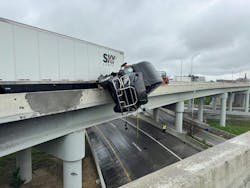
The scene was eerily familiar, but this time the cab hung by nothing more than the fifth-wheel hitch pin. Crews recognized the similarities immediately, and the lessons from the previous rescue were evident in our actions.
Same size-up, new variables
The difference was clear from the start. A secure work area was established and cordoned off, traffic below was halted, and command was organized without delay. Our 1,000-lb. tip load Seagrave Aerialscope Tower was the first to arrive and quickly positioned for use as an AHD. Rescue companies followed, rigging load-equalizing anchors to support pulleys mounted beneath the platform. A twin-tension system was deployed again, but this time using CMC Clutches, allowing a single operator and tailer to control the lines with greater efficiency. The anchors were tied directly to the apparatus, keeping everything aligned with the ladder.
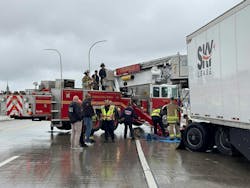
Compared to the first incident, the setup was faster, communication smoother, and roles already designated. Members were able to contact the driver by cell phone, talking him through the plan and preparing him for rescue. They were able to reassure him that the same crew worked the 2024 rescue, which put the victim in a more relaxed state. Crews chained the cab to the loaded trailer above to stabilize it, while our rescuer staged with radio, window punch, knife, and patient harness. What had once felt like controlled chaos now resembled a practiced rhythm.
Within 20 minutes, a rescuer was lowered to the cab, broke through the glass, entered, secured the driver, and lifted him to safety.
Training paid off
Every lesson from the first bridge response came into play, from experience, readiness, and refined procedures all combined to make this operation faster, safer, and more efficient. The call reinforced something we already knew—every major incident leaves behind valuable lessons, but only if you take the time to examine them honestly. This rescue proved the value of that investment in training, debriefing, and adjustments which paid dividends when it mattered most.
These incidents reaffirmed several truths for us as a department. First, that risk is never absent—but careful, deliberate planning allows us to manage it rather than be controlled by it. Second, that equipment and training only go so far without strong communication, leadership, and trust between crews. And finally, that after the lights and sirens fade, it’s the lessons carried forward that matter most.
For our team, these rescues weren’t just about pulling one driver to safety—it was about sharpening our craft so that the next time, and every time, we are even better prepared. The image of these semi-truck cabs hanging over floodwaters and roadways are images none of us will forget. But equally unforgettable is the calm precision with which our crews worked together, the discipline of rope operators and ladder crews, and the courage of the rescuers who climbed into both cabs.We train for the extraordinary because, in our line of work, the extraordinary eventually comes. And when it does, we owe it to the public, and to each other, to be ready.
About the Author
 Michael Renn
Michael Renn
Captain
Michael Renn has 18 years in the fire service, including 10 years with the Louisville, KY, Fire Department and holds the rank of captain. He has served as captain of Engine 2, Rescue 2, Truck 7, and Rescue 11. Renn is a dedicated instructor in special units and technical rescue and committed to advancing the fire service and urban search and rescue teams.