Innovations in Rope Rescue Technology for Fire Departments
Key Takeaways
- Development of less hefty rescue rope (including 11 mm versions) and hardware systems (rather than individual components) aids fire department rescue technicians in terms of reducing weight and bulk that must be carried from their rig to the incident scene.
- Budgetary constraints might prevent fire departments’ rescue teams from replacing less-than-optimal rope and hardware with innovative alternatives. However, the basis for arguments that should be made to those who hold the purse strings is convincing.
- Chief among future innovation in components for rope rescues includes the potential for 9.5 mm rope to be constructed so that it meets NFPA standards.
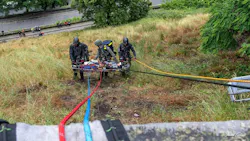
We’ve always done it that way.” Time and again, many fire department personnel cite this adage to defend their tactics when they encounter challenges to the status quo. In the realm of rope rescue, those traditional tactics can relate to not only the way that they set up systems but the hardware of those systems and the rope itself. Fortunately, open mindedness increasingly prevails, and thinking is evolving to produce better outcomes and to improve the safety of firefighters and civilians alike.
Often, influences for change emerge out of the innovation that’s produced by companies that supply the products that are instrumental to the fire service’s mandate to save lives. Rope and rescue hardware specialists are no exception. Their recent developments make technicians’ job more effective and less taxing. Of course, many departments’ capability to replace existing tech with the most innovative solutions is constrained by budgetary limitations. However, the basis for arguments that can and should be made to those who hold the purse strings is convincing. With a little luck, funding can be garnered, and “the way that it’s always been done” yields to the way that it should be done today.
Emergence of 11 mm rope
“I feel that when people push back [against innovation], often, they just don’t care to actually get educated on the science behind rope rescue,” Mike Halprin of rescue training provider Valor Rescue says. He adds, “I understand that funding is really tight, but imagine the patient in the basket is your four-year-old daughter, your grandchild, your spouse. You need to have the safest means of rescuing someone.”
Included in those safest means in Halprin’s mind is 11 mm rope and, particularly from his experience, the Gravitas rope from Marlow Ropes. Halprin’s organization had the opportunity to sample Gravitas before it was introduced into the market. “We recommended it as soon as we knew it was getting released."
Rob Manson, who is Marlow Ropes’ general manager, claims status among the people who invented the first 11 mm rope that passed the 40 kilonewton break strength test.
“The beauty of Gravitas is the way it handles,” Manson tells Firehouse. This includes its soft construction, which is key to ease of tying knots, its very low elongation and its thicker sheath that stands up to abrasion. “When a rope’s really stiff, it won’t glide through the hardware, and it’s harder to tie a knot and get the knot to stay in place.” Gravitas’ 1.7 percent elongation delivers “a good sweet spot” in terms of handling, Manson adds.
Mike Lydon, who’s assigned to Boston Fire Department’s Rescue 1 and is familiar with Gravitas, offers, “If you can have a rope that doesn’t stretch as much, it makes the whole operation more efficient. This is another way that … manufacturers have made technical rescue and rope rescue safer and better.”
Sterling also has an 11 mm offering, its SYNC rope.
“At 11 mm, you’re right on the edge of meeting the NFPA standard,” Phil Shettig of Vertical Supply Group, which owns Sterling, explains. “That’s why 11 mm took a while to come to market.”
SYNC, with its high-tenacity polyester sheath and low-elongation core, is suited to raising and lowering systems. The company also includes 11 mm rope with its Stealth bailout kit. Although Shettig believes that fire departments don’t think of self-rescue when they think of rope rescue, he believes that they should.
“We use the same engineering principles whether it’s a self-rescue for a single person or a system where you’re rescuing multiple people off a ledge,” he notes. “Getting the most static rope that meets the drop requirements, that’s the magic.”
BlueWater Ropes’ expansion of its Armortech product line included availability of its 11 mm rope in a double-sheath version.
“When we went to the Atlanta Fire Rescue Department (AFRD), they were on large Manila ropes, and they were like, ‘We’re not going to get on that small rope,’” BlueWater Ropes’ president, Scott Newell, recalls. However, it didn’t take much convincing for the AFRD to appreciate the cut resistance of the material and the increased predictability.
Predictability is the word that Bob Hnatko of rescue training company Spec Rescue uses to describe the Armortech line, too. “It’s very difficult to be able to follow the rope path and make sure that you’re not going to rub up against an object while you’re moving back and forth or that there isn’t a sharp edge that wasn’t noted,” he adds. “The Armortech rope gives an extra layer of safety.”
Right out of the bag
The CAL FIRE/Placer County Fire Department’s Technical Rescue Team (TRT) consists of 20 members throughout the CAL FIRE Nevada-Yuba-Placer Unit. The majority of the technical rescues that are conducted are low-angle rescues in the Sierra Nevada foothills. Capt. Leon Valentin states that almost every rope rescue that the TRT carries out involves a Twin Tension Rope System (TTRS). Unsurprisingly, Valentin reminds that time is of the essence when a victim must be reached. Expedited set up of a rope system is crucial for that. Right after CMC introduced its CAPTO device, which combines a multifunctional rope grab, a high-efficiency pulley and an integrated becket, Valentin and his team members added it to their equipment cache.
“It changed how quickly and efficiently we can set up rope systems,” Valentin tells Firehouse. “Instead of having to wrap a Prusik around a rope three times and tie it on a carabiner and a pulley, the CAPTO just clicks onto the rope.”
CMC’s Andrew Juiliano says that the advantages don’t stop there. “CAPTO’s built-in rope grab allows technicians to quickly switch between hauling and lowering, and the grooved cam design that has a force-limiting slip built into it allows the rope to slide through rather than cause damage to the rope.”
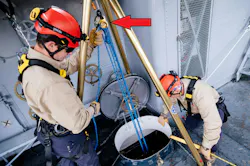
Petzl’s Twin Release system is another rope rescue system engineered to use right out of the bag, to eliminate lacing pulleys and other complexities.
“Confined spaces are one of the most dangerous places to have to perform a rescue, particularly when the atmosphere may be oxygen-deficient or contain toxic or explosive contaminants,” Petzl’s Michel Goulet points out. “Once entry is deemed safe and necessary, the rescue must be performed immediately to be successful. The Twin Release system delivers rapid deployment and exceptional versatility, allowing rescuers to switch instantaneously between lowering and raising. This enables fast, controlled transitions and helps teams execute an efficient, casualty-accompanied rescue when seconds matter.”
Albuquerque, NM, Fire Rescue (AFR) tried the Twin Release toward the end of its development. Impressed with how well it worked, the department purchased the system right after it went to market.
“We run a couple of them now,” Justin Spain, who is program manager for technical rescue for AFR, says, “and members are asking for more.”
One confined space rescue that AFR conducted recently involved a recycling plant worker who fell 10 feet into a hole below a conveyor. Spain states that his team’s positive experiences with the Twin Release system’s external brake and the fine-tuned adjustments that it provides were proved once again.
Another event where the team used the kit might be the antithesis of confined space. A 57-year-old elephant at Albuquerque’s ABQ BioPark required surgery on its eye, which required it to be anesthetized while it lay on its side. An AFR team used rope rescue techniques, including the Twin Release, to hold up the animal’s trunk so that it could be intubated, lift up its head to position it properly for surgery and move its legs during the surgery so that it didn’t get crush syndrome or rhabdomyolysis.
The Twin Release system’s performance, including because everything that AFR needed was in one package, was flawless, Spain states.
Flawless performance is what Sterling’s Shettig says is the goal of the Stealth bailout kit, because it gets deployed at the worst moment for firefighters. “It is the last chance that they have to get out, and this isn’t a thoughtful, considered action.”
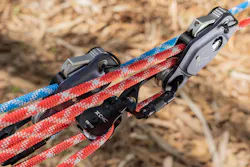
Like the CAPTO device, the Twin Release and the Stealth bailout kit, removing multiple components from the equation also was the purpose behind the development of PMI’s EDC Anchor Hitch. For deployment at rescue operations where movement, heat and repeated loading are unavoidable, the EDC replaces multiple single-purpose tools that typically are required to handle anchors, hitches and extension, PMI’s Tim White says. “One hitch adapts to the situation without sacrificing rating, durability or speed.”
What’s next?
It’s been a peak time recently for innovations in rope and hardware for rope rescue, with lightening the load that rescue technicians must carry from the rig to the incident site being a clear result. One wouldn’t be going out on a limb to expect that effort to continue. Perhaps chief among upcoming improvements might be the development of 9.5 mm rope that meets the needs of and standards that are applicable to rope rescue.
“The world is moving to smaller ropes,” Marlow Ropes’ Manson tells Firehouse. “A lot of high-end competition teams are starting to use 9.5 mm rope.” Among trends, he believes that this is a big one.
CAL FIRE’s Valentin says that the performance of 9.5 mm rope is nearing the point that it will be suited for technical rescue. “We do so many remote rescues where we’re hiking in, and the difference in weight and space of 9.5 mm rope versus even 11 mm rope is significant.”
It seems safe to say that neither man is just feeding us a line.
About the Author
 Rich Dzierwa
Rich Dzierwa
Managing Editor, Firehouse Magazine
Rich Dzierwa joined Firehouse Magazine in 2019 after four tenures with other publications. He was editor-in-chief of Consumers Digest/ConsumersDigest.com and of trade magazine Cutting Tool Engineering. He served as the consumer products reporter for BridgeNews and began his publishing career with an 11-year tenure at Appliance magazine, where he rose to managing editor after serving in other roles. Dzierwa's experience with consumer products, including furnishings, appliances, electronics and space design, has transferred to his Firehouse work regarding the magazine's Station Design columns and the Station Design Awards. Previous work also has contributed to his supervision of several surveys of fire service/EMS members, to produce unique reporting for Firehouse's audience. Dzierwa earned a bachelor's degree in English from Columbia College Chicago.