Training Firefighters for Rescues at Incidents That Happen on Farms

David Newcomb explains why training for rescue incidents that occur in the agriculture realm is vital for members of fire departments whose response district includes farms, whether the firefighters have experience with farm equipment, livestock, farm chemicals, etc., or not.

Key Takeaways

  • The matters that Illinois Fire Service Institute’s (IFSI) Handling Anhydrous Ammonia Emergencies class addresses include different reasons that anhydrous ammonia releases occur, preplanning for such incidents, how to safely handle releases, and identifying the equipment and piping that’s involved in transporting and applying the product.
  • IFSI’s Large Animal Rescue Awareness class covers techniques for low-stress movement of animals through an understanding of large animal behavior and the different types of trailers that are used to move large animals, among other elements.
  • IFSI’s Grain Bin Rescue Awareness class gives trainees the ability to complete a nonentry retrieval rescue, including how to safely cut a grain bin via techniques that don’t disrupt the structural integrity of the grain bin. 

The Illinois Fire Service Institute (IFSI) Agriculture Rescue Program takes training on the road to the rural areas of Illinois. Through this training program, first responders train for tractor rollovers, grain bin entrapments, anhydrous ammonia releases and incidents that involve large animals, among others. These responses in the agriculture world could be classified as high-risk/low-frequency. The key to handling these incidents is training. Instructors must identify the level of current training and the level of experience of the students and build on those key items.

Five classes

Classes that the IFSI offers to fire departments and districts under its Cornerstone Program include Agriculture Rescue, Handling Anhydrous Ammonia Emergencies, Fires on the Farm, Large Animal Rescue Awareness and Grain Bin Rescue Awareness. The Cornerstone Program supports fundamental and essential skills training at no cost to the local fire districts and departments throughout Illinois, with funding from the Office of the Illinois State Fire Marshal.

These classes are taught by field instructors who travel throughout the state to firehouses and farms.

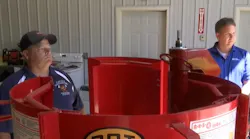
The Agriculture Rescue class utilizes numerous specially equipped props that are carried on trailers to simulate real-time incidents. Some trailers also include rescue equipment for first responders to try before their department purchases the equipment with its own budget. The instructors also encourage the first responders to use the rescue equipment that they already have to see how it fits the rescue incident.

The Agriculture Rescue class is an all-encompassing training that covers everything from tractor rollovers to manure pit rescues. The hands-on portion utilizes an actual tractor that’s supplied by IFSI to rollover onto a “victim.” This is done along with a review of modern farm equipment that usually is supplied by a local dealer or farmer.

The Handling Anhydrous Ammonia Emergencies class addresses different reasons that these releases occur. It also addresses the basic characteristics of this common fertilizer. The class emphasizes preplanning for such incidents; how to safely handle small and large releases; how the product is transported and applied safely; and identifying the equipment and piping that’s involved in transporting and applying the product. Some IFSI instructors maintain Illinois Department of Agriculture Anhydrous Ammonia Competent Attendant certification to keep up with the latest rules and regulations.

The Fires on the Farm class challenges students to explore how individual agencies can handle rural fires (e.g., fires in barns, shops, machine sheds and large farm equipment, including tractors and combines). The class is available in person and online. It addresses preplanning response areas, automatic aid and other techniques.

The Large Animal Rescue Awareness class covers a need that first was addressed and requested by horse owners in Illinois. From that, the class was developed to focus on multiple species to address the spectrum of farm animals. The class teaches techniques for low-stress movement of animals through an understanding of large animal behavior. This covers some general first aid for large animals and the need to get a veterinarian who specializes in large animals on scene as soon as possible. The class also discusses the different types of trailers that are used to move large animals, because transportation incidents represent a significant portion of the emergency calls that involve large animals. This class also covers techniques to safely extricate animals from a variety of entrapments.

The Grain Bin Rescue Awareness class gives students an overview of everything that can be done on the outside of the grain bin during an entrapment incident as well as familiarization with the components of a grain handling facility. It gives trainees the ability to complete a nonentry retrieval rescue, because they might not have confined space training. Students are taught how to safely cut the grain bin with techniques that don’t disrupt the structural integrity of the grain bin. This procedure is done to release or remove the grain to either uncover victims or get pressure off of their body.

Operations-level training

In addition to the Cornerstone Program classes, the Agriculture Rescue Program offers two operations-level classes. Large Animal Rescue Operations and Grain Bin Rescue Operations are fee-based classes. Often, the fees are covered by local agricultural organizations, such as farm bureaus, commodity groups and livestock groups.

The Large Animal Rescue Operations class (usually comprising 16 hours of training) includes hands-on training with real animals and/or a life-size horse manikin. The class includes moving animals from one location to another using low-stress techniques and safely packaging large animals that were injured. It also emphasizes working closely with a large-animal veterinarian during an incident. The class also covers how common equipment that already is carried on fire apparatus can be put to work during large-animal rescues.

The Grain Bin Rescue Operations class gives students training that’s needed to meet the requirements of Occupational Safety and Health Administration (OSHA) regulations and NFPA standards for confined space in grain bins. The individual that completes this class can enter and hopefully complete a successful rescue of a grain bin entrapment victim.

The class instructs students on how to successfully use grain bin rescue tubes to free victims and then package victims to safely get them out of the grain bin. The class is the only OSHA-approved class that’s offered in Illinois. Students complete the class over two weekends (Friday night, Saturday and Sunday), amounting to a total of 40 training hours. The schedule was set up to meet the time requirements of many volunteer firefighters who serve in rural areas.

The class covers permitted confined space items, such as atmospheric monitoring, proper use of safety equipment, such as harnesses and retrieval lines, and lockout and tagout. Instructors are a mix of Agriculture Rescue Program and rope rescue operations instructors.

Essential training

There are times when the Agriculture Rescue Program instructors are called on to present programs on farm safety and incidents in which they were involved. They have done this for annual farmer meetings, grain marketing meetings, webinars, agriculture sector company safety directors and farm youth groups. Their in-depth knowledge lends itself to prevention as well as rescue.

IFSI’s Agriculture Rescue Program fills a need in the rural and small city areas of Illinois where first responders are called on to respond to incidents. These first responders might not have experience with farm equipment, livestock, farm chemicals or grain handling equipment even though they live in the rural response area. One must realize that less than 2 percent of the population is involved in production agriculture. On the other hand, agriculture is the
No. 1 industry in the state of Illinois, so it’s essential to have the training to perform these rescues.  

About the Author

David Newcomb

David Newcomb

David Newcomb is the program manager for the Illinois Fire Service Institute Agriculture Rescue Program. He blends his years of fire and emergency services experience with an expansive background in the agriculture industry.

Sign up for our eNewsletters
Get the latest news and updates

Voice Your Opinion!

To join the conversation, and become an exclusive member of Firehouse, create an account today!