The Best Technical Rescue Officers Don’t Micromanage
Key Takeaways
- Technical rescue officers must know their company or team members’ strengths and weaknesses, to put those members in the best position to work with as much autonomy as possible.
- Incident commanders at a technical rescue might have little or no knowledge about what the technical rescue team is about to do at the incident. Technical rescue officers must simplify their explanations for the IC.
- There never should be radio silence between the technical rescue officer and the IC at a technical rescue incident This includes giving realistic time frames for aspects of the rescue.
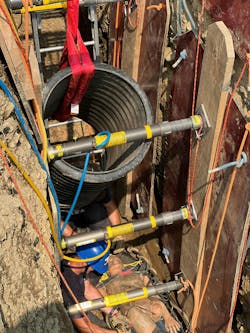
What defines a competent technical rescue officer? There is no simple answer, because the role encompasses a combination of multidisciplinary training, interpersonal skills, crew and team management, and practical experience. Through these, the officer can manage any emergency scenario effectively. That said, the role can be particularly challenging for individuals who are new to a company or team.
Technical rescue officers must know their company or team members’ strengths and weaknesses, to place them in the best position to work with as much autonomy as possible. A solid, well-thought-out training program allows the officer to observe members’ technical skills as well as other skills, such as their ability to work well with others. Invite other stakeholders, particularly chiefs or incident commanders (ICs) who you might work with to attend these training programs.
Beyond this, working closely with other responders and ICs who the technical rescue officer might not know can pose challenges. By walking in with a team mentality, officers can gain important buy-in early on. Keeping an anxious IC updated and making efforts to include rescuers on scene pays dividends in the long run.
Selling your plan
It can be nerve-racking to oversee an incident that’s beyond one’s agency’s knowledge, skills and capabilities. As an officer, you always must be cognizant of this when meeting and engaging with ICs. They might have little if any knowledge about what you and your team are about to do, and you must sell them on your game plan. This can be easier said than done.
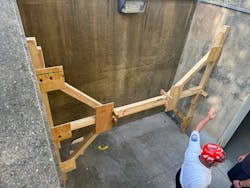
Let’s say that you’re the officer at a building collapse and decide to build raker shores to support a wall. You must simplify your explanation for the IC.
Avoid using jargon or technical terms that might not be familiar to that person. Instead, say something like, “Chief, we’re concerned about this exterior wall and plan to stabilize it before entering. We’ll build some wooden shores, which should take about 30 minutes, and I’ll keep you updated.” This clear communication can help to reassure the IC, answer the IC’s questions, and build trust through honesty about the process and potential delays.
See the plan through
One of the benefits of technical rescue is that there are a lot of ways to solve problems. That also is one of the drawbacks to technical rescue.
Technical rescue officers must pick a tactic that works among the several that are available to them. Often, everyone who is on scene will have a different way of addressing the issues at hand; the officer must pick one of them and make sure that the plan is the only one in play. If the plan isn’t working, the officer must either modify it or come up with a Plan B,
a Plan C or even a Plan D. Whatever the plan is, everyone who is on scene must know the technical rescue officer’s intent and be working that plan and only that plan.
Don’t take over
Even though the technical rescue officer sets the pace of the rescue, it might not be that person’s operation.
An officer who is part of a technical rescue team that goes mutual aid might not know the initial responders who are on scene. They already are invested in the operation and want a successful outcome, just as everyone else does. Include them in operations whenever possible and empower them. No one likes it when another agency or company arrives and simply takes over, ignoring everyone else. Work with the responders who already are on scene, make them feel part of the operation, and keep them and the IC in the loop. Be happy that they realized that this was beyond their knowledge, skills and capabilities and called you instead of winging it.
Update, update, update
Rarely do things ever go according to plan. Technical rescues are no exception. If technical rescue officers accept this, they can roll with the punches and operate like a true professional.
Let’s go back to that fictional building collapse: You told the chief that it was going to take 30 minutes, but after 45 minutes, the shoring isn’t up yet. Own it.
There never should be radio silence between the officer and the IC. Just because something isn’t going to plan doesn’t mean that the officer hides. Keep the IC in the loop.
Put the IC at ease. “Chief, we’re running a little behind. We just wanted to double check some math and grab some additional lumber” is better than the chief believing that nothing is happening. When the IC is kept in the dark, imaginations tend to run wild. Officers never should let such a circumstance happen.
Also, give realistic time frames: “five more minutes” often turns into 30. If it’s going to take 30 minutes, just give that time frame. Even have a face-to-face with the IC every 10 minutes.
Know your people
Good technical rescue officers know their personnel. Technical rescue officers must evaluate the crew that they are working with continually, through drills and on operations, to identify where those crewmembers might be deficient. In doing this, the technical rescue officer can focus training in these areas to help to build the team.
Also, in building personnel, a team must be diverse in roles, not having too many people specialize in one particular field. The technical rescue officer can help to direct members to specialize in specific areas by understanding their interests and building a rapport.
The development of the team is complex and is key to the team’s success and, ultimately, operational success. Building new members, empowering members to get over plateaus and drawing on senior members as mentors are things that the technical rescue officer can help to put together. With this, the technical rescue officer also is a student of listening to the senior members and respecting their time and knowledge. A lot of information is gained through the brief conversations in front of the rig when responding to and taking up calls.
Empower and lead
Technical rescue officers’ days of swinging hammers and rappelling down ropes are likely over. These people have a responsibility to their team to lead them to success, and it’s next to impossible to lead while rappelling down a rope or from inside of a confined space. It’s easy to lose perspective when in a particular technical task, such as belaying a rope or shooting a strut. Instead, technical rescue officers must empower their subordinates to solve the problem with minimal interference. Technical rescue officers don’t have the time to get bogged down by specifics; the team members, on the other hand, do. Technical rescue officers have a team of experts and problem solvers at their disposal; let them problem-solve. If on a rope rescue and a main line must be set up, technical rescue officers should task that to a competent rope person on the team and leave the particulars to that individual. Whether the team members choose a bar rack or a descender won’t make or break the entire operation; a boss micromanaging will. If the team members pick blue rope when the technical rescue officer was thinking red, it’s going to be OK.
Bring order to chaos
Technical rescue incidents can be among the most challenging, but technical rescue officers can bring order to chaos by taking the time to understand their team members’ strengths and weaknesses and by placing them in the best possible positions for success.
Technical rescue team members should be able to work autonomously, solving issues that they were trained to handle. While this is going on, the technical rescue officer can work with others who are on scene to ensure that the plan that was selected is the one that’s being implemented in a safe manner.
About the Author
 Christian Brown
Christian Brown
Christian Brown is a 19-year member of FDNY, where he holds the rank of lieutenant. He has spent time in special operations and is also a special operations instructor for the state of New York. He is pursuing his bachelor’s degree in emergency management at Metropolitan College of New York.
 Jeffrey Mondo
Jeffrey Mondo
Jeffrey Mondo is a fire protection specialist with the New York Office of Fire Prevention and Control (New York State Fire) and is assigned to the Technical Rescue Branch. He also is a rescue team manager with New York Task Force 2 Urban/Technical Search and Rescue (NY-TF2). Mondo is an adjunct instructor at Onondaga Community College who is assigned to the fire protection technology program.