The Incident Command Team: Strategic Infrastructure for Technical Rescue Success
Key Takeaways
- Incident commanders at technical rescues must provide a solid command team, so technicians can focus on the physics of the rescue without the friction of the outside noise.
- If technical rescue incident commanders hand out orders without the perspective that’s achieved from an initial 360-degree size up, they only contribute to the chaos and set the tone for a poorly run, unsafe incident.
- The most immediate way that an incident commander at a technical rescue can help a rescue team is by ruthlessly enforcing hot, warm and cold zone integrity.
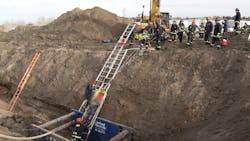
In the fire service, we often hear about incident commanders (ICs) managing a technical rescue incident in the same manner as a standard suppression call. However, on a technical rescue incident, incident command is less about traditional suppression management and more about building a solid foundation that supports incident objectives and the crews who operate on scene. Whether it’s a trench collapse, a high-angle rope rescue or a complex structural stabilization, the IC is the architect of the environment in which the technicians work.
Technicians who spent any time on the spoil pile or in the trench know the feeling when “mission creep” sneaks in. It can be noisy, crowded and chaotic. When trying to evaluate the dimensions or secondary collapse potential of a trench or setting a high-point anchor, interruptions by site workers or a well-meaning but untrained responder who is standing on the edge of the trench can occur.
To set up company officers and rescue teams for success, the IC must provide a solid command team that comprises leaders who concentrate on all of the peripheral needs, so technicians can focus on the physics of the rescue without the friction of the outside noise. Although the size of this team depends on the scope of the incident, a standard model includes an IC, a support officer and an incident safety officer.
First five minutes: Setting the tone
Technical rescues are high-risk/low-frequency events. When dispatched to a trench collapse or a person trapped in machinery, the adrenaline of many responders goes up compared with “routine” calls. Command officers’ most critical job is to function as the thermostat, not the thermometer.
If technical rescue ICs arrive and start handing out orders without the perspective that’s needed to do so, they only contribute to the chaos and set the tone for a poorly run, unsafe incident. Success begins with a deliberate size-up. The IC should be the calmest person who’s on scene. By taking an extra 60 seconds to perform an initial 360-degree evaluation and establish a clear command post, the IC sets the stage for an informed operation. In technical rescue, the clock is the enemy, but setting up the right structure and layout is the critical first step in a proactive, safe rescue operation.
Defining zones
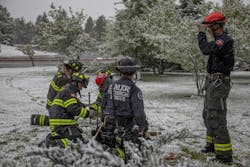
The most immediate way that an IC can help a rescue team is by ruthlessly enforcing zone integrity. A technical rescue site has dynamic hazards in every one of its zones. If it’s a trench, every person who’s standing on the lip of the trench adds a surcharge load that increases the chance of a secondary collapse. If it’s a rope rescue, every extra person who’s in the warm zone is a potential trip hazard over a life-safety line.
The IC and the incident safety officer must be the enforcers of the hot zone. By the time that the rescue team is flaking out its first line or unloading the first shore, the IC already should have established the:
- Hot zone: Only technicians on the tools and technical safety personnel.
- Warm zone: Tool staging, backup teams and medical.
- Cold zone: Media, family, support personnel and apparatus.
When ICs manage a well-delineated scene, they clear the mental bandwidth of the rescue team to focus entirely on the rescue operations.
Leading: “what,” not “how”
This is where many talented ICs struggle. The instinct of ICs who have a background in technical rescue is to jump in and start rigging. However, the moment that the IC starts telling a technician which knot to tie or what pressure to set the struts to, the system breaks.
To set up teams for success, technical rescue ICs must lead by tactical objectives. Instead of saying, “I want a 4:1 mechanical advantage system on that tripod,” say, “Rescue Group, your area of operations is the confined space vault in the hot zone. Your resources are [applicable units]. Your objective is to provide vertical extrication for the victim. Let me know your needs as soon as possible.” This empowers the company officer and rescuers to use their training, keeps the IC at the 30,000-foot level and creates a clear line of accountability.
Resource anticipation
The technicians who for example, are in the hole must be focused on what’s going on at the moment, such as the victim’s airway or the stability of a specific shore. Although a strong technical rescue officer focuses on what’s coming next and communicating needs, the command team’s job is to anticipate those logistical needs further down the line—in other words, not just what’s coming next, but what’s coming in the next 20 minutes and two hours.
If on a trench call, don’t wait for the rescue group to ask for a vacuum truck; call for it the moment that a collapse is confirmed. Order the heavy equipment early, as those requests take time. Consider a trench rescue in 40-degree weather, with a two-hour rescue operation because of entrapment: Do you have enough rescuers on scene to account for weather fatigue? How about extra portable heaters for the victim?
Technical safety
In a standard structure fire, the safety officer is a generalist. In a technical rescue incident, the safety officer must be a specialist. The IC sets up the team for success by appointing a technical safety officer who speaks the language of the rescue. This person, for example, double-checks rigging, monitors atmospheres and watches for subtle cracks in a trench wall. By giving the technical safety officer top authority, the IC creates a safety net that allows the rescue team to work with confidence. Strong technical safety officers and incident safety officers approach this as a team.
Rotation and rehab
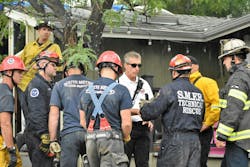
Technical rescues often are marathons disguised as sprints. The adrenaline of the first hour can mask the fatigue that sets in by the third hour. The IC must be the one to enforce work-rest cycles. Technicians rarely admit that they’re tired; their “complete the mission” mindset will keep them in the hole past the point of exhaustion if they are allowed to do that.
The IC ensures success by guaranteeing that a three-deep model is utilized: Have the backup team briefed and ready to step in the moment that the primary team needs a break; proactively assign a technical rescue RIT; don’t wait for signs of heat stroke (get fans, water and shade set up before they are needed).
Most dangerous part
As the incident nears its conclusion—or when it transitions from a rescue to a recovery—the IC’s role becomes one of moral and tactical discipline. When adrenaline fades, the risk-to-reward ratio changes. The command team members are the ones who are outside of the “white space” who can see objectively when the environment has become too dangerous in which to operate. Sometimes, setting up your team for success means having the courage to say, “We are backing out, taking a tactical pause and reassessing.” It’s a difficult call, but it ensures that everyone goes home.
Command team = facilitators
Ultimately, the IC may be the ranking officer on scene, but the technicians are the specialists. Success is a bottom-up reality that’s built on a top-down foundation. By providing an organized scene with clear objectives, technical rescue ICs build that foundation where training and skill actually can work.
This command team strategic infrastructure is an essential partner to the work of a competent technical rescue officer. While that individual manages the multidisciplinary strengths of the crew and “sells” the tactical plan, the command team provides the trust and the resources to see that plan through. The IC doesn’t need to be the person
who ties the best knot; the IC just needs to be the leader who ensures that the person who’s tying the knot has the space, safety and support to be set up for success.
About the Author
 Scott Richardson
Scott Richardson
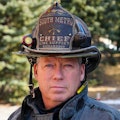
Scott Richardson is the division chief of special operations and line support for South Metro Fire Rescue in Centennial, CO. His oversight includes 12 special operations teams, fleet services and emergency communications. Richardson has been a rescue specialist who deployed to natural disasters with FEMA USAR Colorado Task Force 1. He is a Colorado state-certified Fire Officer II and Fire Instructor, EMS Primary Instructor and a paramedic. Richardson has served as a faculty member for the Community College of Aurora EMS and Fire Science program and the Metro Regional Technical Rescue School. He holds a master’s degree and a bachelor’s degree in organizational management, an associate degree in public safety and the Chief Fire Officer designation from the Center for Public Safety Excellence. Richardson is the co-founder of Empower2Evolve as well as On the Job Emergency Services Training.