6 Operational Lessons Firefighters Can Take from the Yarmouth, MA, Trench Rescue
Key Takeaways
- Yarmouth firefighters were trained on basic trench rescue skills before a long-term construction project started, helping prepare them for this response.
- Two regional technical rescue teams from Barnstable and Plymouth counties responded with highly trained rescuers.
- An incident command check list helped crews ensure the incident action plan was carried out correctly and safely.
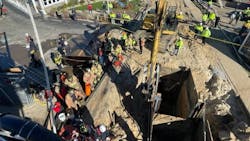
On the morning of Nov. 18, 2025, the weather was crisp and clear. At 8:50 a.m., a Yarmouth police officer working a traffic detail at a long-term sewer project radioed that a trench had collapsed and workers were trapped. Because the call came through a detail officer, the information went directly to both the Yarmouth Police Department and the Yarmouth Fire Department (YFD) and the incident was immediately dispatched as a trench collapse with entrapment, and a full departmental recall was activated. Several ambulances, pumpers, a tower ladder, and the collapse trailer were sent.
While responding, YFD requested additional resources, including a vacuum truck, and the activation of the Barnstable County Technical Rescue Team (BCTRT), along with a working fire assignment to cover all three stations YFD stations. Formed in 2012, the BCTRT is made up of firefighters from departments across Cape Cod who are trained to handle various technical rescue incidents throughout Barnstable County and the state.
Initial arrival and early actions
Yarmouth is in the early stages of a multi-year sewer project that began 10 months before this incident. Anticipating the risks, YFD had already trained all line officers in trench and confined-space awareness and reviewed their equipment, making upgrades where needed. This preparation proved critical as the incident went on.
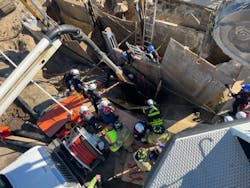
The work area was close to the Atlantic Ocean and the soil was sandy, wet, and unstable. Several workers stood along the roadside watching the day’s work when, suddenly, the ground beneath them gave way, sending them sliding 10–15 feet toward the trench box. As the loose soil continued to fall, two workers became trapped. Three others attempted to help: one jumped into the area and was injured, while the other two were able to escape on their own.
When YFD arrived, they removed the injured worker and transported him to the hospital. Firefighters immediately began stabilizing the scene by placing ground pads, stacking trench panels and struts nearby, clearing the area of bystanders, shutting down machinery, and gathering information from witnesses. They learned that two workers were still trapped and that one was visible from the surface and able to communicate.
Firefighters placed a ladder into the trench and reached the first trapped worker, who was buried up to his chin but still breathing. They cleared sand from his face to protect his airway and performed an initial medical assessment. When the vacuum truck arrived, it was quickly positioned to the north side of the trench.
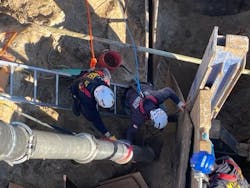
Firefighters used both the vacuum truck and hand tools to remove soil from around the worker’s head and upper body. However, because of the unstable soil, sand continued to slide back into place. Small plywood sheets were used to shield the worker’s face as vacuum operations continued, until members of the BCTRT arrived.
Developing a dynamic incident action plan
Once BCTRT leadership arrived, they developed an incident action plan and began replacing YFD firefighters in the trench with BCTRT members wearing harnesses and tag lines for safer operations. The priority remained protecting the patient’s airway. A piece of plywood was set up in a tent-like position to prevent soil from covering his face.
Hand digging was attempted but was largely ineffective due to continued soil movement. A shoring panel with a strongback was placed directly opposite the trench box to help control soil movement. The vacuum truck assisted in lowering the panel into position. Access was difficult because the adjacent trench box was approximately 30 feet deep and 15 feet wide, limiting safe working areas. Ground ladders were placed inside the trench box so rescuers could climb to the top and help those working below.
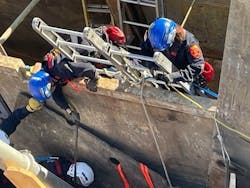
A second shoring panel was needed behind the patient to stop soil from sliding in from his back. The standard 4-foot panel was too wide for the available space, so it was cut down to 3 feet. It was set in place with the help of the vacuum truck, removing soil behind the patient. Additional plywood pieces were used to block loose dirt, creating a narrow, controlled space for rescuers to work. Vacuum operations continued, gradually improving conditions, but the patient’s position made progress difficult.
Patient care
Once two shoring panels were in place and soil movement had slowed, rescuers were able to clear soil down to the patient’s waist. A technical rescue medic egressed into the hole to perform a full ALS evaluation on the patient and they established an IV and began giving fluids.
Because of the high risk of crush injuries and the expected long extrication time, Boston Med Flight had been requested. The helicopter landed at a nearby beach, and the flight crew was brought to the scene. They met with YFD's medical officer and developed a treatment plan focused on managing pain, hydration, and crush-injury prevention. The patient then received pain medication and treatment for potential crush syndrome.
Extrication
As soil removal continued slowly, a plan was made to lift the patient from the trench once enough debris had been cleared. YFD’s tower ladder was positioned to create a high-point anchor directly over the patient. A hauling and lowering system were assembled in a nearby parking lot, and the tower ladder was moved into place.
With the patient cleared to his waist, rescuers tried lifting him using a basic rescue harness placed under his arms. However, his legs remained trapped, and the attempt was unsuccessful. An LSP halfback extrication harness was also attempted, but could not be positioned correctly due to limited access to his lower body.
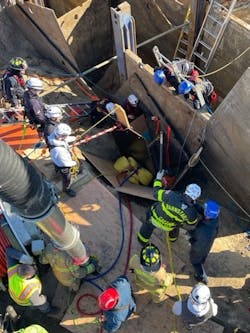
Rescuers returned to vacuuming and digging until they were finally able to free his legs. Once fully exposed, the patient was placed into a harness and carefully raised out of the trench. He was loaded onto a stretcher, brought to an ambulance, and then transferred to the Med Flight helicopter where he was flown to Rhode Island Hospital, a Level 1 trauma center.
Victim recovery operations
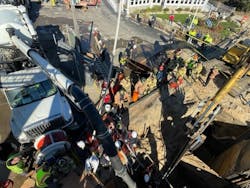
After the patient was recovered from the trench, there was still one victim remaining. He was found shortly after the patient was removed and it was confirmed that the next operational period would be a recovery of the victim. The Plymouth County Technical Rescue Team (PCTRT) had been brought to staging as the rapid intervention team and relief crew. A face-to-face was had with leadership from the BCTRT and the PCTRT and a new IAP for the recovery was developed. The recovery was completed in a safe and metered fashion with no injuries to any members.
Lessons learned
As firefighters, we know that trench incidents are some of the most unforgiving calls we respond to. The soil doesn’t care how experienced we are or how fast we get there, if conditions aren’t recognized early and managed properly, things can go bad quickly. This recent trench rescue reminded us of the importance of disciplined operations, strong interagency coordination, and constant readiness.
- Early recognition of trench hazards - Early in the incident, it became clear that we were dealing with an unstable trench. Recognizing the hazards right away and requesting specialized technical rescue resources made all the difference. Fast size-up, identifying collapse potential, and respecting the hazard zone are what keep firefighters safe. The sooner we classify the call as a trench rescue, the sooner the right people and equipment get moving.
- Cold weather and daylight challenges - Cold temperatures, and early darkness added another layer of complexity. Winter conditions change everything: soil behaves differently, equipment becomes harder to handle, and lighting becomes a priority. Any trench rescue plan needs to account for the season we’re operating in. As we move into the next period, we need to be ready for those environmental hurdles before they hit us.
- Multi-agency training pays off - One of the many things that went well was how smoothly we worked with public works, the contractor, mutual-aid partners, and other supporting agencies. That coordination doesn’t happen by accident; it comes from training together. Trench responses are rarely single-agency events, so making time for joint drills ensures we speak the same language and know what to expect from each other.
- Use and review of the trench rescue checklist - A structured approach makes a dangerous situation more manageable. Our trench rescue checklist—incident command system roles, monitoring equipment, tool inventory, call-down procedures—helps us stay organized and reduces the chance of missing something critical. But it only works if we keep it current. Regular review and updates ensure it reflects the way we operate.
- Documenting lessons and feeding them back into training - Every incident has something to teach us, and this one was no different. Capturing lessons learned and folding them back into training, pre-plans, and SOP adjustments makes the department stronger. These reviews shouldn’t just live in a binder; they should drive real change and become talking points in future drills.
- Advancing technical rescue-medic capabilities - Our Tech-Medics played an important role in patient care under tough conditions. Moving toward full adoption of the Massachusetts State Protocol 6.3 USAR medical specialist standard strengthens our ability to treat victims in confined or unstable environments. Having medically trained personnel who understand technical rescue operations is a major asset at scenes like this.
Conclusion
Trench rescues demand respect, preparation, and teamwork. The incident demanded a large amount of apparatus, equipment and most importantly experienced rescuers, support staff and liaisons that all contributed to the completion of the tasks required. This incident reinforced what works and highlighted what we need to keep improving. By applying these lessons and staying committed to training and readiness, we’ll be better prepared for the next time the tones drop for a trench emergency.
About the Author
 Christopher Beal
Christopher Beal
Christopher Beal is the fire chief of the Barnstable, MA, Fire Department, where he has worked for the 23 years. Beal is also a Rescue Squad Officer with the FEMA Urban Search and Rescue Team Massachusetts Task Force 1, a Task Force Leader with the Barnstable County, MA, Technical Rescue Team, and a FEMA certified technical rescue instructor with Spec Rescue International. Beal is a licensed paramedic, a Credentialed Fire Chief in Massachusetts as well as with the Center for Public Safety Excellence, and holds a bachelor’s degree in fire science from Columbia Southern University and a masters of Public Administration from Anna Maria College.
 Scott A. Smith
Scott A. Smith
Scott A. Smith, assistant fire chief for the Yarmouth, MA, Fire Department, has 26 years of experience in the fire service. Smith, the owner of Fire Culture Training LLC, a lifelong student of the craft, with a particular interest in leadership development and the role of organizational culture in building high-performing teams.