Beyond Convention: What Firefighters Conducting Rescues at EV Accidents Must Know
Key Takeaways
- One major difference of firefighter operations on scene of a rescue or extrication for an accident that involves an electric vehicle compared with that which involves an internal combustion engine (ICE) vehicle is the amount of weight of the two types of automobiles. Because EVs can weigh as much as double that of an ICE automobile, a stronger focus on stabilization of an EV is required.
- The heavier weight of EVs compared with ICE vehicles compounds the force that’s applied to a vehicle that was struck by an EV, which can lead to more significant injuries to the occupants of the second automobile.
- Because the battery assembly of an EV that was involved in an accident can off-gas hydrogen fluoride gas, rescuers should consider placing an atmospheric monitoring device on the vehicle to identify potential gas release during the extrication and be prepared to perform extrication techniques while wearing SCBA.

There has been a significant focus on electric vehicle (EV) safety and operational considerations when the vehicles are encountered on the emergency scene. Research organizations and fire departments are looking continually for the “next best” product, policy or procedure when dealing with these vehicles when they are on fire. Manufacturers are developing new and improved products to utilize on these vehicles, including blankets, specialty nozzles and, in some cases, new extinguishing agents, all of which are focused on the experienced difficulties when they are on fire. However, while not wanting to lessen the importance of handling these fires, a lesser focus regarding the accident scene instead of the fire scene is resulting in some departments being less prepared to disentangle occupants from the wreckage.
EV accidents
In 2023, there were approximately 4,120 reported EV fires in the United States. In that same time frame, there were approximately 165,730 reported EV accidents, making up nearly 3 percent of all motor vehicle accidents nationwide. Statistically speaking, fire departments are 40 times more likely to be faced with an EV that’s involved in an accident than an EV that’s involved in a fire.
Statistics show that an EV suffers 50 percent more damage than a vehicle that’s powered by an internal combustion engine (ICE) vehicle, and almost 47 percent of EV accidents result in the vehicle becoming a total loss. Consumer data show that the cost of providing automobile insurance coverage can be as much as 27 percent more than that for an ICE-powered vehicle. In some cases, the cost of EV repairs can be significantly higher than that for ICE-powered counterparts.
Attention to details
There are some significant differences between EV and ICE vehicles to consider when performing size-up on the emergency scene.
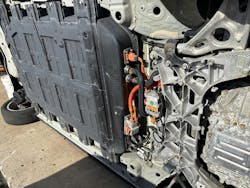
One major difference is the amount of weight that’s added to the vehicle in the form of battery power. EV batteries can range from 1,000–4,000 lbs., which in some cases almost doubles the weight of the EV in comparison to the ICE powered vehicle. This requires a stronger focus regarding stabilization of an EV as well as lifting these vehicles in the event of an underride or override incident and a vehicle that’s on its side or roof.
The additional weight also must be considered from an impact point for victim injuries. A two-passenger vehicle accident can result in significant force toward traumatic injuries when an EV strikes another vehicle. The weight compounds the force that’s applied to the other vehicle that it collides with, which can lead to more significant injuries to the occupants.
Some EVs have multiple electric motors that can be located on each axle or, in some cases, on each of the wheels, which requires a focused application of rigid stabilization to limit vehicle movement.

More actionable intelligence
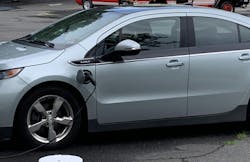
Clues on the incident scene regarding the presence of an EV are critical on size-up. Looking for EV badges, the absence of a tail pipe and/or charging doors in the front areas of the vehicle help to identify the presence of an EV.
The use of both a thermal imaging camera (TIC) and an atmospheric meter is mandatory when developing an action plan. Utilizing the TIC when performing the inner circle survey can identify heat signatures under hoods for ICE vehicles or the absence of heat in the front area where the engine normally would be located. Utilizing a six-sided approach for this survey, including the bottom/underside of the vehicle, can spot heat signatures from axle or wheel motors, which can aid in identifying an EV.
The TIC also should be utilized for an accurate account of the number of victims who were in the vehicle. Heat signatures can remain on seats when victims might have been ejected from the vehicle or climbed out of the vehicle prior to fire department personnel’s arrival.
The battery assembly can off-gas hydrogen fluoride gas when an EV vehicle was struck by another object or when rescuers are displacing vehicle components during the rescue attempt, leading to potential lethal environments around the incident. There have been reports of rescuers operating on extrication incidents that involved an EV vehicle that went into battery failure, releasing the gas and causing significant respiratory injuries where rescuers still haven’t returned to work. Consider placing an atmospheric monitoring device on the vehicle to identify potential gas release during the extrication and be ready to perform extrication techniques while wearing SCBA.
EV battery assemblies have a battery management system (BMS) that’s built into the vehicle to keep the system cool and functioning. Certain points of impact, particularly “T-bone” accidents, can compromise the EV battery assembly, causing it to go into thermal runaway. A BMS runs on the 12-volt system that’s within the EV, to provide power to pumps and fans that keep the EV coolant flowing around the battery pack, through a “radiator” to remove the heat and back into the assembly. This leads to a safety issue regarding securing vehicle power during an extrication. A common procedure on scene of an extrication is to disconnect the 12-volt system so that the supplemental restraining system components (air bags, seat belt tensioners, etc.) will be de-energized; but doing so shuts down the BMS for the battery pack.
Also, some EVs have a dashboard icon that shows when the BMS might be compromised or beginning to fail; keeping the coolant moving is significant during the extrication.
The presence of EV components requires alternate steps to previously accepted procedures that have been utilized successfully in the past on extrication scenes. The location of the charging port for an EV can be in the location of where the fuel fill door normally would be, or in some cases, it can be found in the front fender. The front fender charging port location requires any displacement of the dashboard to be done without compromising the A-pillar or the fender area for placing relief cuts to aid in displacement.
Utilizing the floor pan or the rocker channel as a point to “push off” with a hydraulic displacement tool can direct the energy into the battery assembly, causing potential failure and thermal runaway. The practice of utilizing hydraulic spreaders to “squeeze” a fender to expose a latch or a set of door hinges might contact high-voltage wiring that runs through the fenders, causing fire or a significant injury to rescuers. This practice must be weighed seriously against the potential failure that it could cause.
Additional considerations during extrication operations that involve an EV include listening for popping or crackling coming from the vehicle, which could be an early indicator of thermal runaway.
Early size-up that identifies a vapor that might look like steam from a radiator hose leaking on an ICE vehicle can be hydrogen fluoride gas escaping from the vehicle. Assigning a rescuer as a “designated observer” to monitor the vehicle with a TIC and an atmospheric meter should be mandatory, which unfortunately takes a set of hands away from a task that might need to be done on the incident.
A charged 2½-inch hoseline should be deployed when an EV is involved in an extrication incident, because there’s a potential for a difficult suppression operation during the incident.
Additionally, EMS personnel should be made aware of the potential hazards and risks that can arise from potential fire and gas exposure, not only to the victims but to themselves as well.
Avoiding further problems
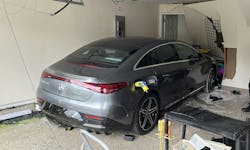
Successful extrications that involve EVs start with early recognition and safety practices put into place from the onset. Utilizing a TIC, an atmospheric meter and other technology helps in identifying hazards early in the incident to be mitigated faster.
The presence of an EV requires altering stabilization capabilities as well as modifying displacement operations to guard against causing a failure of the electrical system or further injuries to the victims or the rescuers.
About the Author
 Michael Daley
Michael Daley
MICHAEL DALEY, who is a Firehouse contributing editor, recently retired as a 37-year veteran who served as a captain and department training officer in Monroe Township, NJ. He is a staff instructor at multiple New Jersey fire academies and is an adjunct professor in the Fire Science Program at Middlesex County College. Daley is a nationally known instructor who has presented at multiple conferences, including Firehouse Expo and Firehouse World. His education includes accreditations as a Chief Training Officer and a Fire Investigator, and he completed the Craftsman Level of education with Project Kill the Flashover. Daley is a member of the Institution of Fire Engineers, a FEMA Instructor and a former Rescue Officer with NJ Urban Search and Rescue Task Force 1. He operates Fire Service Performance Concepts, which is a training and research firm that delivers and develops training courses in many fire service competencies.