State-of-the-Art Vehicle Extrication Equipment for Firefighters
Key Takeaways
- Seven companies that specialize in equipment for use on scene of automobile accidents and three fire departments explain the innovation and implementation of cutters, spreaders, combi tools, rams and struts for better outcomes for victims.
- Better batteries, AI-powered diagnostics and reduction in the number of parts of shoring systems headline the advancements of vehicle extrication technology over recent months.
- As more and more new vehicles incorporate designs that better protect occupants, firefighters who respond to automobile accidents face new challenges in extricating victims. Fortunately, suppliers of equipment that those responders utilize are on top of the situation.
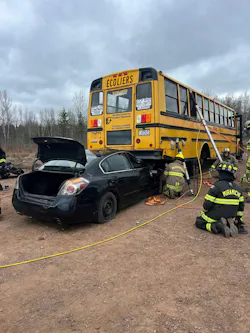
With increasingly more automobiles that are engineered for greater strength and enhanced passenger safety today, vehicle extrication training no longer is a wash, rinse and repeat scenario, as it was for dozens of years. The manufacturers of vehicle rescue tools have been working with firefighters/departments for more than a decade to meet the challenges that fire department personnel find on streets across the United States. This has resulted in them conceiving and developing innovative and smart tools to free victims.
“We never can make the tools light enough, we never can make them strong enough, and we never can make them fast enough,” AMKUS Rescue Systems Engineering Manager Tim Jennings tells Firehouse.
Adds IDEX Fire & Safety’s Elizabeth Speaker, “A real goal is to help increase uptime and reduce downtime [for firefighters].”
No time to lose
One way that Speaker’s company, in conjunction with its HURST Jaws of Life business, has attended to its goal is the development of the Captium IQ mobile app. It provides an AI-powered diagnostics and service layer to HURST’s line of E3 Connect rescue tools. She says that the app moves HURST from “connected tools with data to intelligent tools with guided action.” This innovation results in the company being capable of delivering predictive maintenance as well as standardized service and maximum readiness for when the tones sound and teams must respond.
Jon Shackelford is a battalion chief with the Honey Creek Fire Department (HCFD), the response district of which includes Terre Haute, IN, and surrounding areas. Shackelford added the app to the agency’s operation of its E3 Connect cutters, spreaders, combi tools and rams in April 2026. Still in the midst of ramping up the app’s availability to all of the department’s battalion chiefs and maintenance personnel, Shackelford nevertheless heralds the system’s usefulness, including in terms of advantages that it will afford HCFD members who respond for automobile accidents. In that vein, he finds Captium IQ’s capability to provide equipment performance data that’s particularly useful for the vehicle extrication operations that are performed by less-veteran members of the department.
“We deal with a lot of younger members who are new to the extrication world,” Shackelford explains. “They might come back and say, ‘This tool wasn’t cutting right.’ I can go into the app and find out if it’s a tool issue or a user issue.” For example, did the member allow the tool to work its full cycle before the firefighter thought that the tool stalled out, or did the tool in fact hit something really hard that required the tool to work longer than it might typically need to?
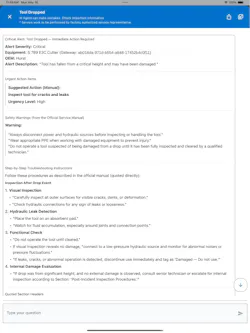
“Having the app on my tablet can afford huge time savings,” Shackelford continues. “You can figure out an issue yourself rather than having to invest time to contact a dealer—or to conduct another training, which can incur more cost.”
Time savings—as well as firefighter safety—is a benefit of Power Hawk’s Auto Crib-It piston-activated, automatic-locking mechanical system that replaces traditional wood cribbing. Traditional wood cribbing can be “a major bottleneck” on scene of a vehicle extrication, the company’s Sean Paige reminds us.
“Stacking, wedging and constantly readjusting wooden blocks under a shifting vehicle takes too much time, requires manual labor under unstable loads and leaves too much room for human error. Auto Crib-It completely removes the need for technicians to crawl under unstable vehicle loads to jam wood wedges.”
The Auto Crib-It automatically extends and mechanically locks into place the exact microsecond that a gap opens under a vehicle’s chassis, such as when an automobile’s suspension unloads during the process of a rescue lift.
Material challenges
Increasingly, the newest automobiles include structural components that are constructed of ultra-high-strength steel and other materials that deliver toughness that’s beyond those of years past. Long-time Firehouse “University of Extrication” columnist Ron Moore wrote about the complexities that these materials present to vehicle extrication personnel multiple times. Shackelford offers that working on these automobiles that are involved in accidents is “like cutting tanks.” In fact, such operations (e.g., cutting A-posts and B-posts) are just the sort of thing for which the Captium IQ app can trigger a diagnostics alert for an E3 Connect cutter that had difficulty getting through the components.
The newest automobiles also present challenges from the perspective of increased strength in regard to their inclusion of laminated glass for windows, which once only was required for windshields. Federal Motor Vehicle Safety Standard 226 (FMVSS 226) established requirements, including the use of laminated glass for side windows, for ejection mitigation systems for most vehicles to reduce vehicle occupant ejections through side windows during rollovers and side-impact events. Punches won’t shatter laminated glass like they can tempered glass. Enter Rescue 42’s The Ripper laminated side-window glass cutter.
The Ripper attaches to most standard impact drivers. A piercing tip on the device is used first to penetrate laminated automobile glass approximately one inch, which allows responders to operate entirely within the “safe cut zone.” The shearing action of The Ripper’s blade to cut the glass to open the vehicle door is less than 10 seconds.
Tim O’Connell, who is Rescue 42’s executive chairman, tells Firehouse that attendees of trade shows who stopped by the company’s booth have been expressing interest in The Ripper like never before since its introduction three years ago—“100 times more,” O’Connell says. Further, this increased interest isn’t only a result of fire service members encountering laminated side window glass. FMVSS 266 also established requirements for side-curtain air bags.
When side-curtain air bags are deployed, their tethers must be cut for responders to access the victim(s), O’Connell explains. The Ripper is suited to this procedure, too.
Power-ful improvements
Just as consumers continue to benefit from the increasing performance of power tools that results from development of more powerful batteries, so, too, do firefighters. This includes in regard to vehicle extrication calls.
AMKUS Rescue Systems introduced its Light Rescue Series cutter, spreader and combi tool in 2025. Its Heavy Rescue Series cutters, spreader, telescoping ram and combi tool debuted in 2026. Before these introductions, the company’s rescue equipment only was designed to work with DeWalt batteries.
However, now, they also can be powered by Milwaukee Tool’s recently introduced Forge battery pack.
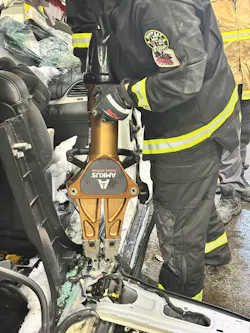
“We had several departments demo our tools, and they loved their operation and their ruggedness, but they were stonewalled by the fact that they only were offered with DeWalt batteries,” AMKUS’ Jennings states.
When the company decided to rectify the problem, it used the circumstance to look at the entire power platform of its tools.
“We started with a clean slate,” Jennings says. He explains that the company developed its own brushless motor that’s designed particularly for extrication tools and its own battery adapter and optimized electronics, including the controller, wiring, connections and drive train.
“We wanted to take as much power from the battery as possible,” he tells Firehouse.
Genesis Rescue Systems Eforce SLi cutters, spreaders, combi tools and rams use Milwaukee batteries, too. The company’s Jared Rogers points out that “smart features” that recently were incorporated into the line include a training mode, geolocation and an ergonomic rocker switch.
The Eforce SLi line can be used while completely submerged in water. HURST’s E3 Connect tools can, too, and it’s in that use that the Captium IQ app can come into play. Submerged usage is among the scenarios that can be sensed, and the app can report proactive management facets or troubleshooting matters that are related to that for human consideration.
“When the crew returns to the station, what are the actions that must be taken to make sure that the tool is ready for the next call?” IDEX’s Speaker explains. “The app can be opened, and it will automatically provide a series of steps for that. If you can address an issue then, you don’t run into a failure in a critical moment.”
Word from the street
Any fire service supplier worth its salt is in regular contact with departments to learn about issues that they confront as a means for refining the products that they develop for the field. Such was the case with Holmatro’s development of its new OmniShore rescue shoring system. Laura Huggins, who serves as the company’s rescue and training specialist for North America, tells Firehouse that she and others at Holmatro increasingly received feedback from the fire service at large and the urban search and rescue community in particular that there was a clear need for innovation in shoring. This included a desire to minimize the equipment that responders must carry, both on the rig and on scene.
Glenn Resnick, who is the chief of operations for the Pikesville, MD, Volunteer Fire Company (PVFC), put in an order for the OmniShore system in late Spring of 2026. “There’s only six struts (one mechanical, one hydraulic and four pneumatic) in the whole package,” Resnick says, “versus other systems that have a lot more components.”
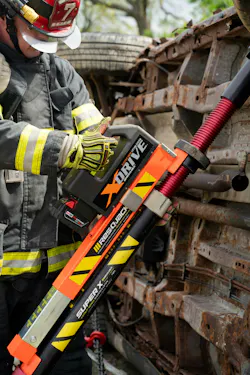
Resnick and other PVFC members demoed the system multiple times before Resnick placed the purchase order. This included at Holmatro’s Rescue Challenge 2026 in March and with the three training prop vehicles that the department has on site at its Station 32. From that, he came away with the opinion that OmniShore is more user friendly than the other shoring systems with which he’s familiar.
“The way that the struts clip together (via the Trident Coupler design), the fact that there aren’t many moving parts and the adjustability at both ends” is a revolution, Resnick offers.
Feedback from firefighters also was in play in the availability of the redesigned foot of AMKUS’ Light Rescue Series and Heavy Rescue Series tools.
“On our previous Ion Series tools, all the foot did was protect the tools from scratches and dents when they were placed down on the ground,” Jennings notes. Information that was relayed to AMKUS from fire service personnel about on-scene operations led engineers to think differently about the foot.
“We turned the foot into a third handle—the Gator Grip. It allows firefighters to gain leverage on the tool no matter the position of the tool.
“If a responder must make a cut, say, high on an A-post and the tool rotates, the individual is able to follow that rotation through all 360 degrees with their support hand,” Jennings continues. “They don’t necessarily need a secondary support individual to hold the tool while they’re operating it.”
“When we did our in-service training with the tools, the AMKUS trainer pointed out the use of the Gator Grip to us,” Bobby Reichardt, who is captain of the logistics division for the El Paso, TX, Fire Department (EPFD), tells Firehouse.
“At first sight, we didn’t think much of it. As we started doing our training and positioning the tools, we quickly realized that, due to the barrel shape of how these extrication tools are designed, the Gator Grip allows us when we’re using the throttle with our left hand to use our right hand to stabilize the tool and keep it from rolling or pitching.”
In November 2025, the EPFD purchased Heavy Rescue Series cutters and spreaders.
“I had one captain tell me that when they were doing an extrication that they specifically pointed out to their firefighter to turn the spreader 90 degrees and positioned their member to put their hand on the Gator Grip. The captain placed the firefighter’s hand on the Gator Grip and put the firefighter’s underhand on the throttle, and the firefighter was able to make the maneuver as he was supposed to.
“As soon as they did that, extrications went very smooth from there,” Reichardt states.
On the horizon
The staff of Firehouse has been in the position to bear witness to the technological evolution in the vehicle extrication equipment field for dozens of years. We’re confident that will continue. Jared Rogers of Genesis Rescue Systems tells us that his company will introduce new product lines in the coming year—although he wasn’t at liberty to discuss any details when we spoke with him. Firehouse’s Product Review evaluators will put a new product from Power Hawk through its paces in the coming weeks.
“You’ll see toward the end of the year some advancements to our DeWalt product lineup,” AMKUS’ Jennings reports. These, he says, will be in the vein of the kind of improvements to electronics that were incorporated into the new tools that are Milwaukee battery-compatible.
So, friends, input that you share with the dealers and suppliers from which you purchase your vehicle extrication equipment might be more useful than ever before. Give them a call. Shoot them an email. Your two cents might be more valuable than you might realize.
About the Author
 Rich Dzierwa
Rich Dzierwa
Managing Editor, Firehouse Magazine
Rich Dzierwa joined Firehouse Magazine in 2019 after four tenures with other publications. He was editor-in-chief of Consumers Digest/ConsumersDigest.com and of trade magazine Cutting Tool Engineering. He served as the consumer products reporter for BridgeNews and began his publishing career with an 11-year tenure at Appliance magazine, where he rose to managing editor after serving in other roles. Dzierwa's experience with consumer products, including furnishings, appliances, electronics and space design, has transferred to his Firehouse work regarding the magazine's Station Design columns and the Station Design Awards. Previous work also has contributed to his supervision of several surveys of fire service/EMS members, to produce unique reporting for Firehouse's audience. Dzierwa earned a bachelor's degree in English from Columbia College Chicago.