Advanced Facilities Enhance Swiftwater Rescue Training Opportunities
Key Takeaways
- Dedicated swiftwater training facilities enable firefighters and other responders to practice in controlled, realistic environments regardless of natural water conditions.
- Swiftwater facilities promote interagency collaboration by providing shared, scenario-based training that improves communication and operational coordination.
- A new center in Houston is set to be the largest swiftwater rescue facility and will incorporate advanced features.
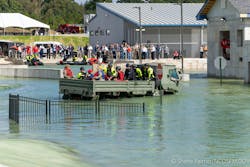
A devastating flash flood hit Central Texas over the Fourth of July this past year resulting in 138 deaths. Flooding incidents like this one have increased in frequency and severity in 2025, raising awareness for the need for swiftwater rescue training.
Today, there are only six dedicated, controlled swiftwater training facilities and pumped whitewater recreation centers that serve as training sites, with a seventh beginning construction at the beginning of 2026 in Houston.
- Swift Water Rescue Training Facility (SWFT), Oriskany, NY
- North Carolina Emergency Training Center, New London, NC
- U.S. National Whitewater Center, Charlotte, NC
- Riversport Rapids, Oklahoma City, OK
- Montgomery Whitewater, Montgomery, AL
- East Race, South Bend, IN
Scott Shipley, S2o river engineering division manager of Calibre Engineering, is among the best-known American kayakers in the world and leads the charge with the development and planning of the facilities. Calibre Engineering is a firm that offers structural engineering, construction phase services and whitewater engineering.
“What our clients want varies with location, which is why each of our facilities is custom designed and built in these various regions,” Shipley told Firehouse.com. “The truth is what they want most is realistic, consistent, repeatable training opportunities.”
The need for dedicated swiftwater rescue facilities
“I'm a big believer that there are no longer the floods of the century,” said Shipley. “It's the century of floods.”
Responders receive a controlled training environment from specially designed swiftwater training facilities, which they are unable to obtain from training on wild rivers. Because water conditions are variable in the field, it becomes hard to train specific situations.
With the touch of a button, these facilities can replicate anything from a mildly flowing river to a full-force flood situation in a training facility. Because of this, crews may practice side-by-side in realistic settings all year long, independent of weather, drought, spring runoff, or the need to travel to far-off rivers.
Additionally, these settings provide sophisticated, scenario-based training that mirrors the real-world experiences of responders. Fast water contained in a small channel, a low-head dam hazard, or submerged cars and trash can all be used to simulate an urban floodplain.
It can modify the hydraulics to meet difficulties that agencies have faced during actual calls. This degree of accuracy enables responders to operate in an environment with safety measures while developing confidence and muscle memory in high-stress scenarios.
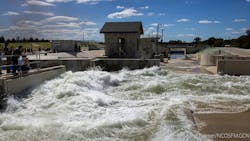
Interagency coordination is another important advantage. During flood or swiftwater events, fire, EMS, law enforcement, and public works frequently need to collaborate, yet historically, they have trained separately, in different settings, or on different schedules. To establish communication patterns, rope systems, command structure, and trust before they are on a live scene, a dedicated facility allows them to practice together regularly in controlled settings.
These facilities' year-round dependability boosts training capacity and operational sustainability. Agencies can train more frequently, more regularly, and with a more concentrated focus because they are able to maintain usable, temperature-controlled flow nearly year-round.
Agencies, from military to local departments, realized that the conditions they were responding to in the field were evolving more quickly than they could prepare for. Floods are occurring more frequently, in increasingly urbanized areas, and often in locations with significant public exposure, restricted space for rescuers, and limited access. Finding the right river on the right day was no longer an option for them.
“What you really need when a flood hits in Colorado, for example, is 2,000 people that aren't necessarily experts, but that know their way around a flood, how to not get themselves into trouble and how to be helpful in that rescue,” said Shipley.
Training insights
Developing a regional resource rather than merely a single-agency training center has been one of the main objectives of Calibre Engineering from the beginning.
For instance, the SWFT facility serves local, county, state, federal, tribal, and private sector response agencies throughout New York and the surrounding area as part of the New York State (NYS) Preparedness Training Center run by the NYS Division of Homeland Security. New York Task Force 2, FDNY Rescue and Special Operations Command units, state police and sheriff's offices, swiftwater teams at the county level, and fire departments from throughout the state are included.
Worldwide interest is occurring with the SWFT facility having visitors and students from China, Korea, Australia, Germany, Ireland and Central American countries.
Deputy Chief Pablo Davis of the Fire and Life Safety Branch of the NYS Office of Fire Prevention Control leads training at the SWFT facility and has seen it pay dividends since its opening in June 2018.
“What I have seen evolve are the changes from doing the training in the field to here, the implementation of our new learning management system and how that supports classes that are offered here and the incubator effect of having a facility like this allows you to develop new ideas and incorporate into curriculum and go in new and different directions,” Davis told Firehouse.com
The swiftwater rescue training facilities are now much more than just swiftwater rescue facilities. The facilities have three primary training zones plus one, with the plus one being what the clients specifically want added to its facility. The pond/lake area (the SWFT facility has a three-acre lake that holds 2.6 million gallons of water) built is part of the on-the-water training, where the fundamentals of ropes work, self-rescue, wading, paddle and powered boat skills training are taught.
There is also a modified version of the traditional swiftwater rescue channel, so the facilities can train in scenarios other than just an unblocked flow of flooding. The RapidBlocs Obstacle System's adaptability allows a design of a variety of scenarios, including rescue from a vehicle, rescue in a low-head dam, and all the training required for Level 1 and Level 2 Swiftwater Rescue Technician training.
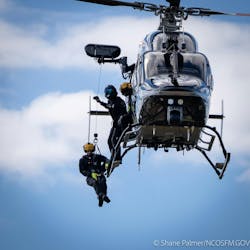
The Urban Flood Rescue Simulator is the last one. This teaches search and rescue, boat abilities, advanced swift water rescue training scenarios, building searches, and high axle vehicle training.
Key designs and operations
The fact that these facilities are fundamentally engineered hydraulic systems is the most crucial concept to comprehend throughout the planning phase. They operate more like a closed loop, regulated river than a swimming pool. The water is kept and recycled rather than continuously released and replenished.
A sizable subterranean or nearby storage basin that serves as a reservoir is most often part of the facility. Water is taken from that basin by high-efficiency pumps, which then transfer it through the training channels before returning it to the basin for future usage. Millions of gallons of water are treated by a state-of-the-art water filtration system, which also reduces water loss by 95 percent.
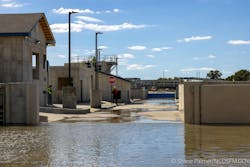
Because of this closed-loop method, water consumption is comparatively constant throughout time, and the system can function in times of drought, winter, or hazardous or unavailable natural water conditions.
The variables that make these specific swiftwater rescue training facilities impactful are:
- Hydraulic design: To simulate actual and local rescue situations, such as low-head dams and urban street floods, the design constructs the channels, buildings, slopes and boulder placements.
- Mechanical and pump systems: Pumps must be sized to produce a wide variety of flow rates, from high-performance, swiftwater rescue situations to low-risk training. Operators can adjust flow patterns using controls, and they can also immediately halt the system when necessary.
- Safety and access: These facilities, in contrast to natural rivers, are constructed with redundant safety elements, such as rescue platforms, throw rope access, overhead belay stations and the capacity to quickly turn off the water.
- Training flexibility: The capacity to conduct repeated, scenario-based training is what really adds value. Crews can train alongside mutual-aid partners, practice the same rescue repeatedly, and refine their approach. On natural water, that is nearly impossible to accomplish consistently.
The Houston facility
While the Houston traning facility won’t be up and running for another 18 months, the implementations will take its facility to the next level. It is three times the size of the SWFT facility, and will be equipped to house, feed and train students. They intend to hold annual water rescue conferences at the facility.
Houston firefighter Billy Morris will be leading the training once the facility is up and running, but he has been having conversations to make this the best facility around.
"Our whole blueprint is to take it above and beyond standard practices," Morris told Firehouse.com. "Bring in as many outside resources as possible, because this isn't just a triad rescue way. This isn't just a Houston way. This should be the best way possible, with ideas flowing in from all avenues. That's the only way that we're going to really set ourselves apart."
About the Author
 Ryan Baker
Ryan Baker
Associate Editor
Ryan Baker is a writer and associate editor with prior experiences in online and print production. Ryan is an associate editor for Firehouse with a master's degree in sciences of communication from the University of Wisconsin-Whitewater. He recently completed a year of teaching Intro to Public Speaking at UW-Whitewater, as part of his graduate program. Ryan acquired his bachelor's degree in journalism in 2023 from UW-Whitewater, and operates currently out of Minneapolis, MN. Baker, also writes freelances for the Ultimate Frisbee Association (UFA) in his free time, while also umpiring baseball for various ages across the Twin Cities Metro Area.