When Firefighters Conduct Water Rescues: The Keys to Triaging Victims
Key Takeaways
- For fire departments, water rescues (e.g., urban flooding, ice rescue) no longer are “special operations” events. Every department should strive for trained, equipped and staffed water-rescue capability. Of course, there are limitations to achieving that. In any case, preplanning is vital.
- Fire department preplanning for water rescues means knowing where flooding target hazards are, which culverts back up first, which retention basins overflow, how rivers and canals react to heavy rain, where debris collects and which access points become unusable when water rises.
- Upon arrival, fire department officers must assess victims in terms of who is calm, who is panicked, who can take commands, who’s fighting the water, who’s injured, who refuses or can’t grab a throw rope, who’s drifting toward a hazard, and who already is caught in a stainer or entrapped?
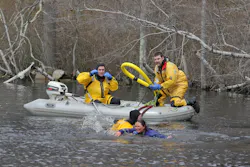
Water doesn’t care about staffing, training levels or whether a department has a dedicated rescue company. It doesn’t care whether you’re an engine with three or a truck with six. When the tones drop for a water emergency, the clock starts immediately, and the people who are in trouble don’t get to wait for the “right” unit that has the “right” equipment. They get whoever is first due. That’s the reality that we live in and the one that we must prepare for long before the call ever comes in.
Over the past few years, water incidents stopped being “special operations” events. They became routine: urban flooding, ice rescue, swift water in streams and canals, vehicles that are swept off of roadways, retention basins that overflow, people who are trapped on islands of debris. Today, these are everyday calls for the first-due engine or truck. “Water-Rescue Considerations for Firefighters” (Firehouse, May 2024) laid out the foundation: understand the environment, respect the water and accept that these incidents will come. The fire service loves to talk about being ready at a moment’s notice. Water rescue is where that statement gets tested.
Staffing
The first reality that we must face is staffing. Some companies run with three, some with four, some with five or six if they’re lucky. Training levels vary wildly. You might have one technician-level rescuer, or you might have none.
Equipment is inconsistent: a throw bag here, a personal flotation device (PFD) there, maybe a rope. Further, timing never is on your side. Water incidents don’t wait for daylight, good weather or the rescue company’s ETA. They happen fast, escalate faster and force the first-due company to make decisions in seconds that determine whether the incident is a rescue or a recovery.
That’s the uncomfortable truth. You might have to act with minimal equipment, minimal staffing and minimal time. That doesn’t mean reckless. It means disciplined, deliberate, brutal honesty about what you can and can’t accomplish. Every department should strive for trained, equipped and staffed water-rescue capability. Until that day comes, the first-due reality is simple: You might have one PFD on the rig, one throw bag and a victim who has minutes or seconds left. Firefighters love to go. We love to make grabs.
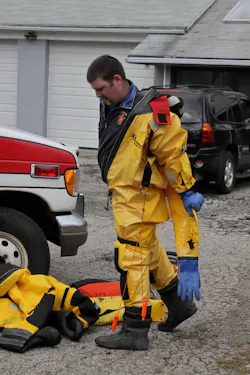
However, water is unforgiving. In a fire, you can bail out of a window, isolate in a room or flow your way out of trouble. In water, once you’re in, you’re committed. There are fewer options, fewer outs and far less margin for error than there are with a fire. The mindset must shift from “go get them” to “go get them without becoming the next victim.”
The officer’s role becomes critical in the first moments. Depending on the situation, the officer might have two drastically different responsibilities. One is to transmit the incident and immediately act, because the victim’s survivability is measured in seconds. The other is to establish command, monitor conditions and coordinate resources, because the situation allows for a structured operation. Both are valid. Both require judgment. Both require the officer to size up, adapt and execute under pressure. When time allows, the officer should be managing weather and water conditions, upstream and downstream hazards, additional resources that are en route, and the crew’s capabilities and limitations. When time doesn’t allow, the officer might be forced to act immediately, transmitting the incident, giving a quick size-up and committing the company to the rescue.
Even in a fast-moving rescue, certain notifications should be nonnegotiable. Units that are responding must know the exact location of the victim, water conditions, weather conditions, access points, whether a swimmer is committed, whether downstream safety is established and whether additional resources are needed immediately. This information shapes the entire response and protects the rescuers who arrive behind you.
Every member who’s on scene, not just the officer, must be conducting a continual size-up. Water incidents evolve faster than structure fires. What was safe 30 seconds ago might be deadly 30 seconds later. You’re looking at the physical location of the emergency, the water conditions, the weather, the victim profile, the resources that you have and the crew’s actual capabilities. Breaking down those initial moments is critical. It determines rescuer safety and victim survivability.
Triage
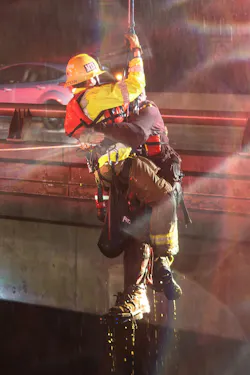
Woven into the size-up is something that members don’t talk about enough: triage. Triage in water rescue isn’t a neat algorithm. It isn’t “Start triage”; it isn’t a color tag; and it isn’t a checklist that can be run through with a clipboard. Water triage happens in milliseconds, and it starts long before you ever lay eyes on a victim. It begins with the initial call, the weather report, the storm forecast, and the preplans that you did on a blue sky day.
If you know that a storm is rolling in, you already should know where flooding target hazards are, which culverts back up first, which retention basins overflow, how rivers and canals react to heavy rain, where debris collects and which access points become unusable once water rises. Just as importantly, you should know your crew. Who is a strong swimmer? Who is better with a throw bag? Who stays calm when things get chaotic? These aren’t judgments. They’re operational realities.
One of the oldest sayings in the water-rescue world is simple: Don’t be fooled by the water; respect it. That applies to rescuers and victims. A kayaker who’s pinned in a rapid might be dressed for the water and mentally prepared for immersion. A resident from an over-55 community who was swept off of a flooded sidewalk is a completely different profile.
Weather and time of day matter, too. An incident that involves people who are drinking on a pontoon boat on a warm summer afternoon isn’t the same as a spring overnight incident when snowmelt is swelling the river and water temperatures are in the 40s.
Once you arrive and visually confirm victims in the water, the brain starts to process information at a speed that can’t be appreciated consciously. Who is calm? Who is panicked? Who can take commands? Who’s fighting the water? Who’s injured? Who refuses or can’t grab a throw rope? Who’s drifting toward a hazard? Who already is caught in a strainer or entrapped.
Physical factors matter just as much. A victim who’s drifting toward a strainer has seconds. A victim who already is pinned might have none. Someone who’s floating freely might be reachable with a throw bag. Someone who’s tumbling in hydraulics might require a swimmer or boat. Someone who’s submerged or entrapped already might be in recovery territory.
This is why blue sky preplans matter. Walk your rivers, lakes and flood-prone areas when the weather is calm. Once the water rises, half of what you saw will be invisible.
Triage in water rescue ultimately is about prioritizing survivability while protecting rescuers. It’s about identifying who can be saved immediately, who can wait and who already is beyond help, even if that’s the most difficult call that you ever will make.
Water rescue RIT
We preach RIT on the fireground. Water rescue deserves the same respect. If you commit one swimmer, you need a backup. If you commit two rescuers, you need even more. However, here is the reality. You might not have the staffing to fill every position. This forces hard decisions. Can you commit one swimmer with a single backup? Must you wait for more resources? Is the victim still viable? Are you about to create a second emergency? Sometimes, the answer is simple: “We need a bigger boat.”
For simplicity’s sake, break the company into four roles: one officer and three rescuers. The officer carries the heaviest mental load: rapid size up, deciding whether to commit a rescuer, managing risk-vs.-benefit, communicating with dispatch, monitoring conditions, tracking rescuers, and determining when the incident transitions to recovery from rescue.
Rescuer 1 is the swimmer, the direct rescuer. Individuals who serve in this role must know their equipment, make controlled patient contact, maintain awareness in the water, and get themselves and the victim back to shore.
Rescuer 2 is the backup, the tender, the upstream safety. Individuals who serve in this role vector the swimmer, monitor the hazards and prepare to become the rescuer if the circumstance dictates that.
Rescuer 3 is downstream safety, the last line of defense. However, once someone enters the water, you might not have the staffing to refill that person’s position. The operation becomes thinner, riskier and more dynamic.
Capabilities & limitations
First-due water rescue is one of the most challenging, high-risk, time-compressed incidents that’s faced. It demands a disciplined mindset, a clear understanding of capabilities and limitations, and the ability to make rapid decisions with incomplete information. We owe it to our members and to the people who we serve to train, prepare and operate with the respect that water deserves. When the tones drop and you’re the first due, the only thing that stands between rescue and tragedy is the mindset and discipline of the crew that’s stepping off of the rig.
About the Author
 Robert Policht
Robert Policht
Robert Policht, who is a Firehouse contributing editor, is lieutenant of Ladder Co. 2 of the Passaic, NJ, Fire Department. He assisted with developing and establishing the department’s response to human vs. machine incidents and is attached to the Fire Investigation Unit. Policht started his career as a volunteer and has served as a chief of department. He taught at the Bergen County, NJ, Fire Academy and is a member of the NJ Division of Fire Safety's Fire Threat Task Force. Policht has a master’s degree in emergency management and homeland security from Arizona State University and has been published in several trade publications. He is a founder of and contributor to Flow and Vent, which is a website that's dedicated to fire and rescue training.