It has been said that only two things in life are certain—death and taxes—and that the only constant in life is change. Considering recent politics, it seems that even taxes change now! While taxes certainly have cyclical impacts on the fire service, death and change surround us daily. Change has had—and left unrecognized will continue to have—deadly consequences for the United States. With this in mind, let’s tick off some of the major fire service changes we’ve witnessed in the past 35 years:
- Residential sprinklers
- ¾ boots/bunker pants
- Nomex gear
- Reinforced helmets
- Back-step riding
- Computerized everything
- Digital radios
It won’t take long for you to find something negative about each of the changes above. It’s generally easier to be negative than positive. For many years, and still today in some circles, I hear the sentiment, “We used to go further and longer so we could feel the heat, instead of being so encapsulated that we don’t feel it until it’s too late.” While the assessment of our newer gear is accurate, the comment taken as a whole is also a traditionalist’s cop-out. While it is more difficult to learn the craft with all of the currently available technology, firefighters and the communities they serve are statistically and realistically safer than we have ever been. The statistical reference bears truth in our firefighter and civilian fatalities that have dropped precipitously in the past 35 years.
Smoke alarms and safety
Like the introduction of smoke alarms did for early warning, I submit that residential sprinklers will be the single most effective tool available today that will positively affect extinguishment. We will save more people and realize less property loss through managing the change to residential sprinkler installations. True, it is not the fire department’s responsibility to install sprinkler systems, but it is our responsibility to advocate for them and celebrate the effectiveness they demonstrate. If you think the adoption of sprinkler legislation and resultant installation will mean less “fun,” you’re probably right—and you should either change that mindset now or leave.
Another significant change has been our industry’s approach to firefighter safety and survival. When I came in the fire service, our almost universal approach was “risk everything, at all cost.” Today, we almost universally use a risk-analysis model that looks something like this: Risk a lot to save a lot, and risk nothing to save nothing. Let’s face it, we cannot take a totally risk-adverse approach in this profession; if we do, we won’t be doing our job. You want something close to totally risk adverse? Give up your position and take a desk job.
Did you notice I said we were almost universally approaching risk more conservatively? The “almost” is one of our biggest industry dilemmas—acceptance of and adaptation to change. I know you’ve heard this one before: “100 years of tradition unimpeded by progress” (in “progress,” read CHANGE).
Adapting to change in and of itself is not found in a book, a promotional exam, a college degree or a plan. Change is found within you. In the simplest terms, it is your ability to recognize a difference and react appropriately—the floor sags, you change direction; heat banks down, you drop to the floor; someone stops breathing, you start CPR; a vehicle enters your path, you take evasive actions; smoke color changes, you strategize to what’s coming. In each of these somewhat obvious examples, a failure to change something you’re doing will have catastrophic consequences.
What about the less obvious examples we’ve faced over the years? How have we adapted to flow-path science? What about cancer prevention?
Look inside your organization and answer this for me: If you weren’t already doing it, have you taken in-depth training and made wholesale changes to your tactical approaches as a result of the National Institute of Standards and Technology (NIST) and UL flow-path research? When I asked this question in class about five years ago, about half the hands went up. Last year, all but two hands went up. One of the two was more than willing to argue the science, explaining that the tactics they had been using for 75 years worked just fine, and that it was hard enough to find volunteers without “taking away all the fun.” I suggested that “fun” as an absolute tradition needed to change. Who doesn’t want their work to be fun? Let’s face it though, folks, having fun at the physical expense of others is a tradition we can do without.
Chiefs and their companies need to embrace the change that the flow-path science brings, including the inside-out tactical paradigms that will save more property and kill fewer people than the way our tradition was proving. Remember, this includes FEWER and better-controlled vertical and horizontal openings, especially in residential dwellings. Watch the videos and ask yourself, “WHY ARE THEY ON THE ROOF?” It’s a simple change, yet a hard tradition to change. Is there a time and place for roof operations? Is there a time to take out all the windows? Absolutely, but certainly not always and not at all costs!
Talking about cancer prevention, have you taken in-depth training and made wholesale changes to your approach to cancer prevention? Are you using exhaust-capture systems? Are you metering air and requiring SCBA use until the air is deemed to be safe? Are you washing your gear after every interaction in an immediately dangerous to life and health (IDLH) environment? Conversely, are you still taking your gear home in the family car? Do you still think that the higher rates of esophageal and testicular cancer rates among firefighters are happenstance?
The positive-change cancer awareness questions posed in a classroom today show most hands raised in the affirmative, but I’m betting about half of those are not entirely accurate. Remember the “100 years of tradition unimpeded by progress (change)” phrase? Even though most of those hands go up, we could easily search many of our social media accounts and find hundreds of “likes” and “smiles” to photos of soot-filled faces and firefighters’ blackened gear. How about the pictures of clearly smoky environments where we see firefighters operating without SCBA or SCBA straps hanging down, and videos of insane driving? While some will say, “Stop taking pictures and video,” that wouldn’t be “fun,” would it?
Over the years, I’ve been as guilty as the next person for having shared pictures and videos that showed reckless behavior without sufficiently commenting. As I rose through the ranks, I recognized the err in those ways, and now have no problem—in fact, I have the responsibility—calling out dangerous activities, not writing them off or celebrating them as “fun.” Chiefs, as you share those pictures and videos, ignoring the problematic elements of them or taking a passive approach without corrective comment or action is affirmation of the action and the proverbial green light for your folks to do the same thing.
I suspect we’ve all heard or quipped when referencing specific safety or rule changes over the years, “Oh, that’s the ‘Nancy’ rule” or “That’s the ‘Jim’ bar.” We tend to trivialize and demean our own people’s tragedies as tepid or half-hearted recognitions of acceptance, then we go out and repeat their mistake. It’s insanity. If you think this talk is just all the “wussification” of the fire service, PLEASE QUIT NOW before you or one of your people die at your careless hands.
Change management
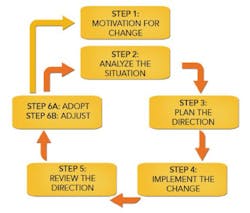
Change management is difficult and unpredictable. No two people will react the same to change. Consider using the fire service “Planning P” as a platform for change management administration (see the June 2016 Chief Concerns column “What’s YOUR Battle Rhythm?” at firehouse.com/12197149). You can also download free help from our industry and other corporate consultants. I like this simple change management cycle as referenced by Dale Carnegie Training. It’s the same basic premise as our “Planning P.”
Considering the six steps above, you’ve been provided with plenty of motivation for change (Step 1) and a tremendous amount of analysis (Step 2) has been conducted within our industry. Many of you have probably been a part of the industry analysis, but either way, for the most part, steps 1 and 2 have been done for you. It’s time to plan your direction (Step 3) and implement change (Step 4). Reviewing your direction (Step 5) and adopting/adjusting (Step 6) should be a continuous part of your management process.
Remember from the beginning, few things are absolute and most will change. You have a responsibility to your people, to your department, to your community, to your political environment, to your family and, most importantly, to yourself to manage change. I have said before, there’s NOTHING wrong with being aggressive; I embrace an aggressive approach to crisis management (which is what we do every day). I also embrace change and I recognize that change is difficult. There are lots of folks to help you along the way. Reach out to me or any other person who can help. You DON’T have to go it alone.
In sum
Let’s start being the change, accepting the change, embracing our new traditions, and be just as aggressive about making sure we are doing everything we can to make sure everyone goes home. Change or become extinct. Will you BE the change? Or, like dinosaurs, will the change be YOU?
About the Author

Marc S. Bashoor
MARC S. BASHOOR joined the fire service in 1981. In 2017, he retired as fire chief of Prince George’s County, MD, Fire/EMS, the largest combination department in North America. His progressive community-based approach led to record hiring and a strategic apparatus replacement plan.
Twitter: @ChiefBashoor
Email: [email protected]