Stronger at the Core: How Pilates Can Boost Firefighter Performance and Resilience
Key Takeaways
- By training the body to stabilize and move more efficientyly via Pilates, firefighters can reduce their risk of sprains, strains and chronic back pain.
- Pilates strengthens and stretches simultaneously, to create long, elastic muscles that have a healthy range of motion, which helps firefighters to move more easily and to react more quickly in unpredictable environments.
- Pilates emphasizes deep, controlled diaphragmatic breathing, to provide improved breath control, to help firefighters to manage stress and extend the effectivenss of their SCBA.
As someone who served in law enforcement for 15 years, I had the privilege of working shoulder to shoulder with firefighters on countless emergency calls. I saw firsthand the physical and mental demands that are placed on the fire service: long hours in heavy gear, sudden bursts of extreme exertion and the stress of responding to the unknown. These demands don’t just require brute strength; they require resilience, precision and control.
Today, as a certified Pilates mat and reformer instructor, I view firefighter wellness through a new lens, one that’s focused not only on strength but on sustainability. Pilates is a practice that often is misunderstood in tactical professions, yet it offers an unparalleled approach to improving performance, reducing injury risk and supporting long-term physical readiness.
What is Pilates, really?
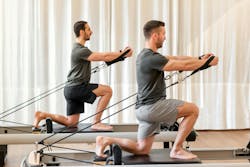
Pilates is a system of low-impact exercises that are designed to strengthen muscles while improving postural alignment and flexibility. Developed by Joseph Pilates in the early 20th century, it combines core conditioning with breath work, balance training and joint mobility. Sessions can be performed on a mat or with equipment, such as the reformer, which is a spring-loaded resistance machine that’s designed to guide functional movement.
Unlike traditional strength training, Pilates focuses on stability and control. It helps practitioners to develop balanced strength, particularly in the deep core muscles that support the spine and pelvis, which are areas that often are vulnerable in high-intensity professions, including firefighting.
Why Pilates matters for firefighters
Core strength prevents injuries. Low back injuries remain a top concern in the fire service. Whether hoisting equipment, dragging hoselines or lifting patients, the spine is under constant stress. A strong core, particularly the deep abdominal and pelvic muscles, helps to protect the spine and to improve posture during these physically demanding tasks.
Pilates directly targets this region. By training the body to stabilize and move more efficiently, firefighters can reduce their risk of sprains, strains and chronic back pain.
Increased flexibility and mobility. Firefighters often operate in tight spaces and awkward positions, such as crawling through attics, ducking under debris and climbing ladders. Tight hips, shoulders and hamstrings can limit movement or lead to overuse injuries.
Pilates strengthens and stretches simultaneously, to create long, elastic muscles that have a healthy range of motion. This flexibility helps firefighters to move more easily and to react more quickly in unpredictable environments.
Breath control enhances focus and SCBA efficiency. One of Pilates’ most overlooked benefits is breath training. The method emphasizes deep, controlled diaphragmatic breathing to power movement and to calm the nervous system. This can be a game-changer in high-stress situations in which adrenaline spikes and breathing becomes shallow.
Improved breath control not only helps to manage stress, it can extend the effectiveness of an SCBA unit by promoting more efficient oxygen use.
Better posture, less fatigue. Turnout gear, SCBA and long hours on one’s feet take a toll on alignment. Over time, this can lead to muscle imbalances and joint pain.
Pilates trains the body to hold itself in better alignment, even under load. Many exercises focus on postural awareness and spinal support, which can reduce fatigue, improve balance, and ease the wear and tear that accumulates across a career.
Mental discipline and stress relief. Firefighters endure some of the most intense stressors in any profession. Pilates offers a structured form of movement that promotes mindfulness, mental clarity and body awareness.
Practicing Pilates becomes more than just physical exercise; it’s an opportunity to reconnect with the body, to manage stress and to build resilience from the inside out. For many first responders, it becomes a vital part of their self-care and recovery routine.
Career investment, not just a workout
During my years on the job, I saw countless colleagues sidelined by preventable injuries or chronic pain. Today, I work with clients, including tactical professionals, who find Pilates not only rehabilitative but performance-enhancing. It’s low impact, scalable for all fitness levels, and ideal for both active-duty personnel and those who are returning from injury.
Some departments already are seeing the benefits. Firefighters who incorporate Pilates into their regular fitness routines report fewer musculoskeletal issues, better movement awareness and improved job performance.
The U.S. Navy SEALs, elite SWAT units and Olympic athletes have turned to Pilates to refine their physical capabilities. It’s time for the fire service to do the same.
Practical integration into firehouse fitness
Pilates is highly adaptable and doesn’t require bulky equipment to begin. Although reformer sessions offer excellent resistance-based training, mat Pilates is accessible and just as effective with the right instruction.
Here’s how fire departments can start:
- Weekly on-site sessions: Bring in a certified instructor to lead short, station-based group classes.
- Recovery-focused training: Use Pilates as a low-impact recovery day workout to relieve soreness and rebalance the body.
- Injury rehab programs: Partner with physical therapists who incorporate Pilates principles for smarter, faster recovery.
- Online or app-based instruction: Many instructors offer firefighter-friendly video routines that can be done with just a mat and 30 minutes of time.
Smarter training for a demanding career
Firefighting isn’t just a job; it’s a lifelong commitment to readiness. The physical and mental demands are unlike any other. To meet them head on, training must go beyond lifting weights and running drills. It must build a foundation of control, balance, flexibility and resilience.
Pilates offers exactly that. As someone who worked alongside firefighters in the trenches and now coaches others toward better movement, I can say with confidence: Pilates doesn’t make you softer; it makes you smarter, stronger and more durable.
For firefighters who are looking to stay injury-free, move with confidence and perform at their best, Pilates might be the missing piece of the puzzle.
About the Author
 Stephen Mette
Stephen Mette
Stephen Mette brings nearly 20 years of experience in public safety and public safety technology. He began his career as a law enforcement officer, rising through the ranks to serve as acting chief of police, and later led a consolidated emergency communications center in central Ohio. Mette holds certifications as a Project Management Professional (PMP), Emergency Number Professional (ENP) and Certified Protection Professional (CPP). He currently serves as Senior Sales Engineer II at Prepared by Axon, where he focuses on modernizing the 9-1-1 technology stack and driving safe, scalable innovation in AI-assisted call-taking and dispatch. Mette teaches Pilates, Pilates Reformer, Zumba, Aqua Zumba and group fitness classes.