Firefighter On-the-Job Exposure & Presumptive Health Legislation
Key Takeaways
- In North America, under presumptive health laws, certain diseases and health conditions are presumed to be occupational in origin if certain criteria are met. In regard to the fire service, this shifts the burden of proof to the employer to present evidence to the contrary from the firefighter to demonstrate that the illness is job-related.
- Although the intent that’s behind presumptive health laws across North America is similar, how they are applied varies widely.
- It’s important for firefighters to establish a relationship with a primary care provider to discuss their unique occupational risk profile and care plan.
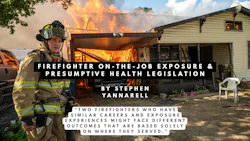
It was my first fire after being assigned to a station out of recruit school. It was an exciting, adrenaline-pumping event. We believed that it was a routine room-and-contents fire in a two-story townhouse. As we performed overhaul on a second-floor bedroom, we uncovered agallon can of ammonia, which often is used in the manufacture of methamphetamine. This routine call turned into a hazardous chemical exposure.
This was a wake-up call: Structure fires aren’t always predictable. Moreover, any fire, any incident at all, might contain a hazard that couldn’t be anticipated reasonably.
I wondered what other chemicals were in that room that we might have disturbed while we pulled ceilings and kicked around in the debris. What would be the consequence of this exposure? This question is the justification for presumptive health coverage.
Burden of proof
Firefighters are at risk of exposure to hazardous substances, bloodborne pathogens and dangerous environments on the job every day. Some dangers might be apparent from the start, such as high heat, confined spaces and mechanical hazards. However, the presence and effect of other unknown hazards on the human body might not be apparent until those effects create a secondary hazard—a disease, illness or condition that threatens a member’s health, job and, possibly, life.
These health conditions are presumed to be the result of firefighters’ occupational exposure through on-the-job exposures. Based on scientific evidence of predisposition to illness, many U.S. states and Canadian provinces and territories passed legislation that provides benefits to fire service members and families in the event of a member’s illness.
Presumptive legislation is designed to help firefighters to mitigate the burden of proving that the job caused an illness. Under these laws, certain diseases and health conditions are presumed to be occupational in origin if certain criteria are met. This shifts the burden of proof from the firefighter who must demonstrate that the illness is job-related to the employer that must present evidence to the contrary. This can mean quicker access to benefits, coverage for treatment, and financial security for firefighters and their family during some of life’s most difficult moments.
Presumptive health in North America
There are many nuances to the coverage that’s provided by each federal, state, provincial and territorial government. Essentially, presumptive coverage can be found for health conditions in the following categories: cardiovascular, respiratory (lung), cancer, infectious disease and mental health. Coverage and legislative language are unique to each jurisdiction.
Cardiovascular disease coverage can include heart attacks, hypertension, strokes and vascular disease. Some legislative language only covers disability or death from heart attacks if they occur within 24 hours of an emergency response.
Lung disease coverage might include particular diseases, such as pneumonia and tuberculosis, or be categorized generically as lung or respiratory disease.
Infectious disease coverage includes numerous common illnesses: AIDS/HIV, COVID, hepatitis, meningitis, MRSA and tuberculosis, to name a few among several others.
Cancer coverage is added one by one and covers an organ or a body system. Firefighter advocacy groups have engaged their legislatures in their localities to add to the list of covered cancers. Some jurisdictions capitalized on the International Agency for Research on Cancer’s (IARC) updated classification of the occupation of firefighting to Group 1: Carcinogenic to Humans to endorse language that includes all cancer types and origins.
Coverage for mental health conditions is gaining traction. The conversation about mental and behavioral health effects from the job is reaching the mainstream. This is leading to coverage around post-traumatic stress disorder (PTSD) in a number of jurisdictions.
Although the intent behind presumptive laws is similar, how they are applied varies widely across North America.
Canada took a relatively coordinated approach, with all provinces/territories providing some level of presumptive coverage for firefighters. Most include extensive lists of cancers that are linked to firefighting, cardiovascular disease, and with increasing frequency, mental health conditions, such as PTSD.
In several provinces/territories, the list of covered cancers has grown significantly over the past few years, reflecting evolving research on carcinogenic exposures, including the work that contributed to IARC’s Group 1 classification. Presumptive coverage in Canada often is tied to years of service and disease latency periods (i.e., how long that it takes between exposure and diagnosis), with different requirements depending on the disease.
In the United States, presumptive legislation exists in most states; however, there’s little consistency. There’s federal cancer presumption for federal firefighters, but that, too, varies from state coverage. Each jurisdiction sets its own conditions for diseases that are covered, years of service, which members are covered and what evidence can rebut a presumption.
Cancer coverage varies significantly. Some states provide coverage for a large number of cancers; others offer limited coverage or require comprehensive documentation. In the case of coverage for cardiovascular disease, states can require that events must occur within a defined period after an emergency response. Only about half of U.S. states have benefits for behavioral health conditions. In at least two U.S. states, there are provisions for Parkinson’s disease, with more pushing to add neurodegenerative diseases as research emerges on the prevalence in firefighters. The result is a system in which presumptive coverage can vary dramatically by geography.
With most health conditions that are covered by presumptive legislation, damage to the body remains hidden until symptoms emerge or are detected through screening. This is why healthy lifestyles combined with annual medical physicals with screening that’s aligned with the U.S. Preventive Services Task Force and NFPA 1580: Standard for Emergency Responder Occupational Health and Wellness are vital. Additionally, it’s important for firefighters to establish a relationship with a primary care provider to discuss their unique occupational risk profile and care plan.
The benefits that are provided through presumptive legislation can be as comprehensive as standard workers’ compensation coverage, treating a medical diagnosis like a typical physical injury that occurred on the job. In other cases, the coverage might be a single financial benefit for diagnosis or only be paid out after the death of the member, described as a survivor benefit.
Support can be identified for complete or partial disability that prevents members from performing their job to the full extent.
Challenges
Many laws are rebuttable by the jurisdiction that provides coverage.
Municipalities and insurers often raise concerns about the rising cost of claims and long-term liabilities as coverage expands.
Although there’s strong evidence that links firefighting to increased disease risk, opponents point out the difficulty in linking an individual’s diagnosis to a particular exposure, which is why exposure reporting is critical.
In the United States particularly, disparities between states’ coverage can create confusion and inequity. Two firefighters who have similar careers and exposure experiences might face different outcomes that are based solely on where they served.
Road ahead
Legislatures continue to add new cancers to presumptive lists, to reduce service requirements and to extend coverage to broader segments of the fire service, such as volunteer firefighters, fire investigators and wildland firefighters. There also is growing recognition of mental health effects, with PTSD presumptions gaining traction.
Fire service organizations play a key role in advancing these changes, often backed by the results of emerging research on the health risks to firefighters. The IAFF, in particular, has helped to drive many of these endeavors by advocating for change that’s grounded in the real-world experience of members as well as findings from independent research. These groups are collaborating with individual departments to invest in prevention efforts, such as PPE decontamination and laundering practices, Clean Cab concepts, cancer screening in concert with medical physicals, and behavioral health support.
What members should know
Presumptive legislation represents more than policy. It’s a recognition of the unseen toll of the job. Every call, every exposure, every shift that’s spent in uncertain conditions adds up. When illness strikes years later, firefighters shouldn’t have to fight alone to prove what obviously is linked to the occupation.
All firefighters should do everything that they can to limit their occupational exposure and its effect. Document exposures with detailed incident and exposure information and know your jurisdiction’s presumptive health laws. Research is constantly evolving, so stay informed and consider enrolling in the National Institute for Occupational Safety and Health’s National Firefighter Registry for Cancer.
About the Author
 Stephen Yannarell
Stephen Yannarell
Stephen Yannarell is an occupational health specialist at the IAFF. He holds a master’s degree in occupational safety and health from Columbia Southern University. Yannarell served 29 years in the Prince William County, VA, Fire & Rescue System. He retired as a battalion chief in 2023.