Fit for Duty at 50? Rethinking Firefighter Wellness, Fitness Standards and Operational Readiness
Key Takeaways
- When firefighters age, their speed and functional abilities decline. However, not all aging is equal, and not all decline is linear.
- Many U.S. fire departments are ill-equipped to support firefighters as they age. This is largely because of agencies' lack of age-related fitness programs that are tailored to physiological aging; the prevalence of dated or inconsistent performance standards that aren't based on current long-term firefighter health and wellness research; voluntary fitness programs that result in inconsident buy-in across different age groups; and wellness programs that only focus on short-term injury reduction.
- An age-smart fire service provides the necessary fitness, wellness, medical and staffing systems to best support members for as long as possible.
The fireground doesn’t care how old you are. The smoke is just as thick, the heat is just as unforgiving, and the stairs are just as steep. For thousands who are on the job, the physical requirements feel heavier than they did when those members were in their 20s.
The fire service is aging. Many members are in their 40s, 50s and older. With that shift comes a reality that many departments are unprepared to address: The body changes with age, even when dedication to the mission remains constant. As with any walk of life, experience and judgment increase with age. At the same time, aerobic capacity, muscular strength, heat tolerance, recovery time and injury resilience decline.
When fireground demands confront limits of the human body
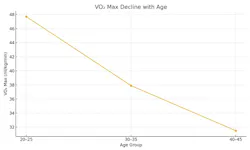
The physical demands of firefighting require essential abilities, including aerobic capacity (VO2 max), muscular strength and power, short-duration anaerobic output, high heat tolerance and rapid recovery from intense workloads. Well-known biological age-related changes (ARCs) are related to lower levels of work performance. VO2 max and lean muscle mass decrease with age at an average rate of approximately 1 percent–2 percent per year after an individual turns 30 years old. Strength and power also decline with age. According to Anssi Saari, et al, in “The Influence of Age on Firefighter Combat Challenge Performance and Exercise Training Habits” (Journal of Strength Conditioning Research, September 2020), older firefighters have significantly slower times in the Firefighter Combat Challenge as well as in power-based task performance when compared with their younger colleagues. In addition, body fat tends to increase, and pulmonary function shows a general decline over time (“Aging and the Fitness of Firefighters: The Complex Issues Involved in Abolishing Mandatory Retirement Ages,” K. Saupe, et al, American Journal of Public Health, September 1991).
Recovery times also increase, with older individuals experiencing greater strain on blood pressure and the heart, multiple reports show.
These physiological changes are related directly to slower times on occupational physical assessments. In “Age-Related Differences in Physical Fitness and Performance of an ‘Ability Test’ Among Firefighters” (Muscles, 2024) Koulla Parpa and Marcos Michaelides measured job-related ability test times and observed a significant increase in the time that was required to complete an ability test with increasing age. The average time for the ability test was 6.20 minutes for a 20–30-years-old age group, 7.13 minutes for a 31–40-years-old age group, and 8.45 minutes for a 41–50-years-old age group.
There’s a clear and progressive effect of aging on speed and functional abilities of firefighters.
Effect of aging on firefighter readiness
Parpa and Michaelides investigated the physical fitness of 20–44-year-old firefighters in Greece to examine how firefighting-specific ability is affected by age. Aerobic capacity, which is a key element of physical fitness, was measured, and older firefighters had significantly lower scores. The two researchers also observed lower ability test times and decreased strength and power in the aging population.
Saupe and her co-authors found that older firefighters took longer to complete the Firefighter Combat Challenge, which they indicated likely was because of the decline in strength and power.
Heat tolerance also had an inverse relationship with age. Firefighters were shown to experience impaired thermoregulation and greater cardiac stress when exposed to PPE thermal stress. Body composition was reported in the data that Saupe and her co-authors produced, with significant differences in body fat percentages in 20-year-old firefighters compared with 45-year-old firefighters.
The information from these studies can be applied to fireground operations to assess the decline of physical ability with age. Age was associated with slower line advancement, shorter durations of SCBA air, the inability to perform prolonged searches, and less power for victim drags, forcible entry and other tasks that require power. Furthermore, aging was associated with earlier onset of fatigue for prolonged incidents. Collectively, crew age has both individual and crewwide implications for fireground operations.
Where departments fall short
Many departments in the United States are ill-equipped to support firefighters as they age, despite the national trend of the average age of firefighters increasing. This is largely because of a number of large and often systematic departmental gaps, including: a lack of age-related fitness programs that are tailored to physiological aging; the prevalence of dated or inconsistent performance standards for fitness that aren’t based on current long-term firefighter health and wellness research; voluntary fitness programs that result in inconsistent buy-in across different age groups and that allow for preventable decline to go unchecked; and wellness programs that only focus on short-term injury reduction as opposed to long-term career span and that don’t offer targeted support for the inevitable physical changes that firefighters experience as they age. There also is a clear lack of strategic or tactical aging-related planning, as few departments factor it into staffing, training and fitness expectations, medical evaluations, and succession planning, Saupe and her co-authors wrote.
Path forward: Smarter fitness for a changing workforce
Studies collectively point to an obvious and inarguable conclusion: Regular exercise is the most consistent predictor of slowing and, in some cases, reversing the effects of aging in firefighters. Resistance training combats sarcopenia (age-related, progressive loss of muscle mass, strength and function) and maintains the power that’s necessary to perform physically demanding fireground tasks. Aerobic training enhances VO2 max at any age and lessens cardiac stress during operations. Functional movement training promotes mobility, stability and more efficient movement, which, in turn, reduces injury risk and enhances overall job performance. However, this also suggests a broader organizational imperative to embrace age-smart solutions across the board, including age-sensitive fitness testing, tiered programming that grows and changes with a firefighter’s experience and career stage, and a wellness culture and climate that normalizes participation rather than deferring to voluntarism or individual initiative. Such a system would depend on data-driven policies and practices around staffing, assignments and workload to keep firefighters healthy, able and safe for as long as possible.
An age-smart fire service
Older workers are a rapidly growing part of the American fire service, but firefighting never has been less forgiving. Every alarm presents challenges to the human body. Every fire, every rescue, every critically stressed patient, every difficult call pushes workers in both physical and operational ways. The physiological challenges of aging in this demanding profession aren’t avoidable, but they also aren’t inevitable.
A predictable decline in aerobic capacity, strength and mobility, recovery capacity, and other physiological factors that can lead to increased heat, exertion and cardiac risk is certain with age. However, not all aging is equal, and not all decline is linear. Research that spans many years clearly shows that what a fire department provides through training, support, culture and policy can influence the trajectory of these effects on an individual level. An age-smart fire service values what experience and maturity can provide in terms of operational knowledge, decision-making, situational awareness and leadership skills. It also provides the necessary fitness, wellness, medical and staffing systems to best support these members in a safe and productive way for as long as is possible.
Preparing the Fire Service for an Aging Workforce
The fire service is aging rapidly, and research shows predictable declines in aerobic capacity, strength, mobility and heat tolerance. Decline is manageable, but only when departments adopt proactive, structured wellness strategies.
What Must Be Done
- Implement age-sensitive fitness assessments.
- Develop tiered training programs.
- Build a supportive wellness culture.
- Use data to guide staffing and assignments.
- Expand medical screening and early intervention.
How to Start Today
- Establish a fitness and wellness committee.
- Audit current performance and injury data.
- Partner with local health and performance professionals.
- Add wellness expectations into policy.
- Communicate goals clearly.
About the Author
 Michael Reily
Michael Reily
Michael Reily is a lieutenant with the Shawnee Heights Fire District in Tecumseh, KS. He holds a Bachelor of Science in Fire Administration and serves as chair of the EMS committee of Kansas State Firefighters Association. Reily is a U.S. Army veteran, a certified Fire Instructor and an advocate for firefighter wellness and evidence-based training. His work focuses on advancing health, safety and organizational readiness within the fire service.