Between the Flames and the Cradle: The Invisible Struggles of Female Firefighters Who Are a Wife and Mother
Key Takeaways
- Accessing therapists who specialize in first responders, reading books that share insight into the emotional world of emergency services and joining online communities can help the wives and mothers of the fire service navigate expectations and sacrifices.
- Talking with their spouse about the real struggles of raising children can soften the isolation that builds quietly over time for female firefighters who are a mother.
- "I Love a Fire Fighter" by Ellen Kirschman provides insight into the emotional world of emergency services work that can help a firefighter who is a wife and/or mother to normalize the internal battle that the face.
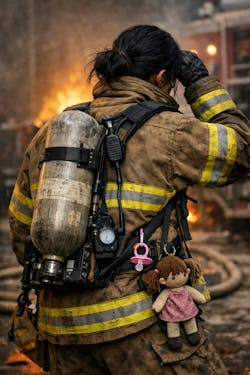
Firefighters are seen as heroes, those who run toward danger while others flee, who rescue families from burning homes and mangled vehicles, who hold the line against disasters that most people can’t imagine. The image is iconic: strong, stoic, almost mythic. However, behind it are real people, including women whose stories often go untold.
For female firefighters, particularly those who are in large, tradition-bound departments, the job is more than physically demanding; it’s emotionally layered and complex. For those who also are a wife and a mother, regardless of their partner’s gender, the complexity deepens. They navigate multiple identities—public servant, household manager, partner, caregiver—and the weight of these roles often is invisible but relentless.
Editor’s note: What’s shared below primarily relates to firefighters who are a wife and mother, but it would be a mistake not to consider that firefighters who are husbands and fathers encounter the same experiences. Parenting struggles aren’t constrained to women; firefighters of whatever gender can benefit from sharing their experiences, to connect better and build camaraderie.
The invisible shift: From firehouse to home
When a 24-hour shift ends, most firefighters are exhausted. They ran calls through the night, handled medical emergencies, trained, cleaned equipment and lived in a communal pressure cooker for a full day. For women who return home not just as firefighters but as a mother and a wife, the moment that they step through the front door, the second shift begins.
The household doesn’t stop because Mom was saving lives. Children wake early, needing breakfast, comfort and steady presence. There are school drop-offs, meal planning, laundry that’s multiplied overnight and the endless mental load of anticipating what every family member might need. A spouse might need emotional support or space to regroup from their own day, and the rhythm of domestic life continues with no respite.
Sometimes, the exhaustion collides with reality in ways that feel almost unbearable. On multiple occasions, I came home after not sleeping for 24 hours, desperate for rest, only to find that my infant son already was awake and ready for the day. On one of those mornings, the fatigue cut particularly deep, because I also stayed up hammering out a paper for school. (I was finishing my degree while working full-time, firefighter by day and student by night.) I told my husband as I came through the door that I hadn’t been to sleep yet. He nodded, but he had a Zoom meeting scheduled to start within 10 minutes, so he ran into his office, leaving me in the kitchen with a wide-awake baby. I cried quietly as I made my son’s breakfast, my body aching for rest, my mind still foggy with smoke and study, my heart heavy with the knowledge that the day’s demands had just begun.
Even in households that strive for balance, women often become the carriers of unspoken responsibilities: remembering appointments, managing schedules, forecasting everyone’s needs. The mental load doesn’t pause just because a shift was brutal. For a firefighter who is toggling between life-and-death decisions and the mundane but unrelenting demands of home, the emotional whiplash can be intense.
Parenting together can ease some of that weight. Many firefighters—and, once again, to be clear, women or men—find that talking with their spouse about the real struggles of raising children softens the isolation that builds quietly over time. When both partners name the difficult parts out loud, they become a team again, not just two people surviving parallel challenges. Sharing even small frustrations or small victories helps to rebuild connection. Parenting is less punishing when neither partner believes that they must pretend to have it all under control.
Motherhood in the fire service
Motherhood adds layers of complexity that many male colleagues rarely must consider. Pregnant firefighters often work well into their pregnancy, balancing concern for their unborn child with pressure to prove their ability. They weigh when to disclose their pregnancy, how their crew will react, whether asking for accommodations will affect how they’re viewed, and whether their department’s policies will support them or leave them patching together sick days, vacation and unpaid time.
Once a child is born, the balancing act becomes even more delicate. Firefighters work long, irregular shifts. They miss birthdays, holidays, school plays and bedtime stories. For mothers, the absence cuts particularly deep, because society still equates maternal presence with good parenting. Although male firefighters might be praised as dedicated providers despite their absences, female firefighters can be judged harshly for the same sacrifice.
Even the simplest routines can be painful reminders. My husband calls me right around 8 a.m. as he drives our son to school, a workaround that eases the guilt of me slipping out at 4 a.m. while he’s still asleep. Sometimes, the phone rings while I’m on a call, and the chance evaporates. My son hears “Momma’s busy working” instead of my voice. Those missed moments accumulate, shaping a kind of longing that firefighters rarely speak aloud.
The weight of partnership
Marriage is tested under fire service demands. Long shifts, missed milestones, sleep deprivation and constant danger create tension in any household, whether the firefighter is a woman or a man. That said, women often face dual expectations: to be as tough and fearless as male colleagues while fulfilling traditional domestic roles. This can produce chronic burnout and a feeling of inadequacy at work and home.
Spouses also struggle. Husbands and wives alike might wrestle with insecurities about danger, attention or identity within the relationship. Resentment can build silently, particularly when household duties are unbalanced or intimacy suffers. For female firefighters, balancing work and marriage—whether with a husband or a wife—can feel like walking a tightrope blindfolded.
Finding help and building support
Many female firefighters eventually reach a point where they need more than endurance. They need support, understanding and tools.
Finding a therapist who specializes in first responders or works regularly with firefighter families can make a profound difference. These therapists understand the culture: the dark humor, the silence after difficult calls, the unwritten rules, the shift work, the emotional suppression, the guilt around missed family moments. Departments sometimes keep referral lists, and organizations, such as the National Fallen Firefighters Foundation, the Firefighter Behavioral Health Alliance and local union chapters, often maintain networks of culturally competent therapists. Many partners also benefit from therapy, not because something is wrong with the marriage, but because they live inside of the same stress ecosystem.
Books also can help to normalize the internal battle. “I Love a Fire Fighter” by Ellen Kirschman, “Counseling Cops: What Clinicians Need to Know” by Kirschman and fellow authors John Fay and Mark Kamena, and similar works provide insight into the emotional underworld of emergency services work. Further, some women find comfort in memoirs by other firefighter mothers, discovering language for experiences that they never have been able to articulate. Of course, reading doesn’t solve the strain, but it provides vocabulary—and sometimes that’s the first step toward relief.
Online communities also have become lifelines. Private groups for firefighter spouses, female firefighters and parents who are in the fire service allow women—and men—to speak openly without fear of judgment. These communities offer a place to say, “This is difficult,” and to hear, “I know, me, too.” That simple exchange can lighten burdens that feel impossible to share anywhere else.
Emotional cost
Firefighters witness more trauma in a year than many people see in a lifetime. Women often carry the emotional effect differently, absorbing not just the images but the relational echoes. They might be more hesitant to share details at home, wanting to protect their spouse from the horror, particularly when their partner already shoulders the weight of childcare and household responsibility.
Of course, some calls never leave you. I remember the night that a newborn girl was Safe Surrendered at our station, wrapped in a dirty tank top, only hours old. I tried to swaddle her, but her tiny legs kept kicking loose. Years later, holding my own newborn son, that memory resurfaced with the full emotional weight that it had left behind. I thought of the woman who surrendered her child and the grief that she must have carried. These moments carve themselves into you.
At home, many women—and, of course, many men—hesitate to share these kinds of stories with their spouses, not wanting to burden them with the horrors that they’ve seen. With children, they guard their emotions, determined to stay present and nurturing. The result is often bottled pain, carried silently.
Add to this the guilt—guilt for missing moments with their children, guilt for not giving enough to their marriage, guilt for not being able to do it all—and the emotional labor for female firefighters, in particular, is as exhausting as the physical, and it’s rarely acknowledged.
Resilience and redefinition
Despite everything, thousands of women continue to serve with strength and adaptability. They create systems for childcare that defy scheduling logic. They carve out spaces for rest, for connection, for small rituals that hold their family together. They seek therapy, lean into support networks and build genuine community among other women who understand. They take leadership roles, mentor new recruits and advocate for better policies.
By surviving and speaking honestly about the challenges, they redefine what it means to be a firefighter, a mother, a wife and a woman in a profession that’s shaped by tradition. They prove daily that courage at work and tenderness at home not only can coexist but can strengthen each other.
Toward a better future
Fire departments adapt constantly to new tools and strategies; cultural adaptation must follow. Policies that support pregnancy, childcare, mental health and family life aren’t luxuries; they’re essential. Peer support, mentorship programs and accessible therapy can transform the experience of women who feel isolated within the job. At home, communication and shared responsibility create partnerships that withstand the unusual demands of fire service life.
The question isn’t whether women can handle firefighting. They already have. It’s whether departments and communities are willing to build systems that truly support them.
Endure, adapt, rise
Being a female firefighter in a major department is a daily test of resilience. Add the demands of marriage and motherhood, and the weight becomes almost unimaginable. These women stand at the intersection of the most demanding roles that society has to offer, constantly navigating expectations, sacrifices and invisible battles. Nevertheless, they endure. They adapt. They rise.
Their heroism doesn’t end at the firehouse doors. It continues quietly in kitchens at dawn, in bedtime stories missed but made up for later, in marriages that are strengthened by honesty, in the everyday resilience of women who refuse to shrink themselves into one role. They are firefighters. They are partners. They are mothers. They carry the weight of all three, not because it’s easy, but because it’s who they are.
About the Author
 Cynthia Sato
Cynthia Sato
Cynthia Sato is a public safety professional who has 20 years of service with the Los Angeles Fire Department. Throughout her career, she has served as a firefighter, paramedic, dispatcher, K-9 search specialist and arson investigator.