Firefighters, Officers & Chiefs: What Is Your End Game?
Key Takeways
- Firefighters, officers and chiefs must not overlook the gap that they likely will experience in their life when they no longer dedicate the time and effort to the fire service that was part of their daily routine for years.
- By engaging in meaningful activities, maintaining social connections and focusing on one's well-being, fire service members who retire can create purpose.
- Having a clear vision for one's post-fire service life is just as essential as preparing for an emergency call.
Volunteer or career, we will all reach a time in our life when we no longer can do the job that many have dedicated 20, 30 or 40-plus years to. Then what?
Sights set on a goal
My story begins in a small village in upstate New York, where I continue to serve with the local volunteer fire department, which is where my father and his father before him also served.
One morning in 1970, my mother, who was a stay-at-home parent, was doing her daily housework when she noticed a young boy walking down the street all alone. She was appalled that someone would let their little boy walk the village streets alone, until she quickly realized that it was her very own three-year-old son. She yelled from our second-floor porch, asking what I thought I was doing. My reply, almost the same as it is today: “Going to the firehouse.”
Fast forward to when I was 16, obtaining my driver’s license, dating a beautiful girl, serving as a member of the high school lacrosse team and serving as an active member of the small village fire department. Life was good.
As high school graduation approached, I thought, “Now what?” Up until that point, I had a purpose to get out of bed every day, but what was to come next? All I ever wanted to do was go to the firehouse and to be a good firefighter who was accepted by my peers.
Thankfully, the local community college offered a fire protection degree program. It appealed to me very much. It offered an opportunity to advance in this career. I enrolled.
After getting married and having kids, I finally completed all of the necessary course work and received my degree. Again, now what?
At the age of 22, I was informed that the local military base would be hiring civilian firefighters as it transitioned from an on-call-type department to a fully staffed career department. I applied. After passing the necessary background and medical checks, I was hired.
Graduating from the fire academy, I reached my lifetime goal of becoming a full-time career firefighter and able to regularly go to the firehouse.
I also was fortunate to be able to continue to volunteer with my volunteer fire department, which was located only a county away. Life still was good.
Life changed
In 2000, I became the fire chief of my volunteer fire department. I served six consecutive terms. In 2010, I was promoted to captain at my career fire department. In 2012, I was promoted to assistant fire chief. During this time, I also spent 9 years as a military firefighter, 20 years as a New York State fire instructor and 10 years as a county deputy fire coordinator. Responding to calls, putting out fires and assisting people in need were all a part of this firefighter’s life. It filled my soul with an unimaginable joy for me and my team of firefighters to be able to help someone on their darkest day. Life certainly was good!
Fast forward to 2025: I retired from my career department and found myself in a limited role with my volunteer department. No longer am I charging for the nozzle, making every run or finding myself smack dab in the brunt of the firefighting. I now drive and operate an apparatus and help with outside activities (e.g., stretching hose and throwing ladders). However, how long will I have the strength and energy to get out of a warm bed at 4 a.m. for a carbon monoxide call or get out of the recliner at 11 p.m. for an automatic fire alarm?
After 40 years of being an integral part of the team, including inspiring the young and teaching them how, in fact, to become an old firefighter, life has changed, and it’s different. I do hope that my legacy incorporates not what I accomplished over the course of my career but rather how I left the agencies better than what they were.
Filling the gap
A colleague and fellow retired chief officer told me on several occasions before my retirement that I needed an end game, something to fill the gap of the time, effort and dedication that I gave to the fire service for more than 40 years. What will my end game look like, I thought?
The Firefighter Behavioral Health Alliance reported 112 suicides in 2024, with approximately 20 percent of those being retired firefighters and EMTs. (Back in the day, while I attended the fire academy, we experienced a harrowing event: One of our classmates attempted to commit suicide. In the same time frame, in my own volunteer fire department, two other members also attempted suicide.) Not wanting to be part of these statistics, I worked to find my end game. Thankfully, I found it.
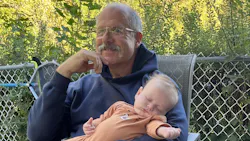
My days now include a daily exercise routine at the local gym and working a couple of part-time jobs. With the addition of my first grandchild, I’ve reached my end game. Life is definitely good!
New chapter
Retirement is a significant life transition that can be both exciting and challenging. By engaging in meaningful activities, maintaining social connections and focusing on your well-being, you can create a fulfilling and purposeful retirement. Uncertainty or feeling a bit lost is a normal part of the path to fulfillment in retirement. Embrace this new chapter as an opportunity for growth and exploration. Take the time to reconnect with your loved ones; remember, they’ve built a life, too, and this adjustment will be just as big for them as it is for you.
Having an end game—a clear vision for your post-fire service life—is just as essential as preparing for any emergency call. It shouldn’t just mark an ending; it should celebrate a life of commitment while opening a new chapter of growth and fulfillment.
If you haven’t thought of it yet, what will your end game be? I encourage you to start to figure that out today.
About the Author
 Paul Parker Jr.
Paul Parker Jr.
Paul R. Parker Jr. has spent more than 40 years in the fire service. He recently retired as the assistant fire chief of Stratton Air National Guard Base in Scotia, NY. Parker also is a past chief and life member of the Round Lake Volunteer Fire Department in Saratoga County, NY. He is the regional representative of Saratoga County and sits on the Volunteer Fire Chief’s Committee for the New York State Association of Fire Chiefs. Parker holds an associate degree in fire protection and Fire Officer III, Fire Instructor III and Incident Safety Officer certifications.