Changing Threats to Firefighters Eyed in New Life Safety Initiatives
"Our vision is clear: to foster a culture where every firefighter’s safety and well-being are prioritized at every level, from the fireground to the halls of government. We know that firefighting will always carry risk, but we are united in our conviction that the highest risks should only be taken when another life hangs in the balance."
That's how NFFF Chief Executive Officer Victor Stagnaro described the methodology in the Firefighter Life Safety Initiatives Matrix developed by a myriad of fire service personnel and subject matter experts who gathered in St. Louis last summer.
In addition to initiatives, the group established a matrix, "a strategic, integrated framework designed to be both adaptable and enduring."
The four pillars include Survival Culture and Leadership, Health and Wellness, Training and Competency, and Government and Community.
"Each pillar reflects a core dimension of firefighter safety, and together, they form a holistic approach that recognizes the interconnectedness of our work."
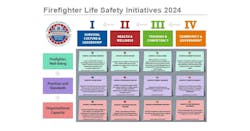
Authors explained the perspectives include:
- Firefighter Well-Being:
Ensuring all efforts converge on directly supporting firefighter well-being, health, safety, and resilience. - Practices and Standards:
Adoption and implementation of evidence-based practices, national standards, and continuous improvement. - Organizational Capacity:
The ability of departments to sustain safety initiatives through leadership, resources, and policies.
The 16 initiatives addressing topics that affect firefighters were created during the first Firefighter Life Safety Summit in 2004 in Tampa. It was considered the guiding document to reduce firefighter injuries and deaths.
"...As every firefighter knows, the environment in which we serve is never static. The risks we face have evolved – new hazards such as lithium-ion battery fires, increasing wildland-urban interface incidents, and complex building systems now challenge our traditional approaches. Advances in science have illuminated the profound impact of mental health, stress, and occupational exposure," authors wrote in the recent report.
The new initiatives developed in St. Louis include:
• Initiative 1: Mentorship Momentum – Implement mentorship programs where experienced leaders support and guide newer firefighters in survival practices.
• Initiative 2: Leading the Way – Standardize leadership practices and protocols that promote a survival culture within fire service organization.
• Initiative 3: Leadership Evolution – Develop a leadership training program that builds the skills needed to foster a survival-oriented culture within fire service organization.
• Initiative 4: Mindful Resilience – Provide mental health resources and resilience training directly to firefighters to support their overall well-being.
• Initiative 5: Evolving Health Practices – Standardize health and wellness policies, including regular health screenings and fitness assessments.
• Initiative 6: Comprehensive Wellness Programs – Establish comprehensive wellness programs that are integrated into the daily routines of all fire departments.
• Initiative 7: Lifelong Learning – Offer ongoing education and training opportunities that are accessible to all firefighters, ensuring they stay up to date with the latest techniques and technologies.
• Initiative 8: Training and Innovation – Implement regular competency evaluations and continuous improvement programs for all firefighters.
• Initiative 9: Organizational Proficiency – Leverage innovative learning technologies to expand access to high-quality training.
• Initiative 10: Community Connection – Conduct community outreach programs that educate the public on fire safety and prevention, while also advocating for policies that support firefighter safety.
• Initiative 11: Engage the Community – Develop standardized policies and procedures for engaging with government and community stakeholders.
• Initiative 12: Forge Shareholder Partnerships – Build partnerships with governmental agencies and community organizations to support fire service initiatives.
"The NFFF and the fire service community now call on all departments, leaders, firefighters, and their communities to adopt and champion this new framework, advocate for necessary resources, and remain vigilant in promoting a culture of safety, wellness, and continuous improvement."
Officials are adamant they don't want this report to sit on shelves and simply reviewed over the coming weeks and months.Advocates will be providing action items to assist the implementation.
Also, one initiative will be featured monthly by the NFFF along with a learning platform comparable to the annual Safety Stand Down.
They also encourage feedback "to assess the effectiveness of these initiatives, which will
remain adaptable to meet the evolving needs of the fire service."
Stagnaro wrote: "Through collaboration, innovation, and an unwavering commitment to our mission, we can continue to drive down firefighter fatalities and injuries. Our work is iterative and ongoing, and it demands the engagement of every member of the fire service – from the newest recruit to the most seasoned chief."
About the Author
 Susan Nicol
Susan Nicol
News Editor
Susan Nicol is the news editor for Firehouse.com. She is a life member and active with the Brunswick Volunteer Ambulance & Rescue Company, Oxford Fire Company and Brunswick Vol. Fire Co. Susie has been an EMT in Maryland since 1976. Susie is vice-president of the Frederick County Fire/Rescue Museum. She is on the executive committee of Frederick County Volunteer Fire and Rescue Association. She also is part of the Maryland Institute for Emergency Medical Services Systems (MIEMSS) Region II EMS Council. Susie is a board member of the American Trauma Society, Maryland Division. Prior to joining the Firehouse team, she was a staff writer for The Frederick News-Post, covering fire, law enforcement, court and legislative issues.