Fort Worth, TX, Firefighters’ Workers’ Comp Claims Mostly Denied, Records Reveal
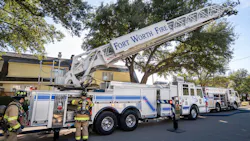
Fort Worth police and firefighters, perhaps unsurprisingly, report the highest number of on-the-job injuries of any city workers, but they also rank near the top of the list when it comes to workers’ compensation claim denials.
In fact, nearly every claim denied by the city over a more than two-year span was filed by a police or fire department employee.
A city spokesperson did not respond to a request for comment, but in a previous statement she said Fort Worth “follows the law and all regulatory guidelines related to injured/ill workers.”
Records obtained by the Star-Telegram show there were 2,402 workers’ compensation claims filed by city employees between Jan. 1, 2024, and March 17, 2026. More than half — 1,399 — were filed by police and firefighters, and nearly a quarter of those were denied.
In total, of the 384 workers’ compensation claims that were denied by the city, 341 were filed by police or firefighters.
Other city departments reporting high numbers of workers’ compensation claims included Parks and Community Services (131 workers’ compensation claims), Transportation and Public Works (97), Water (87), Code Compliance (84), Wastewater (61), Property Management (44), Public Events (25) and Municipal Courts (19).
The denial rate for Parks and Community Service workers’ compensation claims was just over 5%. It was 4% for Transportation and Public Works, 7% for Water, 8% for Code Compliance, 2% for Wastewater, 5% for Property Management, 4% for Public Events and 21% for Municipal Courts (four of 19 claims were denied).
In January, Fort Worth City Council member Charles Lauersdorf took aim at Sedgwick, the city’s workers’ compensation claims administrator, over claim denials. At the time, Lauersdorf accused Sedgwick of engaging in “bureaucratic bull---- that leaves injured firefighters and police officers fighting two battles: one on the job and one at home.”
But there appears to have been the same sort of issues under at least one previous workers’ compensation administrator before Sedgwick.
In 2015, Fort Worth police officer Jody Boday told the Star-Telegram it took more than two years and multiple claims denials before she was able to get surgery for a duty injury. The claims administrator at that time was CorVel.
When asked about Boday’s case more than a decade ago, local police and firefighter union leaders said claim denials were commonplace.
A few months after that Star-Telegram story was published, the city replaced CorVel with York Risk Services Group. Sedgwick acquired York in 2019.
Why so many denials for Fort Worth police, firefighters?
Zac Shaffer, president of the Fort Worth Professional Firefighters Association, couldn’t say exactly why the claim denial rate was so much higher for firefighters than other city employees. He and Vice President Skyler Ainesworth mentioned conditions that are covered for first responders that aren’t covered for other employees as perhaps being part of the reason.
By law, first responders have what is called “presumptive coverage” for health conditions and diseases related to the nature of their work. Covered conditions include smallpox, tuberculosis and certain respiratory illnesses, certain types of cancer, heart attack, stroke and post-traumatic stress disorder.
However, Ainesworth said the city almost always denies those types of presumptive claims, at least initially. Ainesworth and Shaffer said it’s because the city has 60 days to approve claims, and that’s often not enough time to validate a presumptive condition. After the 60 days are up, the claim is denied, and the firefighter has to start the process all over again, Shaffer said.
But Shaffer also attributed the denials to the city trying to save money. Workers’ compensation insurance is like any other kind of insurance, he said: the idea is to take in as much money as possible and pay out as little as possible. Shaffer called denials a “cost-containment” strategy.
A previous Star-Telegram report revealed police and firefighter claims have been denied because the injured employee sought treatment outside the city’s approved provider network, and Shaffer acknowledged that was a common issue.
That was the case with firefighter Caleb Halvorson, who was injured in September 2025 when a roof collapsed on him while he was battling a residential fire. It took months for the city to approve portions of Halvorson’s treatment because he and his family wanted him to use an out-of-network orthopedic surgeon.
Halvorson’s stepfather, Fort Worth firefighter Bobby Cook, previously told the Star-Telegram he believed the city’s approved providers, to a large extent, lacked the expertise to treat Halvorson’s injuries.
Fort Worth police officer Bobbie Sanchez, who was elbowed in the jaw while apprehending a suspect, told the Star-Telegram there was not a single oral surgeon in the city’s network who could treat her injuries, which delayed her recovery.
Lauersdorf told the Star-Telegram earlier this month that first responders shouldn’t necessarily be given special treatment when choosing a provider, but the city’s workers’ compensation administrators needed to understand their injuries are not your typical on-the-job injuries.
“It should be our goal to get them back to the warrior athlete status they were before their injury in the line of duty,” Lauersdorf wrote in a text message. “They should certainly have the right to see specialists that deal with specialized injuries, not just your run-of-the-mill provider.”
Is Fort Worth’s medical provider network sufficient?
At first glance, Fort Worth appears to have a robust network of physicians and medical professionals. According to the city’s website, there are approximately 2,300 approved workers’ compensation medical providers in Tarrant County (not counting pharmacists, dentists and radiologists). But when you whittle down that list, removing duplicate names, you’re left with only around 600 providers. And not all of that information is up to date.
For example, on doctor is listed as working at a CareNow clinic in Fort Worth, but that’s not accurate. Another is listed as practicing out of a Concentra clinic in Arlington, but a receptionist at that location couldn’t recall anyone by that name ever working there.
And a chiropractor still shows up on the list even though the clinic he works at, Southwest Sports and Spine, was dropped from the city’s provider network last year. The address associated with the chiropractor on the city’s website is for a clinic that closed years ago.
In a statement previously provided to the Star-Telegram, a city spokesperson said Fort Worth “offers a variety of in-network providers covering numerous practice areas and locations. The city also partners, through direct contracting, with specialized providers if deemed medically necessary.”
The spokesperson did not immediately respond when asked how often the city vets its provider network for accuracy.
©2026 Fort Worth Star-Telegram. Visit star-telegram.com. Distributed by Tribune Content Agency, LLC.