Tracker Receivers Unused in Ship Search for Missing Newark, NJ, Firefighters
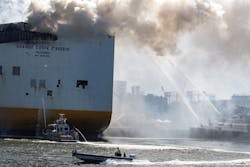
They searched for what seemed like an eternity.
Rescue teams inched their way forward in total darkness, unable to see much of anything inside the smoke-filled freighter as they desperately tried to find two missing firefighters.
It was a race against the clock. Lost and disoriented amid hundreds of closely parked cars being exported to West Africa, both men were running out of air. But by the time they were discovered deep within the burning vessel in Port Newark, the two would be dead.
Throughout that desperate search, however, Augusto “Augie” Acabou and Wayne “Bear” Brooks Jr. were equipped with electronic tracking devices known as “Pak-Trackers” which should have been signaling exactly where the two men could be found.
Documents and testimony before a U.S. Coast Guard inquiry, however, reveal that no one was listening.
A report issued by the Coast Guard last week detailed a litany of mistakes that would be compounded after a fire broke out aboard the Italian-flagged Grande Costa D’Avorio in July 2023. Among the issues raised by investigators included the Newark Fire Department’s failure to deploy Pak-Tracker receivers kept in the vehicles of several battalion chiefs which might have pinpointed the location of the missing firefighters aboard the car-carrying ship.
The hi-tech electronic location devices are meant to be used by fire departments to locate trapped or missing firefighters in burning buildings. The system consists of a transmitter that is integral to the self-contained breathing apparatus, or SCBA, worn by firefighters. In also includes a handheld receiver — essentially a portable radio direction finder — able to home in on the transmitter.
The system is not unlike an electronic version of the childhood game of Hot-and-Cold, where players are told if they are “getting warmer” as they approach a hidden object, or “getting colder” when they head off in the wrong direction. In this case, the receivers might tell rescuers if they are getting closer or farther from the signal.
According to the report, witnesses who testified during hearings held by the Coast Guard and the National Transportation Safety Board in 2024 acknowledged that the Newark Fire Department had possessed three Pak-Tracker receivers.
But none were utilized during the search, investigators said. The receivers had never been taken aboard the ship.
The Coast Guard in its report said there is no way to know whether the system could have saved the men. Radio communications during the fire had been significantly hindered by the vessel’s steel structure. Dispatchers were often left unable to communicate with firefighters within the ship. In recordings of the transmissions, calls for help were broken up or never received. Teams seeking additional equipment in their efforts to free one of the trapped firefighters had to retrace their steps out of the cargo hold to make themselves heard.
But given that the Newark Fire Department had the Pak-Tracker receivers, the Coast Guard report said “it would have been reasonable to have attempted using the device” when the search for the firefighters became prolonged.
Fire officials who had testified during the hearings described limitations of the devices in high-rise fires where they were ineffective in floor to floor operations and said they were not routinely used in any response because of those limitations.
However, officials at 3M — which manufactures the tracking system — maintained that a Pak-Tracker receiver should have been able to pick up the line-of-sight radio signal from the beacons despite the difficulty of making radio transmissions out of the ship because there were no structural walls within the compartment itself.
Despite the testimony by fire department commanders during the hearings downplaying the usefulness of the system, the city officials in the wake of the Coast Guard report said it has since purchased an additional 10 Pak-Tracker receivers, which will be assigned to all ladder companies and battalion chief vehicles for rapid deployment.
The fact that the Pak-Tracker receivers in the fire department’s inventory were never considered as a rescue option as the incident at Port Newark turned tragic, though, underscored a bigger problem with the department’s response. It did not have a plan to fight a shipboard fire, according to the International Association of Fire Fighters or IAFF, which represents Newark firefighters.
“From our perspective that was our big issue. They didn’t receive proper training,” said Sean DeCrane, IAFF assistant to the general president for health and safety.
DeCrane, who served as a battalion chief for the Cleveland Fire Department, said the standard operating procedures for every fire company always need to consider the personnel required, the available equipment, and the contingencies when things go south. If a department has Pak-Trackers, he said, that should be part of the toolkit.
He said every tool has challenges. Air tanks can only perform before they run out of air. Hose lines can deliver only so much water. But whether or not Pak-Trackers should have played a role should have been set out in Newark’s operating procedures before the ship fire.
“And that’s what training does” he said. “It shows us our limitations.”
The Coast Guard in its investigation echoed many of the same findings that were part of a separate NTSB report issued this past April that was highly critical of the city.
It said the Newark Fire Department did not have a formal routine training program established for shipboard firefighting.
“Fire companies located near Port Newark did not routinely visit the port facility or go onboard cargo vessels to establish familiarity,” the Coast Guard said.
That was a problem, the report said.
“Port Newark was an expansive, busy port complex with many large vessels arriving and departing each day,” it noted. “Establishing vessel familiarization was critical for the fire companies within whose area of responsibility the port resided. Vessel familiarization should have covered, at a minimum, the vessel’s crew organization and responsibilities, structures and layout of the vessel, the vast array of machinery and fire suppression systems and equipment that can be found onboard.”
Newark Mayor Ras Baraka in a joint statement with Public Safety Director Emanuel Miranda said the city has implemented what they said “targeted operational improvements and training programs” to strengthen firefighter safety, enhance maritime incident capability, and reinforce interagency coordination at the Port of New York and New Jersey.
“As the City of Newark continues to grieve the losses of our fallen heroes, Newark Fire Captains Augusto Acabou and Wayne Brooks, Jr., who both died in the line of duty at Port Newark on July 5, 2023, our most heartfelt commitment to their memories is to ensure that such a tragic outcome never occurs again,” they said.
Those actions have included live vessel boarding exercises and tours, a ship-fire and marine firefighting awareness training program, and what they called Rapid Intervention Training, with a focus on firefighter rescue and self-rescue techniques.
In addition, the mayor and public safety director noted the purchase of the additional Pak-Tracker receivers; 137 thermal imaging cameras intended to be mounted on firefighter harnesses; four adapters known as an international shore connections, or ISC, which firefighters can use in an emergency to tie shore hydrants directly into ship standpipes to feed water lines throughout the vessel — no matter the size of the hose; and 16 large capacity air tanks to support rescue and search operations.
The NTSB, in its own findings, had also harshly criticized the city’s fire division and Newark.
Bart Barnum, the lead investigator for the NTSB, told the board the fire department was unprepared and that firefighters should never have gone down into the ship when a blaze broke out in an aging Jeep being used to push non-running vehicles onto the multi-deck “roll on-roll off” or Ro-Ro ship.
The best strategy, said Barnum, would have been to seal off the cargo hold and let the ship’s CO2 fire suppression system do its job — even with the failure of one gaping watertight door that could not be properly closed to starve the fire of oxygen. Let the CO2 system extinguish the fire, he explained.
“No one would have gone into the space and no one would have died,” he told the board.
The fire began after a 16-year-old Jeep Wrangler that appeared to be struggling as it pushed a non-running 2010 Toyota Venza up a ship ramp erupted in flames on Deck 10, according to court filings and witnesses appearing before the joint NTSB and Coast Guard hearing.
Acabou, 45, and Brooks, 49, died after commanders made a decision to send a squad of firefighters into the burning compartment in an effort to extinguish the blaze. But the dark smoke-filled compartment was nearly impossible to navigate. Both men became disoriented and ultimately ran out of air, one entrapped by the lashings of the vehicles in the huge cargo hold and the other lost in a maze of tightly parked cars and trucks in a far end of the parking garage-like deck.
One exhibit entered into evidence during the hearings offered a grim testament to the difficulty in locating the men. Firefighters laid out a fire hose when Brooks and Acabou first made their way onto Deck 10 from a port stairway. That hose led rescuers to the burned-out Jeep.
The rescue party then stretched out a rope line, tying it off on the Jeep’s bumper, and continued their search before coming upon Acabou. He was discovered wedged between an SUV and light truck, about 100 feet from the stairwell where he and Brooks entered the compartment with other firefighters seeking to track down the source of the fire.
Mutual aid squads from Jersey City and the Fire Department of New York stretched out additional rope lines further into the compartment to continue the search for Brooks. They came across his flashlight and, further away, his helmet.
His body was found more than 200 feet from the port stairwell, but not far from an escape trunk that could have led him to safety had he known it was there.
“While it will never truly be known what happened to (Acabou and Brooks) while trying to exit Deck 10, the evidence suggests they became disoriented, lost track of the hose, and attempted to follow the line of cargo vehicles they believed would take them back to the ladder well from which they originally entered,” said the Coast Guard in its report. “Unfortunately, they instead followed the vehicle line the opposite direction further into the space.”
The families of two firefighters who perished have filed a $50 million wrongful death complaint in federal court charging that negligence, carelessness and recklessness on the part of the city, the owners of the ship, and others led to the untimely deaths of the men.
The lawsuit alleges that Newark failed to properly train and equip the firefighters to deal with the dangerous conditions they faced aboard the Grande Costa d’Avorio. It also alleged its owners, Grimaldi Deep Sea of Naples, Italy, operated the ship in an “unreasonably dangerous and unseaworthy condition.”
Mark A. Apostolos, an attorney for the families, said the Coast Guard’s report further reinforced that the events that led to the deaths of firefighters Acabou and Brooks were preventable, caused by the negligence and failures of the shoreside personnel, the ship and her crew, and the Newark Fire Department.
He noted the tragedy began with the misuse of the Jeep that caused the fire, followed by the vessel’s crew’s inability to extinguish the fire. It concluded with “the complete lack of training and equipping to fight a shipboard fire by the Newark Fire Department,” he said.
As to the Pak-Trackers, Apostolos said all firefighters, especially those required to board a vessel to fight a fire, “should be equipped with every lifesaving device available.”
©2026 Advance Local Media LLC. Visit nj.com. Distributed by Tribune Content Agency, LLC.