Redefining Fire Streams: Precision, Performance, and the Next Evolution in Nozzle Technology
Key Highlights
- FLEX Series improves reach, penetration, and overall fireground effectiveness.
- FLEX Series enables adjustable flow without compromising stream quality or performance.
- BLADE pattern enhances cooling, coverage, and control without thermal disruption.
- Dual-purpose design supports both structural and wildland firefighting operations.
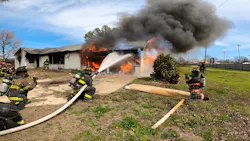

In the modern fire service, few tools are as fundamental—or as scrutinized—as the fire nozzle. For decades, the combination fog nozzle has been the default selection for many departments, valued for its perceived versatility. Yet, as fire behavior understanding has evolved and data-driven tactics have become the standard, so too has the scrutiny of traditional equipment. Increasingly, firefighters and fire officers are reexamining whether legacy nozzle technology truly aligns with today’s operational realities.
At the center of this conversation is a fundamental question: Are we maximizing the effectiveness of every gallon delivered to the fire?
The Operational Challenge
In both structural and wildland firefighting, the limitations of combination fog nozzles have become more apparent under real-world conditions.
In structural environments, fog patterns, particularly when improperly applied, can disrupt thermal balance within a compartment. The introduction of finely atomized water into superheated atmospheres often results in excessive steam production, reducing visibility and increasing the risk of steam burns to interior crews. Additionally, the wide dispersion of water can disturb the thermal layer, pushing heat and unburned gases back toward firefighters and potentially contributing to fire spread.
From a mechanical standpoint, these nozzles frequently require operating pressures around 75-100 psi, generating significant nozzle reaction. This creates a physically demanding environment for nozzle operators, often leading to fatigue, reduced flow rates, or premature shutdown during critical fire attack phases.
In wildland firefighting, the challenges shift but remain equally consequential. Fine droplets produced by fog nozzles are highly susceptible to wind and thermal updrafts, often evaporating before reaching the fuel. This reduces cooling efficiency and limits the ability to achieve effective knockdown. Additionally, the complexity of combination nozzles introduces reliability concerns in harsh environments, where debris from natural water sources can clog internal components and degrade performance.
Across both disciplines, the common denominator is inefficiency; water that fails to reach, penetrate, or effectively cool the seat of the fire.
A Return to Fundamentals—With Modern Innovation
The fire service has long recognized the inherent advantages of smoothbore nozzles. Their ability to deliver a solid, cohesive stream provides superior reach, deeper penetration, and reduced nozzle reaction due to lower operating pressures—typically in the 45–50 psi range.
In structural firefighting, this translates to more effective application on deep-seated fires, improved crew mobility, and reduced disruption of the thermal environment. The solid stream minimizes steam production while maintaining visibility and tenability for interior crews.
In wildland applications, the advantages are equally compelling. Larger water droplets are less affected by wind and heat, allowing more water to reach the target fuels. The simplicity of smoothbore design, absent of internal moving parts, enhances durability, reduces maintenance requirements, and significantly lowers the risk of clogging when drafting from untreated sources.
Despite these advantages, traditional smoothbore nozzles have historically lacked one key feature: adaptability. Fixed orifice sizes limit operational flexibility, requiring crews to change tips or lines to adjust flow; an impractical solution in dynamic fireground conditions.
Introducing the Next Generation: The FLEX Series
HEN Technologies has addressed this longstanding gap with the introduction of the FLEX Series—the world’s first select gallonage smoothbore nozzle engineered for both structural and wildland firefighting.
This innovation represents a significant advancement in nozzle design, merging the proven performance of smoothbore streams with the adaptability modern fireground operations demand.
At the core of the FLEX Series is the ability to adjust flow seamlessly without sacrificing stream quality. For structural firefighting, the nozzle allows operators to flow between 175 and 250 gallons per minute with a simple quarter turn. This capability enables firefighters to match fire flow to evolving conditions without interrupting operations or changing equipment.
Operating at a low 45 psi nozzle pressure, the FLEX Series significantly reduces nozzle reaction, improving handling, minimizing fatigue, and enhancing overall crew effectiveness during interior attack.
The BLADE Pattern: Expanding Tactical Capability
A defining feature of HEN Technologies’ innovation is its patented BLADE pattern; a unique stream option that complements the traditional solid bore.
The BLADE pattern is engineered to deliver the “3 C’s” critical to effective suppression: cooling, coverage, and contraction. Unlike conventional fog patterns, it achieves broader coverage without producing excessive steam or disrupting the thermal layer. This allows firefighters to maintain control of the environment while applying water more efficiently across surfaces.
The integration of both a solid stream and the BLADE pattern within a single nozzle provides a level of tactical versatility previously unavailable in smoothbore technology. Firefighters can transition between penetration and coverage instantly, aligning stream characteristics with specific fireground objectives.
A Dual-Purpose Solution for Structural and Wildland Operations
Beyond structural applications, the FLEX Series extends its innovation into wildland firefighting with a dedicated select gallonage model.
This version allows operators to select flows of 15, 30, or 45 gallons per minute—again, with a simple adjustment—enabling precise water management in environments where supply is often limited. Whether establishing a wet line, conducting mop-up operations, or engaging active fire fronts in the wildland-urban interface (WUI), firefighters can tailor their flow to match the mission.
The result is improved water conservation, reduced refill times, and extended operational duration; critical advantages in remote or resource-constrained incidents.
As in its structural counterpart, the wildland FLEX nozzle maintains the durability and reliability inherent to smoothbore design. Its resistance to clogging and minimal maintenance requirements make it particularly well-suited for demanding field conditions.
Performance Backed by Real-World Application
The evolution of fire stream technology is not driven by theory alone. Field evaluations and comparative testing continue to reinforce the effectiveness of solid-stream applications across a range of scenarios. Industry analysis, including evaluations published in leading fire service platforms, highlights the importance of stream reach, droplet size, and application efficiency in both structural and wildland firefighting.
These findings align with what many firefighters have observed firsthand: when water is delivered more effectively, fires are controlled more quickly, exposure is reduced, and overall safety is improved.
Conclusion: Advancing the Fireground
The fire service is built on a foundation of tradition, but it is sustained by a commitment to continuous improvement. As fire behavior becomes more complex and operational demands increase, the tools firefighters rely on must evolve accordingly.
HEN Technologies’ FLEX Series represents a meaningful step forward; combining the reliability and performance of smoothbore nozzles with the flexibility required for modern firefighting. By addressing longstanding inefficiencies in traditional nozzle design, it empowers firefighters to operate with greater precision, adaptability, and confidence.
Ultimately, the goal remains unchanged: deliver water where it matters most, as effectively as possible, to protect lives and property. With innovations like the FLEX Series and the integration of the BLADE pattern, the fire service moves closer to achieving that objective—one stream at a time.
Authors:
Alex Cummings (Firefighter at Enola Fire & Rescue)
Jason Floyd (Retired Battalion Chief at Las Cruces Fire Department)
Eric Guida (Retired Captain at Sacramento Fire Department)
Ryan Kostel (Retired Captain Florissant Valley Fire Protection District)