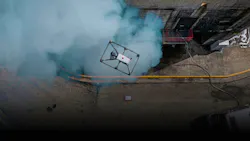

Emergency response has always depended on good information. The faster incident commanders can understand what is happening, where the risks are, and how conditions are changing, the better they can protect responders and the public. That is why unmanned aircraft systems have become more common in fire, rescue, and hazardous materials operations.
But not every agency needs a traditional drone program for every mission. In many cases, what responders need most is not a drone that can fly long distances. They need a reliable elevated view that can be deployed quickly, stay in the air for hours, and provide live visual and thermal information to command. That is where tethered drone systems like Fotokite offer a practical advantage.
Fotokite is best understood as a persistent aerial command camera. The aircraft is connected to a ground station by a tether that provides power and data. This means the system is physically limited in where it can fly, but it gains important advantages in endurance, reliability, and ease of use. Instead of launching a battery-powered drone, assigning a pilot, managing flight time, and landing for battery swaps, teams can deploy a tethered system to provide continuous overwatch from a fixed location.
For fire departments, the most obvious use is incident scene visibility. A tethered drone can provide command with an elevated view of roof conditions, exposures, apparatus placement, hose lines, smoke movement, collapse zones, and changing fire behavior. Thermal imaging can help identify heat signatures, hot spots, extension, and areas that may need closer attention during overhaul. This type of view is especially valuable because incident commanders are often limited to what they can see from one side of a structure or from ground level.
Does the Value Extend Beyond Structure Fires?
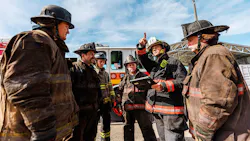
For search and rescue teams, a tethered drone can support operations from a base camp, trailhead, riverbank, or last-known-point location by giving crews a stable overhead view of the area around them. In HazMat response, it can help teams observe scene conditions from a safer distance, such as monitoring an exclusion zone, watching decontamination flow, or keeping an eye on visible plume movement and runoff concerns. Technical rescue teams can use the same elevated perspective during trench, collapse, high-angle, industrial, or water rescue incidents, where command needs to understand crew movement, hazard zones, access points, and equipment placement. Even outside major emergencies, departments can use tethered drones for traffic incidents, large public events, storm response, training exercises, and after-action reviews. In each case, the benefit is the same: responders get a clearer view of a complex scene without pulling people away from critical assignments.
The Limitations Are Real, But Manageable
Of course, tethered drones have their limitations. The biggest is mobility. A Fotokite-type system cannot fly blocks away, map a large wildfire perimeter, follow a moving subject across a wide area, or inspect a structure from every angle. The tether is both the strength and the constraint. It provides endurance and a secure power/data connection, but it anchors the aircraft to the vehicle or ground station.
Placement also matters. Responders need to consider trees, utility lines, building overhangs, ladders, apparatus movement, hose lines, and personnel working around the scene. A tethered drone may be simple to operate, but it still needs thoughtful deployment and department SOPs.
Cost can be another concern. Compared with consumer or prosumer drones, a public-safety tethered system may look expensive. Agencies have to evaluate whether the benefits justify the investment. For some departments, especially those that already have trained pilots and an established drone program, a free-flying drone may be the better first purchase. For others, the easier deployment, long-duration operation, thermal capability, and reduced staffing burden can make the investment easier to justify.
There are also policy considerations. Agencies still need guidance for when the system is deployed, who monitors the feed, how recordings are stored, how video is shared, and how privacy concerns are handled. Tethered systems may simplify some operational challenges, but they do not eliminate the need for responsible governance.
So why would responders accept those downsides? Because the benefits solve a real problem: getting eyes above the scene quickly and keeping them there. Many departments do not need every aerial tool to fly miles away. They need a dependable overhead view during the incidents they respond to every day. If a tethered drone can launch quickly, remain in place for extended operations, provide thermal and visual intelligence, and reduce the need for a dedicated pilot, then the tradeoff becomes worthwhile.
The most successful agencies will likely view Fotokite not as a replacement for every drone, but as a specialized incident command tool. Free-flying drones are excellent for mapping, searching large areas, and mobile inspection. Tethered drones are excellent for persistent overwatch, command visibility, and extended scene monitoring. Used correctly, they complement each other.
For fire, rescue, and HazMat teams evaluating this technology, procurement can be just as important as capability. Departments need equipment that fits their mission, budget, grant requirements, training needs, and purchasing process. Safeware is a strong resource for agencies looking to simplify that path. As a trusted public-safety procurement partner, Safeware can help departments access Fotokite solutions through established purchasing channels, while also supporting broader equipment needs across fire, rescue, HazMat, and emergency response.
In the end, Fotokite and tethered drones are not about chasing technology for its own sake. They are about giving responders better information, faster. When command has a clearer view of the incident, teams can make safer decisions, allocate resources more effectively, and stay ahead of changing conditions. That is why this technology deserves serious consideration across the fire, rescue, and HazMat communities.
About Safeware, Inc.: Safeware is a leading provider of safety solutions, specializing in assessing, distributing, and training advanced technologies to mitigate risks and enhance safety across various industries. With a commitment to innovation, quality, and customer satisfaction, Safeware remains at the forefront of safety excellence, empowering organizations to protect lives, assets, and the environment. Learn more about Safeware and Fotokite at www.safewareinc.com