Diesel Exhaust Exposure Inside Fire Stations
Key Highlights
- Diesel exhaust can remain in the station air after apparatus operations.
- Airborne contaminants can move beyond apparatus bays into living areas.
- Diesel exhaust is classified as a Group 1 carcinogen linked to cancer.
- Source-capture and air purification systems help reduce exposure risks.

When the engine is back in its stall, the call may be over, but a less visible but equally serious threat lingers: airborne toxins within the fire station. As firefighters spend extended periods inside the station during each shift these toxins add to the overall health risks that firefighters could face throughout their careers. Ensuring proper filtration is an important step departments can take to protect them from toxic particulates in the areas where they train, work, and rest.
Diesel fumes can travel throughout the station and according to The International Agency for Research on Cancer (IARC) are classifies diesel engine exhaust as a Group 1 carcinogen and links it to lung cancer, with positive associations to bladder cancer.
Because of these risks, protecting fire departments from diesel exhaust by capturing it at the source is a priority for many departments. MagneGrip delivers fully integrated clean air solutions to protect firefighter health by combining source-capture exhaust removal with air purification systems that continuously improve the quality of the air circulating throughout the station.
Source-Capture Exhaust Removal Systems
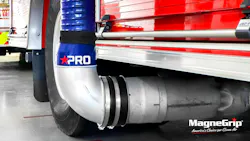
MagneGrip with the Straight Suction Rail (SSR) System and Pro Nozzle setup provides 100% diesel exhaust capture at the source, using flex-magnet technology for a seal from any angle, reducing strain and streamlining response times. Designed for high-use, space-conscious stations, the system features automatic fan activation, a durable lifting elbow, integrates into your station’s existing HVAC system and reinforced hose support to ensure reliable, low-maintenance performance. The system captures diesel exhaust before it enters the station air, helping to reduce long-term exposure to cancer-causing particles and other airborne toxins. With both the PRO Nozzle and SSR system working simultaneously, firefighters can now operate in a significantly cleaner, safer environment.
AirHAWK Air Purification Systems
AirHAWK systems circulate station air through a multi-stage filtration process designed to capture airborne particles, gases, and other contaminants. Filtration components remove particulates, while ultraviolet treatment helps address microorganisms such as bacteria, viruses, and mold spores before purified air is returned to the facility.
Units are typically ceiling-mounted in apparatus bays, allowing them to operate without hoses or vehicle connections. This configuration avoids floor-level obstructions while enabling continuous, automatic air filtration throughout the station.
Complete Clean Air Solutions
MagneGrip delivers fully integrated clean air solutions by combining:
- Source-capture exhaust removal systems
- AirHAWK air purification systems
- Real-time air quality monitoring
Source-capture exhaust removal systems address diesel emissions directly at the tailpipe during apparatus operation. Air purification systems help reduce airborne contaminants that remain inside the station environment afterward.
Together, these technologies form MagneGrip’s Complete Clean Air Solutions, designed to support firefighter health and operational readiness.
For more information about MagneGrip products or get no-cost grant assistance, visit magnegrip.com/no-cost-grant-assistance or call 1-800-875-5440.