Commercial Structure Fires Demand a Different Nozzle Conversation
Key Highlights
- Modern commercial fires burn faster, hotter, and become ventilation-limited earlier.
- Large commercial layouts expose critical limitations in traditional nozzle designs.
- Smoothbore streams provide penetration, but increase firefighter workload and fatigue.
- Fog nozzles improve cooling but can disrupt thermal balance in large structures.
- Emerging nozzle technologies combine penetration, cooling, coverage, and contraction of gases.
The Modern Commercial Fire Environment
Modern commercial fires are no longer fought under the same conditions that shaped many of the fire service’s traditional tactics. Research from organizations like UL Fire Safety Research Institute has repeatedly demonstrated that today’s fireground is faster, hotter, more ventilation-sensitive, and far less forgiving than the commercial environments firefighters faced decades ago.
Synthetic fuel loads, lightweight construction, tightly sealed buildings, and massive open floor plans have fundamentally changed fire behavior. Fires now reach critical heat release rates faster, transition to ventilation-limited conditions earlier, and conceal dangerous thermal conditions in overhead spaces long before crews fully recognize the threat.
In warehouses and large retail spaces, firefighters often encounter a dangerous illusion of safety. Smoke may bank high overhead while lower levels remain relatively clear, masking extreme heat and rapidly deteriorating conditions above the nozzle team.
High vertical storage racks , palletized goods, and expansive layouts also create significant water-mapping deficiencies, where traditional fire streams struggle to effectively reach the seat of the fire.
As these environments continue evolving, the fire service is being forced to reevaluate one of its most important tactical tools: the nozzle.
The Traditional Debate: Smoothbore vs. Fog Nozzle
For decades, nozzle selection has been centered around two primary options — smoothbores and fog nozzles. Both remain respected because each offers distinct operational advantages. However, modern commercial fire behavior has exposed critical limitations in both designs.
Smoothbore nozzles remain highly effective for commercial interior attack because they deliver a solid, high-mass stream capable of deep penetration and exceptional reach. In large commercial buildings with long stretches, high ceilings, and heavy fuel loads, the ability to place water directly onto burning materials from a safe stand-off distance is critical.
Their lower operating pressures reduce nozzle reaction and help crews advance long hoselines through challenging environments. Smoothbores also avoid many of the air entrainment problems associated with fog patterns. Rather than disrupting thermal balance or pushing heat and smoke toward firefighters, the solid stream maintains better environmental stability while preserving visibility.
However, traditional smoothbores are not without weaknesses.
The narrow stream profile limits overall coverage and gas cooling capability, creating a smaller footprint of extinguishment. To compensate, nozzle teams often work aggressively to “paint” the environment with rapid stream movements to achieve broader cooling and suppression. That workload accumulates quickly. Fatigue increases. Air consumption rises. Crews become exhausted sooner, reducing operational time inside the structure.
Fog nozzles approach suppression from a completely different philosophy.
By breaking water into smaller droplets, fog streams dramatically increase surface area, allowing for rapid heat absorption and cooling. Fog patterns can cool upper thermal layers, provide exposure protection, and generate steam conversion capable of suppressing combustion in semi-confined spaces. Combination fog nozzles also offer versatility, allowing firefighters to shift from wide-angle protection to narrow straight-stream application.
Yet the same characteristics that make fog nozzles effective in certain environments can become liabilities in large commercial structures.
Wide fog patterns entrain large amounts of air, disrupting thermal layers and pushing heat, smoke, and fire conditions toward advancing crews and potentially uninvolved spaces. Fine droplets frequently evaporate before reaching burning materials, particularly in large-volume fires with significant heat overhead.
In some cases, firefighters experience a false sense of suppression while the core fire remains largely unaffected beneath the thermal layer.
For years, the fire service has approached nozzle selection as a compromise: penetration or coverage, reach or cooling, smoothbore or fog.
But modern commercial fires demand both.
A Different Approach to Water Application
Today’s crews need streams capable of reaching deep-seated fire while simultaneously managing thermal conditions overhead. They need penetration without excessive air movement and cooling without sacrificing reach.
That is where newer nozzle technologies are beginning to reshape the conversation.
The HEN BLADE nozzle was engineered to bridge the gap between smoothbore and fog nozzles, maximizing their advantages while reducing their drawbacks.
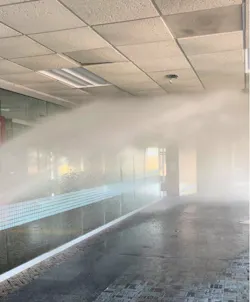
Rather than forcing firefighters to choose between a narrow solid stream or a highly atomized fog pattern, the BLADE technology creates a solid wide linear stream composed of large, high-velocity droplets.
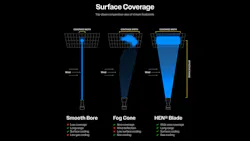
A traditional smoothbore can be compared to painting a wall with the edge of a pencil eraser — highly focused with excellent penetration, but limited overall coverage.
The BLADE stream functions more like a paint roller.
It maintains the large-droplet characteristics necessary for penetration and gas contraction while dramatically increasing the width of stream interaction.
This expanded stream profile changes the efficiency equation for nozzle teams operating in commercial occupancies.
Instead of requiring constant aggressive nozzle movement to cool and cover large areas, the BLADE stream naturally interacts with a greater volume of heated space. The wide linear pattern improves thermal layer cooling, contracts heated gases more effectively, and reduces firefighter workload during advancement.
Importantly, the droplets remain large enough to survive the hostile thermal environments commonly found in commercial structures.
Rather than evaporating prematurely like fine fog droplets, they penetrate through superheated gases and continue onto burning surfaces, improving suppression effectiveness.
In large open commercial spaces lacking compartmentation, this becomes particularly valuable. Traditional straight streams often pass through uninvolved areas without sufficiently interacting with nearby surfaces.
The BLADE stream arrives already expanded into a controlled linear pattern, allowing firefighters to cool and suppress the leading edge of the fire more consistently while supporting hoseline progression.
Cooling the Overhead Before It Overwhelms the Crew
Commercial fires are often fought beneath massive overhead heat conditions that may not initially be visible or felt by crews. Concealed overhead fire can rapidly intensify and overwhelm nozzle teams with little warning.
That reality makes early cooling and gas contraction essential survival functions — not simply suppression tactics.
The BLADE stream’s wide cooling profile allows firefighters to rapidly address overhead gas layers while simultaneously maintaining reach and penetration toward the seat of the fire.
The result is improved environmental control without sacrificing stream performance.
Equally important is the reduction in firefighter fatigue. By minimizing excessive nozzle movement and improving stream efficiency, crews conserve energy, reduce air consumption, and maintain operational effectiveness longer during extended commercial incidents.
The Future of Commercial Fire Attack
No nozzle eliminates the complexity of commercial firefighting. Tactics, training, coordination, ventilation discipline, and water application strategy will always remain the deciding factors on the fireground.
However, modern fire conditions demand modern tools.
As commercial structures continue evolving, the fire service must critically evaluate whether legacy nozzle designs alone are sufficient for today’s fire behavior.
The future likely does not belong exclusively to smoothbores or fog nozzles. It belongs to technologies capable of combining penetration, cooling, coverage, and gas management into a more effective and firefighter-centered solution.
Commercial firefighting has changed.
The nozzle conversation must change with it.