Maximizing AI to Minimize Risk When Responding to Emergencies
Key Highlights
- AI helps firefighters reach emergency scenes more safely.
- Real-time hazard detection improves awareness around emergency vehicles.
- Smart camera systems reduce blind-spot collision risk.
- AI-driven coaching supports safer driving habits and fleet performance.

Every emergency response requires a difficult balance: reaching the scene as quickly as possible while protecting firefighters, motorists, and pedestrians along the way. While emergency vehicle operators are highly trained, the challenges they face continue to grow. Congested roadways, distracted drivers, crowded urban environments, and limited visibility around large apparatus all increase the risk of a collision during a response.
According to data cited by the National Library of Medicine, an estimated 15,675 fire department vehicles were involved in traffic accidents, resulting in hundreds of firefighter injuries and multiple firefighter fatalities. Vehicle crashes remain one of the leading causes of injury and death among firefighters while on duty.
The question for fire departments is straightforward: How can emergency responders reduce roadway risk without compromising response effectiveness?
Increasingly, departments are turning to artificial intelligence (AI) and intelligent vehicle safety systems to help answer that question. These technologies are designed to provide drivers with additional awareness, earlier warnings, and actionable information that can help prevent incidents before they occur.
AI has become one of the most discussed technologies in fleet safety. While enthusiasm for its potential is growing, successful implementation requires understanding both its capabilities and its limitations. Organizations operating in regions with advanced vehicle safety regulations, particularly within the UK and European Union, have gained valuable experience deploying AI-powered safety systems in real-world conditions. These lessons provide important guidance for emergency fleets looking to adopt these technologies responsibly and effectively.
Proactively Supporting Emergency Vehicle Operators
Traditional camera systems improve visibility, but intelligent safety technologies add an additional layer of protection through real-time hazard detection. Advanced camera systems equipped with Human Form Recognition (HFR) can identify pedestrians and other vulnerable road users within designated risk zones surrounding a vehicle.
For emergency vehicles operating in crowded intersections, near schools, or around incident scenes filled with civilians, these systems can provide visual and audible alerts when someone enters a potential blind spot. This additional awareness gives operators more time to react and helps reduce the likelihood of a collision. Because image processing takes place directly within the camera, extensive additional hardware is not required.
The benefit is simple: more information at the moment when it matters most.
Enhancing Driver Training and Performance
Detecting hazards is only part of the equation. Preventing future incidents also requires helping operators continually improve their driving performance.
AI-powered dashcams can identify hazardous situations and provide real-time alerts to drivers. For example, systems can warn operators of a potential rear-end collision risk or an unsignaled lane departure, allowing corrective action before an incident occurs. Driver-facing cameras can also detect behaviors such as cellphone use, distraction, or failure to wear a seatbelt.
Beyond the immediate alert, these systems create opportunities for ongoing coaching. Video clips and event data can be automatically captured and reviewed, allowing fleet managers and department leadership to identify recurring driving behaviors and provide targeted training. By focusing coaching efforts where they will have the greatest impact, departments can strengthen driver performance, improve retention, and reinforce a culture of safety.
Improving Driver Awareness in Challenging Conditions
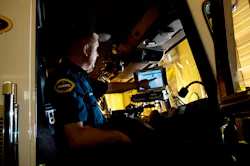
Emergency vehicle operators routinely encounter conditions that limit visibility, including severe weather, nighttime operations, congested streets, and rapidly evolving incident scenes. Large apparatus such as engines, ladder trucks, and rescue vehicles present additional visibility challenges due to their size and operating environments.
AI-enabled camera systems help address these issues by combining multiple camera views into a comprehensive 360-degree perspective around the vehicle. These systems can identify obstacles in real time, maintain visibility in low-light environments through infrared capabilities, and provide alerts that improve situational awareness.
Imagine a ladder truck navigating a crowded downtown intersection during rush hour. A pedestrian steps off the curb while approaching traffic yields to emergency lights. A smart camera system can identify that pedestrian before they enter a critical blind spot, giving the operator valuable seconds to react. In emergency response, those seconds can make a significant difference.
Future-Proofing Emergency Fleet Safety
One of the most significant advantages of intelligent vehicle safety technology is scalability. Unlike traditional hardware-only solutions, many AI-enabled systems can be enhanced through software updates, allowing departments to access new capabilities without replacing existing equipment.
- New detection models capable of identifying additional roadway hazards.
- Enhanced analytical reporting and performance dashboards.
- Improved telematics integration.
- Advanced cloud-based storage and data analysis capabilities.
This approach enables departments to continue improving safety performance while maximizing the value of existing technology investments.
Supporting Safety and Compliance Objectives
Vehicle safety technology is also playing an increasingly important role in helping fleets meet operational, regulatory, and organizational safety goals. Advanced camera systems can support documentation efforts, provide objective records for incident investigations, and contribute to broader risk management initiatives.
By maintaining accurate and auditable records, departments are better prepared to address evolving safety expectations and demonstrate a commitment to protecting employees, motorists, and vulnerable road users alike. Organizations that have experience designing systems for the stricter safety standards often found in the UK and European Union provide valuable insight into how emerging technologies can support these objectives.
Conclusion
Artificial intelligence will not replace the judgment, experience, or training of emergency vehicle operators. What it can do is provide earlier warnings, broader visibility, and better information when critical decisions must be made in seconds.
As emergency fleets become increasingly connected and intelligent, AI-powered safety technologies have the potential to reduce collisions, improve driver awareness, and support safer responses. Whether the goal is identifying vulnerable road users, improving operator training, or enhancing situational awareness, today's safety systems offer departments practical tools to better protect their people and the communities they serve.
The future of emergency vehicle safety will always rely on skilled professionals. Technologies that help those professionals see more, know more, and react sooner can play a meaningful role in ensuring crews arrive safely when communities need them most.
About the Author
Corey Heniser is CEO of Brigade Electronics, Inc., a global market leader and award-winning provider of commercial and machinery vehicle safety solutions. The company’s mission is to save lives, protect vulnerable road users and assist drivers to maneuver safely by creating high-quality products that reduce the risk of collisions and eliminate vehicle blind spots. Brigade’s product portfolio offers a range of devices suitable for OEM and aftermarket customers. These include the latest AI-enhanced 360-degree camera systems, camera monitor systems, White Sound® back up alarms, radar and ultrasonic sensors, enhanced with AI capabilities, as well as video recording devices and dashcams which are compatible with various telematics platforms, including Brigade Telematics. Brigade’s products can be integrated to suit a broad range of applications and requirements. All devices come with generous warranty periods (some lifetime), technical support and expert aftercare. For more information, visit https://brigade-inc.com.