Health Concerns Evident in 2021 Station Design Winners
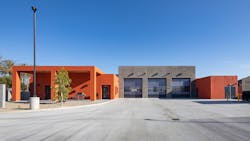
The November issue of Firehouse Magazine features every entry in the 2021 Station Design Awards. This year, 64 entries were received across the seven categories and 2021 winners begin each section.
In this year’s awards program, it was evident majority of fire departments focused on the health of personnel with the separation of areas in the stations. “Dirty” areas, in most cases, were equipped for decontamination of gear, equipment and personnel, and separated from the clean, living areas by transitional areas including airlocked hallways.
One department, Aberdeen, MD, Volunteer Fire Department House One, emphasized natural daylight in every occupiable room through the windows and clerestory dormers. In addition, the department has “one way” response paths for responders to enter clean areas after an aggressive decontamination process.
North Hays Fire Station No. 74 in Dripping Springs, TX, specifically requested their station design include natural daylight for positive mental health and black-out shades for undisturbed sleep. Comal County ESD 3 Canyon, Lake EMS & Firehouse No. 54 in New Braunfels, TX believes high-stress situations require a station to feel like home. To reduce stress in each sleeping room, red lights gradually brighten to complement adjustable-volume speakers for response calls.
Two Florida entries were specifically designed for natural disasters. Monroe County Fire Rescue Station 11 in Cudjoe Key, FL, includes sustainable practices such as hurricane-resistant glazing. The site challenge included the natural environment, which had to accommodate for sea-level rise, flooding and saltwater. In response to these challenges, the building was raised eight feet above flood plain elevation. Daytona Beach, FL, International Airport Station 17 is a Level IV essential facility and is hurricane-hardened. The fire station is LEED-certified, and all utilities have full redundancy through a backup generator.
Sustainability continues to be at the forefront along with stations being designed for their environments, but also for a station to last 50 to 75 years. Fitchburg, WI, Fire Station East’s sustainable features include geothermal heating/cooling, solar hot water, LED lighting and on-site storm-water treatment. These features also support the citywide commitment to sustainability and offer an annual utility savings of approximately $48,000. Fitchburg’s fire station also features an emergency operations center.
Emergency Operation Centers (EOC) are being incorporated into fire headquarters, law enforcement and municipal shared facilities. Newton, ME, Fire Department Headquarters’ task was to preserve and expand its 1928 fire station headquarters.
In the Shared Facilities category, the new San Rafael, CA, Public Safety Center was designed to upgrade all the city’s essential service buildings into one area. The center houses the entire police department’s operations, fire department administration, the EOC and fire station No. 51 Engine Company. The goal was to enable police and fire to best coordinate response to a major disaster.
Perhaps one of the biggest challenges to building a new emergency facility is the residents’ concern about safety and fitting into the neighborhood. Architects are frequently challenged to design an effective facility, but also design a building that fits into the local community.
Chula Vista, CA, Fire Station No. 5 is adjacent to Orange Park and the Chula Vista South Library. Design selections were in response to the community’s desire to maintain Mexican modern architectural aesthetics and create a civic campus.
In the agricultural-based town of Queen Creek, AZ, the exterior of Fire Station No. 4 draws from the surrounding community. Two features that coincide with the farm community are the impressive stone veneer and the seamed metal roof.
Another challenge architects encounter is when a fire department is set in an historic area and the new station needs to be significantly larger. The requirements for a new fire station in Raleigh, NC, were to be three times larger than the original station built in 1949. The community wanted to preserve the historic nature of the southern city, and consequently many items were salvaged from the 72-year station, including hardwood floors and the fire pole.
But wait—the most challenging station entered in 2021 was the LaPointe Emergency Services Facility in Wisconsin. The volunteer/combination station is located on an island on Lake Superior. The small community is accessible by ferry in summer and ice roads in the winter. The architectural firm which was hired not only designed but constructed the new station. Equipment and materials were transported over ferry and ice road, and there was an urgency not to interrupt summer tourist season. The facility now includes the fire, EMS and police departments.
What in the Firehouse November Station Design Awards showcase will appeal to you and your next fire station? You have 64 examples to choose from.
About the Author

Janet A. Wilmoth
Special Projects Director
Janet Wilmoth grew up in a family of firefighters in a suburb of Chicago. Wilmoth, who is owner of Wilmoth Associates, worked with Fire Chief magazine for 27 years until it closed in 2013. She currently is the project director for Firehouse, overseeing the Station Design Conference.