Cross-Laminated Timber is Reshaping Durability and Wellness in Fire Station Design
Key Takeaways
- Cross-laminated timber provides a warm, natural aesthetic that promotes firefighter comfort and reduces stress through biophilic design principles.
- Prefabricated CLT panels enable faster construction, minimizing site disruption and supporting project schedules.
- Mass timber like CLT offers predictable fire performance by forming a protective char layer, enhancing structural safety during extreme conditions.
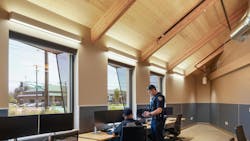
Across the country, firefighters work and sleep in buildings defined by concrete walls, harsh lighting, and small windows. These fire stations get the job done, but many feel more industrial than residential. For crews who spend a third of their lives — or more — on shift, environments like these can wear on both physical well-being and mental resilience.
On the rapidly growing northwest side of Boise, ID, city leaders wanted to build something different for their firefighters, something that felt more like a true home away from home while still meeting every operational requirement of a modern fire station. The city and Boise Fire Department partnered with the design team to create a facility that would meet performance goals but also support wellness, comfort, and long-term durability. That vision led them to a material still emerging in fire station design: cross-laminated timber (CLT).
Why CLT Entered the Conversation
The materials we use to construct fire stations have evolved as our understanding of firefighter wellness and building performance has changed. With sustainability requirements, cost predictability, and wellness-centered design rising in importance, mass timber has reemerged as a strong, natural, and resilient alternative to steel and concrete. CLT, the most versatile of the mass timber family, is particularly well suited to civic facilities like fire stations.
CLT panels are made by stacking layers of dimensional lumber in alternating directions and bonding them into large, solid panels. This crosswise arrangement gives CLT its strength, stability, and inherent fire resistance. A simple comparison is to think of CLT as oversized, structural plywood made from real lumber but performing at the scale of heavy timber and concrete.
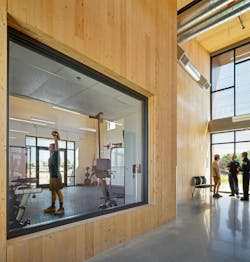
Other mass timber products, such as glulam, nail-laminated timber, and dowel-laminated timber, remain important in modern construction, but CLT stands out for its efficiency and ability to replace conventional structural systems in buildings requiring durability, long spans, and repeatable design.
Wellness and comfort in the firefighters' environment
In recent years, fire departments have increasingly emphasized design strategies that support sleep, stress management, and overall health. Fire station design has moved toward biophilic principles, integrating natural materials, daylight, and views to create environments that help regulate circadian rhythms and reduce stress. CLT supports these goals in several ways.
Wood naturally absorbs sound and reduces echo, creating gentler acoustics for crews who need restful spaces between calls. Timber also minimizes glare and brings a warm, calming visual backdrop to living and working areas. Trauma-informed design acknowledges the mental and emotional pressures that firefighters experience over long careers; CLT, with its exposed natural grain and warm tones, contributes to a sense of stability and safety.
Inside a station designed with CLT, the environment feels grounded and residential rather than industrial. This shift is not merely aesthetic, firefighters consistently report greater comfort and a stronger sense of belonging in spaces that use natural materials.
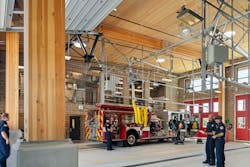
"The cross laminated timber used in the construction of Fire Station 13 has enhanced the livability and functionality of the station," Boise Division Chief of Logistics Jeremy Kircher said. "Large structural spans that are achievable with CLT support an open-concept layout that fosters connection and collaboration among crew members in the living areas as well as bringing a warmth and sense of calm to the space. During construction, the prefabricated CLT panels allowed for a faster and more efficient build, which minimized on-site disruption and helping our project stay on schedule."
CLT provides performance, strength, and sustainability
While wellness benefits matter, performance remains paramount in any fire station. CLT offers practical advantages that align closely with municipal expectations for durability, resilience, and cost control.
Fire performance: Mass timber behaves predictably under fire exposure. Instead of rapidly losing strength like unprotected steel, CLT forms a char layer on the outside while maintaining structural integrity on the inside, creating additional time and safety in extreme conditions.
Sustainability: Timber has a significantly smaller carbon footprint than concrete or steel. For cities working to meet sustainability goals or green building codes, mass timber offers measurable reductions in embodied carbon and environmental impact.
Schedule predictability: One of CLT’s most important advantages is its prefabrication. Panels are CNC-milled with openings, penetrations, and connection points before they reach the site. This reduces surprises during construction, supports clean integration between disciplines, and allows the building to be enclosed much faster than with conventional framing. Prefabrication becomes especially valuable when coordinating temporary operations, apparatus relocation, and move-in schedules.
Operational comfort: Beyond the structural and environmental benefits, CLT creates a noticeably more comfortable interior environment. Many people associate calm with being in nature; mass timber brings some of that same stability indoors, helping firefighters feel more centered throughout long shifts.
Planning and construction sequencing
Using CLT does require early and thorough planning. Designers, engineers, and contractors must coordinate panel sizes, logistics, and installation order with the supplier from the beginning of the project.
Material sourcing is critical. U.S. suppliers now provide competitive pricing without international tariffs, while Canadian manufacturers offer long-standing production capacity. Considerations for forest practices, transportation distance, schedule, and cost all play a role in choosing the right supplier.
For Boise Station 13, the panels arrived with factory-applied finishes and protective wrapping. This required careful handling but ensured that exposed timber remained clean and unmarred throughout construction.
CLT as structure and architecture
At Station 13, CLT serves as both the structural system and a defining architectural feature. Large roof and wall panels form a durable enclosure while leaving the natural wood exposed on the interior. Two CLT walls shape the main entry sequence, and throughout the station, the material enhances acoustics, resilience, and comfort.
The design team prioritized longevity, anticipating that the exposed timber would develop a natural patina over time, aging gracefully rather than showing wear. This approach supports long-term lifecycle durability and reduces maintenance needs compared with painted finishes.
Station 13 serves as model future stations
On June 30, 2025, the community gathered for a hose-uncoupling ceremony to officially open Boise Fire Station 13. The completed station demonstrates that mass timber is not a stylistic trend, it is a strategic choice grounded in durability, cost stewardship, performance, and the long-term health of the people who serve the community.
For Pivot North Architecture, Station 13 affirms that mass timber is a practical and scalable solution for future fire and EMS facilities. As more departments recognize the connection between station design, recruitment, retention, and crew wellness, CLT offers a clear path forward. It is a system strong enough for the job, warm enough to elevate the daily environment, and efficient enough to meet city budgets.
About the Author
 Tad Bradley
Tad Bradley
Project Manger
Tad Bradley is a project manger for Pivot North Architecture. Raised in the Adirondack Park and the Olympic village of Lake Placid, NY, Bradley has called the Rocky Mountains home for more than 28 years. After earning his Master of Architecture from Montana State University, he has pursued a life shaped by curiosity, exploring materials, craft, teaching, travel, and design with equal dedication. Bradley's architectural education continues to ground his approach to research, fabrication, presentation, and dialogue. His experience spans over a decade of university teaching, work in residential and commercial architecture, public speaking, blacksmithing apprenticeship, and a growing body of public and gallery-based sculptures and his adventures have taken him across Canada, Europe and Asia, both independently and with students. Rooted in hands-on research and material fluency, Bradley designs with a belief in the quiet power of space, light, scale, and texture to shape and awaken the human spirit. He draws inspiration from biomimicry, seeing in nature’s adaptive intelligence a model for living and designing in balance with our environment. When not in the studio or the office, he can often be found traveling with his family and three dogs, resting on mountain summits, swimming in high alpine lakes, or wandering long stretches of ocean shoreline.