Fire Station Design: Evolving the Prototype
Key Takeaways
- Despite what fire departments that are planning new stations might infer from the phrase “prototype design,” such initial plans can be evolved while the operational consistency and relative cost predictability remain.
- Although Springdale, AR, Fire Department’s Fire Station #4 sprung from a prototype design that was utilized for the development of five previous stations, the design team was capable of considering the context of how stations operate today, including the incorporation of modern alerting systems directly into construction.
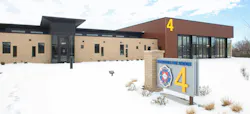
- Springdale city leadership expressed a desire for a new exterior aesthetic for Fire Station #4 compared with that of the other stations that sprung from the prototype design. Rather than completely redesigning exterior wall systems, the design team refreshed the exterior wrapping while preserving the operational efficiencies of the established framework.
For more than a decade, the conversation in northwest Arkansas has been about growth. Springdale and its neighboring communities were expanding, response boundaries were shifting, and the priority was clear: Deliver new stations efficiently, responsibly and in a way that would serve crews for decades.
A prototype approach made sense. It provided operational consistency, cost predictability and a foundation that crews could trust. However, as Mary McGrath noted in “When Prototype Fire Station Design Does and Doesn’t Work (Firehouse, March 2020), replication only works when it’s grounded in clear operational planning and when lessons learned are carried forward.
Springdale Fire Station #4, which marks the sixth station of the prototype design, represents what happens when that foundation is allowed to evolve, to create room for adjustment to operational issues, technological changes, fiscal pressures and the expanding role of regional training.
A living framework
When Springdale completed Fire Station #2 and Fire Station #3 in 2015, the focus moving forward was on operational efficiency, adaptability to different sites and cost control. Those priorities remained, but what’s changed is the context in which the stations operate today.
Today’s challenges include inflation and procurement issues, which affected construction costs; technology, including shifts in alerting and communications systems; and security concerns. Fire Station #4, which is the latest in Springdale’s lineup of fire station development, is responding to these shifts.
One example is cost control. Earlier stations revealed that certain design decisions, such as placing equipment on upper floors, carried significant upfront expenses in routing ducts and conduits to a remote location. Additionally, dryer vent routing proved more complex and costly than anticipated, and heavy apparatus bay doors contributed to unnecessary stress to building systems.
Those lessons informed Fire Station #4. Venting systems were reevaluated, and a new type of apparatus bay door system was introduced to improve longevity. For the first time in Springdale, Fire Station #4 also integrated the alerting system directly into construction, equipping the site with large-format hallway displays, updated speakers and synchronized lighting.
Each of these shifts reinforces a central principle: A prototype is only as effective as its capability to absorb change. The industry is moving in this direction, and embedding the concept at the design stage avoids costly retrofits while improving responder readiness.
Defining shift: Training center
What most clearly distinguishes Fire Station #4 from its predecessors is the deliberate integration of regional training into the facility’s core identity. Around 2020, regional fire training wasn’t driving design conversations in the same way that inflation, technology and security concerns were.
Springdale is a career department, as are its neighbors in northwest Arkansas. The region routinely brings in instructors from across the country for specialized courses. Many of those sessions are hands-on and equipment-intensive and require allocated space.
Unlike previous Springdale stations, Fire Station #4 introduces a new 30-person classroom that has a dedicated entrance, standalone bathrooms and a kitchenette. In consideration of a design to host meetings and classes without taking crews fully out of service, the community carefully selected the site to be in the middle of the city and positioned it within five minutes of the Interstate 49 corridor. This allowed crews to attend trainings while remaining centrally located and available for calls.
The design also provides the department with an additional location to host larger events, which strengthens its position as a regional resource for leadership.
A second phase of development will include a training tower and expanded drill grounds. That addition will transform the station from a response node into a training hub, to make it capable of supporting neighboring departments, including smaller communities that might not have the resources to build such infrastructure independently.
Knowledge of how to make firefighting response stronger and safer isn’t proprietary information. It’s Springdale’s philosophy that if it has the space to share useful information with surrounding departments that makes communities safer, it’s worth the investment.
Providing centralized, accessible training reduces travel burdens for on-duty crews and provides conveniently located support to departments that face staffing and training pressures. In short, Fire Station #4 was conceived not only as a building for Springdale but as a center point to conveniently provide training to all of northwest Arkansas.
Evolution in form & identity
Interestingly, the evolution of the station is visible not just in program but in appearance.
Since the completion of Fire Station #9 in 2021, city leadership expressed a desire for a new exterior aesthetic. Rather than completely redesigning exterior wall systems, the design team refreshed the exterior wrapping while preserving the operational efficiencies of the established framework. Interior finishes shifted toward warmer color palettes, updated flooring and refined furnishings. The result feels new aesthetically, without sacrificing the amenities that the local crews have come to trust. As the design team puts it, the essence of a station is its function, but the “wrapping paper” of a building can be personalized easily.
This balance, in terms of honoring operational consistency while allowing architectural expression to come forth, reinforces ownership for the community. Each station shares a lineage, but they aren’t carbon copies.
The adaptability of the framework already extended beyond Springdale. Neighboring community departments in the state have pointed to Springdale’s design, citing that the stations represent what they need for their next station. However, during the planning phase of these other projects, it frequently became apparent that they have their own challenges and benchmarks. Although each of the stations embraces elements of the Springdale prototype, the designs ultimately become their own. What worked in one jurisdiction was adapted for another, and it’s that exact flexibility that’s the mark of a working system.
The next station
There already is a new set of changes Springdale is embracing with Fire Station #10 under construction. Thanks to the protype model and end-user feedback, new strategies not only can be implemented for the next design but also implemented into current ones. Fire Station #4 and Fire Station #10 will be integrated into a new citywide access control system, replacing the mechanical pushbutton locks that previously were used by the Springdale Fire Department (SFD) and improving security. Solar control glazing also is being introduced in key locations after earlier stations experienced interior finish discoloration and flooring degradation from sustained sun exposure.
Mechanical systems are being updated, too. Although Springdale has used variable refrigerant control (VRF) systems to provide individualized bedroom temperature control, prior specifications resulted in ongoing maintenance challenges. Fire Station #4 and Fire Station #10 incorporate a newer VRF system that offers improved reliability, better thermal comfort and a more compact ceiling profile, which reduces long-term maintenance strain while improving performance.
Continuous improvement
Springdale’s experience shows that a prototype is a commitment to continuous improvement. By treating each station as an opportunity to refine performance, integrate training and respond to real-world operational feedback, the SFD created infrastructure that grows alongside its community. In that way, Fire Station #4 isn’t just the next building in a series but proof that a living framework can strengthen both a department and the region that it serves.
The Early Bird Catches the Worm
The 2026 Station Design Conference begins Monday, May 18, with the pre-conference programs. If you can arrive early, it’s worth it (The rates at the Grand Sierra Resort are incredibly reasonable!)
The popular 1-on-One program starts at 9 a.m. This is a chance to sit down with an experienced architect for an objective, third-party review of your project. Whether your project is just launching or well along, a fresh set of eyes can spot issues that you might miss.
The 1-on-One is organized by four architectural firms that are headquartered in various parts of the country. Appointments are scheduled in advance of the conference.
In recent years, the 1-on-One program expanded to include law enforcement agencies, and it fills up quickly. A separate registration is required.
Monday afternoon offers 12 additional pre-conference sessions, including:
- Ready, Set, Go! Pro Tips to Advance Your Project No Matter Where You Are in the Process. This session walks through the entire process, from early planning and design through construction and move-in. It’s practical, straightforward and focused on what to expect at each stage. A simple flowchart helps make sense of the process.
- Biophilic Design: Integrating Nature into Public Safety Design for the Well-being of Emergency Responders. It might sound like a fad, but the concept is grounded in research. Biophilic design focuses on incorporating natural light, materials and other elements into buildings to support well-being and performance. For fire stations, this can mean better lighting, improved materials and a more comfortable environment, all of which is achievable without significant cost.
About the Author
 Ashley Mauldin
Ashley Mauldin
Ashley Mauldin is director of civic projects at MBL Architecture and leads the firm’s Public Safety Division. She has 18 years of professional experience. Mauldin is married to a fourth-generation career firefighter, so her passion for emergency services design is genuine and she brings personal perspective to critical design factors, such as first responder health and wellness, building longevity and end-user satisfaction. Having completed numerous fire stations, training facilities and emergency operations facilities, Mauldin’s architectural expertise, combined with an understanding of typical fire department operations and day-to-day station life, provides a unique approach for her municipal clients.