Urban Integration of a Fire Station: Redefining Civic Infrastructure
Key Takeaways
- The development and construction of the Somerville, MA, Fire Department’s Assembly Fire Station serves as an example of how a municipality and a private owner of a property can collaborate to produce public safety facilities that can be incorporated into mixed-use projects.
- Identifying a developer for a project that incorporates a fire station into a mixed-use property is optimized when developer candidates are evaluated based on their experience with projects that combine disparate project types and familiarity with stringent technical requirements.
- The success of the creation of the Somerville Fire Department’s Assembly Fire Station was aided by collaboration between the building owner, the design team, the city and the architect to ensure that firefighting requirements as well as proper separation between uses to achieve structural independence and continuity of operation.
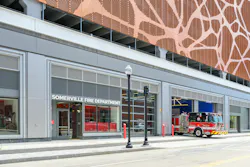
The Somerville, MA, Fire Department’s Assembly Fire Station is a prime example of how public safety buildings can be incorporated into the urban fabric of mixed-use projects. The station demonstrates a new civic building type that demonstrates collaboration between a municipality and a private owner. By inserting the station seamlessly into a new development and at the entrance of a booming new neighborhood, the firehouse reinterprets the nature of civic typologies.
Structural independence
The Assembly Square neighborhood has seen a remarkable transformation over the past decade. Named after a Ford Motor Company plant that occupied the area until 1958, the mixed-use development broke ground in 2012. The city of Somerville released a new Fire Department Strategic Plan in 2016 that recommended a new station near Assembly Square to improve response times and accommodate the burgeoning population in that part of the city. The new station would be the first for the city in almost 50 years.
Its success began with a clear statement of goals by the municipality, articulated in a Request for Proposal for a developer. In terms of identifying a developer for such a project, experience with mixed-use projects that combine disparate project types and familiarity with stringent technical requirements are key. In this case, the developer’s proposal stood out because the company developed a detailed architectural “program,” or list of rooms with related square footages, which demonstrated how the city’s desired needs would fit into the space that was allocated.
The developer provided a shell, if you will, but aspects of the shell needed to be completed as part of the fire station work. For example, the station’s floor had to be specified as a structural slab to accommodate proposed and future apparatus. Further, the initial proposal anticipated only two apparatus.
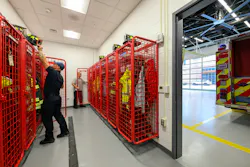
Ultimately, the city decided to provide three, which required rethinking how the third apparatus bay door would fit into the exterior design as well as efficient use of space in the interior to fit the third apparatus bay. As well, the turnout gear and decontamination rooms that were to be located at the side of the bay were moved to the rear after determining that a 48-foot-deep bay was required to fit the apparatus.
Following this was a collaborative working relationship between the building owner, its design team, the city and the architect to create a building that meets the latest requirements for firefighting and provides proper separation between uses to achieve structural independence and continuity of operation. The importance of the station, including as a 24/7 civic landmark, was expressed through a distinct identity that celebrates and welcomes the community.
Collaborative process
The opening of the station in 2025 followed a multiyear collaborative process between the city and real estate developer, BioMed Realty. It required visionary and strategic planning on behalf of the city to negotiate and obtain meaningful tenant space for the proposed station. The city asked for a minimum 4,400-sq.-ft. station. The developer responded with a proposed 10,000-sq.-ft. floor plate that could accommodate the station on the ground floor of the new Xmbly parking garage and retail space at a prominent gateway to the Assembly Square neighborhood.
“Assembly Square is a neighborhood on the rise, and a standalone site here simply wasn’t a realistic option. The costs would have been enormous,” Tom Galligani, who is executive director of the Somerville Office of Strategic Planning & Community Development, explains. “Working with BioMed Realty, we found an elegant way to deliver full fire capacity right where our residents need it most, weaving essential city services seamlessly into the fabric of one of the most exciting and fastest-growing neighborhoods in the region.”
Another key to the success of the process was a clear statement of requirements by the city, which set minimum program goals, environmental goals (including LEED Gold under LEED version 4 for the entire development) and a street presence that would complement a newly developed neighborhood.
Despite being part of an overall building development, the new station is configured as structurally independent from the garage, achieving a higher Risk Category IV designation, including separate access, egress and building systems. This seismic and functional independence ensures continuous operation of the station in case of emergencies that might damage or disable the base building. This required more than a year of coordination meetings between the city, the architect and the developer.
Meeting Risk Category IV requirements included providing a separate, two-hour-rated roof above the fire station between the parking garage and the station. A three-hour-rated roof was provided above the station’s emergency generator. All building services (plumbing, heating and cooling, fire protection, fire alarm and electrical) are provided separately between the station and the parking garage. Electrical and transformer rooms were raised above grade by more than four feet to meet FEMA future flood elevation requirements.
Horizontal and vertical gaps that are between the parking garage and the fire station were designed to be large enough to accommodate wind and seismic drift without contact; they are finished at the exterior with expansion joints that can expand and contract while remaining watertight. Parking garage precast columns are on an approximately 48 x 60-foot grid, which provides long-span structures that can span the station or be seismically separated as needed. Separate steel brace frames provide the station with its own lateral loading system.
Civic identity
Separate in structure and function from the parking garage, the station also needed a unique identity, to engage the public and signal civic pride in both Somerville’s newest neighborhood and its first responders.
Glass apparatus bay doors that are 16 x 16 feet provide clear sightlines, daylight and a lively street presence.
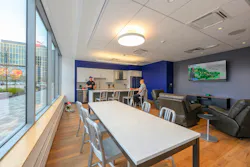
Other rooms that face the street feature expansive glazing (more than 20 feet in width) to give natural light to the dayroom, the fitness room and the patrol room. Shades provide first responders control over glare and visibility.
The extensive glazing required consideration of the interior spaces as part of the station’s civic façade. Striking blue and red graphics that feature the city seal and American flag enhance the patrol room and apparatus bay to add visual interest for pedestrians while signaling pride in the work of Somerville’s first responders.
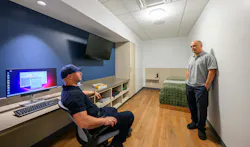
Because there are only two exterior walls to the station, the station’s interior organization was shaped by consideration for which spaces would benefit from daylighting and which spaces could be interior. All bunkrooms, including that of the captain, are away from windows to achieve equity between spaces and allow increased visual privacy and acoustic isolation. Within the apparatus bay, the turnout gear and decontamination rooms were moved to the back wall, which is shared with the parking garage. Within the living quarters, interior spaces include meeting rooms, bunkrooms, storage and the mechanical mezzanine.
Environmental sustainability
Everything that’s noted above had to be accomplished while demonstrating a commitment to the city’s sustainability goals, including the Community Climate Action Plan to electrify 50 percent of the city’s commercial buildings by 2030.
The station is Somerville’s first all-electric fire station: fossil fuel-free during normal operation, with electric water heaters, energy recovery units and an air source heat pump system. (All of this equipment is located on the 1,400-sq.-ft. mechanical mezzanine, which is placed between the living quarters and parking garage levels above.) Key to the function of providing an all-electric station with good indoor air quality was proper sizing of the louvers at the façade. Extensive coordination was needed to provide louvers that could achieve proper free area within the base building façade module. The louvers supply ventilation for the building via a 4,000-cfm, dedicated outside air system that’s located on the mezzanine.
“The Assembly Fire Station represents what’s possible when public safety, sustainability and smart urban planning come together,” Fire Chief Charles Breen says. “This station is a symbol of Somerville’s progress and commitment to its growing community. By embedding vital infrastructure like this within a mixed-use neighborhood, we’re ensuring faster response times, a stronger connection with residents and a future-ready facility that reflects the city’s values.”
Model for other cities
The architect is seeing an increasing number of public safety projects that share a building with other uses. These innovative solutions allow for creative financing and efficient use of space, existing and new structures, and utilities.
Nearby, the city of Revere is renovating its historic McKinley School into a home for city offices, a public preschool and an emergency communications center to serve three municipalities. The city and the Metro North Regional Emergency Communications Center developed a productive working relationship to see this project through. The project preserves a historic building by introducing a new addition that provides a fire wall and establishes the necessary separation of services and structural independence between the distinct uses.
Another nearby municipality is looking at options for space at the top floor of a historic fire station. Although the top floor no longer is needed as offices for the fire department, the city has looked at multiple options for transforming the abandoned rooms into tenant space. Although the work will require a separate entrance, elevator and services, that cost is offset by the elimination of deferred maintenance and increased revenue to the city.
New paradigm
Somerville’s Assembly Fire Station exemplifies how visionary collaboration between a municipality and private developers can transform public safety infrastructure into a new civic archetype that enhances urban vitality and community pride. The all-electric facility not only meets critical operational needs but also sets a replicable model for other cities.
By weaving essential services into mixed-use developments, future-ready fire stations that balance functionality, environmental stewardship and architectural distinction are achievable.
About the Author
 Justin Crane
Justin Crane
Justin Crane, FAIA, who is a principal at CambridgeSeven, has designed civic, cultural and academic projects, and his work includes new buildings as well as adaptive reuse and historic renovations, master planning and urban design. Throughout his career, Crane has led advocacy efforts, from grassroots to the national level, to forge a more ethical architectural profession and a more equitable built environment, to leverage outreach and education and bridge professionals and the public. He was awarded the American Institute of Architects’ (AIA) Young Architects Award in 2016 and elevated to the AIA College of Fellows in 2023.