Fire Departments: Don't Be Blindsided by Sustainability Requirements
Key Takeaways
- The awareness and budgeting for sustainability costs are crucial for any municipality that’s pursuing fire or EMS stations to avoid unnecessary expenses and delays.
- Electric buildings might require accommodation, such as substations, if a town’s electric grid can’t provide substantial electricity to power the 24/7 facility.
- Planning for or even investing in sustainable options for public safety facilities can help to save an agency money long term and reduce the need for additional renovations in the future to align with modern innovations.
Requirements for all-electric and Net Zero buildings affect public safety in ways that never were seen before. Well-intentioned municipal governments and environmental advocates are causing fire departments to cut functional programs from their buildings because of prioritizing sustainability over public safety. These decisions lead to dramatic effects on stations, with potential negative effects on first responders in many ways. From station renovations to new construction, public safety facilities must accommodate a growing commitment from local communities to implement all-electric, Net Zero and/or other sustainability initiatives.
Construction is expensive, so any updates to a public safety facility demands significant financial investment for the community that it serves. The growing trend toward prioritizing electrification or sustainability often can come at a significant cost for the communities that advocate for it. Public safety officials around the United States must understand these trends so as to get ahead of the curve and to incorporate them in the most effective ways, so they don’t have to sacrifice necessary program requirements in their buildings. The goal is to balance the needs of the fire department and sustainable initiatives that are set out by government officials who might not understand what these stations truly need.
Three New England stations experienced unexpected hurdles and steep expenses because of their community’s newfound commitment to sustainability goals. There are clear lessons in each example that are transferable to every community in the country. City council members voted for each building in Cambridge, MA, to be all-electric, Net Zero and fossil fuel-free just prior to planned renovations of the city’s fire headquarters. From this project as well as a Net Zero public safety facility in Exeter, NH, two fire stations in Chelmsford, MA, and numerous others that are in development, widespread commitment to sustainability is having unforeseen effects on first responders. What’s below examines how a few New England communities overcame these challenges in the development of their project.
A city that outlaws fossil fuels
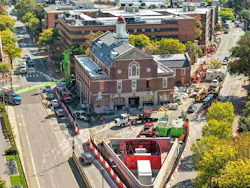
After mandating that all of its new nonresidential construction projects must be completely electric, fossil fuel-free and Net Zero, the city of Cambridge faced unexpected challenges as it worked to renovate its 100-year-old, 35,000-sq.-ft, historic fire department headquarters building. As a start, Eversource, which is Cambridge’s local energy provider, was unable to provide adequate power for an all-electric building of this size that operates 24/7. Further, to achieve Net Zero, insulating a masonry structure of this vintage would require deep specialty knowledge so as to not cause future damage to the building envelope.
To solve the issue of lack of available electricity, the local power authority required a full substation to be built on headquarters property. Not only did this take parking away from firefighters, it also cost the city a significant unplanned expense (in the realm of a few million dollars in unplanned costs because of deeper excavations, concrete area wells and new site drainage patterns) and had the potential to be a wrapped-in-chain-link-fence eyesore.
The solution was careful conversations with the city to help officials to understand the limits of what’s possible from the utility companies, what was available for space on the limited parcel of land and how to make the chain link problem go away. The solution to the latter was to wrap the power plant in a decorative red steel enclosure that echoes the coverage area of the department.
Additional measures to meet sustainability initiatives included the installation of a new slate roof that supports 85 solar panels that produce more than 43,000 kWh/year as well as 22 separate geothermal bores that are scattered around the super-small urban site.
One big lesson learned is that anytime that an agency recommends or requires an all-electric building, it must engage a design team very early. This is necessary to size a building, develop conceptual electrical loads and engage utility companies as soon as possible. This allows an agency to get ahead of problems, such as needing additional substations to generate power or larger transformers and related items. All of these have significant costs, and if those costs aren’t planned as part of early studies, the budget can get out of control very quickly.
The city’s impressive commitment to sustainability advances this fire headquarters to lead the city’s vibrant legacy but demonstrates how experience and creative design solutions are required to support strict sustainability guidelines that are necessary for the modernization of any fire department facility, historic or otherwise.
Community mandates Net Zero
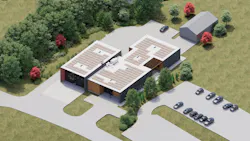
Throughout a series of town meetings, the residents of Exeter agreed that a new combined public safety facility was required. The previous architect prepared a design study, a needs list (program) was put together, and a proposed building was presented for funding. During voting for the funding, townspeople made it clear that the only way that funding would pass is if the building were all-electric and Net Zero, a requirement that clearly was unplanned. The funding passed but without the necessary increase for the sustainability measures.
As a creative solution to this issue, the public safety facility program had to be cut significantly, and the shape and size of the building had to be simplified. That said, it was a stretch to redesign the project to meet these unforeseen stringent demands. What originally was designed as multiple volumes put together with high-pitched roofs had to be redesigned to a simple rectangle-shaped building that has a flat roof. Because flat roofs are much less expensive than pitched roofs, the project was able to be brought into budget.
A major step toward reducing the community’s carbon footprint in the future, Exeter’s Net Zero combined public safety facility demonstrates the ways that innovative solutions are necessary to facilitate projects with unexpected sustainability requirements. If additional funding was provided, drastic cuts to the building and program wouldn’t have taken place.
A tale of two stations
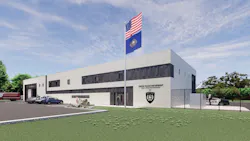
In Chelmsford, two 1960s-era fire stations needed to be replaced. State of Massachusetts energy code now requires buildings to be “all-electric ready,” which means gas heat canbe used, but the electrical service nevertheless must be twice the size. Solar panel-ready is another code requirement, and using solar power would augment an all-electric facility.
The community was interested in installing solar panels and geothermal wells to use the earth’s temperature to heat and cool the building. Neither of these were affordable when the projects initially were funded.
Rather than compromising its sustainability goals in favor of lowering the price tag for both facilities, Chelmsford applied for a federal grant to incorporate geothermal well and photovoltaic (PV) systems. In response to the community’s determination to prioritize a long-term sustainable approach, the town ultimately was awarded a $1 million state grant for fire station decarbonization and a federal grant from the U.S. Department of Energy Resources Green Communities Division. Supporting Chelmsford as a climate leader, this funding will facilitate the installation of solar PV at both stations and ground-source heat pumps that provide a low-carbon temperature control for Station 3.
In all cases of “decarbonization” of fire facilities, special discussions about diesel- or gasoline-driven emergency generators must ensue. Regulators that mandate fossil fuel-free must understand that emergency services can’t be provided if the electricity goes out in a storm. Fossil fuels must be incorporated as the only reliable back up for a 24/7, life-critical facility.
For example, major storms or blizzards that hit the East Coast in February 2026 knocked out electrical power in many communities for close to a week. Generators kicked in to power each building, and roads were clear enough for deliveries of fuel to keep them operational. Power-damaging storms such as these aren’t uncommon in many areas of the country, and if not for gasoline or diesel generators, the capability to provide emergency services would be out of commission. With each storm comes increased 9-1-1 call volume, and the last thing that’s needed is for dispatch to be offline. E9-1-1 call centers normally have two generators, one as backup to grid power, and the second as backup to the first generator. This belt-and-suspenders approach confirms continued safety for all that are involved and the wider community as a whole.
Invest in sustainable stations
It’s become clear that as communities across the United States push for some level of sustainability, public safety officials and their architects must know how to navigate all of the complexities that are involved, so the budgets ultimately are prepared appropriately up front and drastic cuts or expensive equipment needn’t be added to the project at the wrong time. Sustainability requirements demand outside-of-the-box, informed and cost-effective solutions to meet the needs of the community and to prevent unnecessary interruptions to the development of new stations. As municipalities envision their community goals for the next several decades, the expense of opting for electric buildings and sustainable features is becoming a universal standard. All departments must be informed and equipped to adapt to these changes and ensure that the changes don’t halt projects in their tracks.
About the Author
 Theodore Galante
Theodore Galante
Theodore (Ted) Galante has designed fire, EMS and police facilities for 35 years and leads all station design projects at The Galante Architecture Studio. His 30-person-strong firm has designed public safety buildings for communities large and small, including FDNY and the Boston Fire Department. Its station design work has received numerous awards and is included in design excellence books and other publications. Galante holds a master’s degree and a bachelor’s in architecture. He is registered at the national level (NCARB) and is licensed to practice in numerous states. Galante has been a professor of architecture, a frequent speaker at national fire station design conferences, a contributing writer and a jurist for public safety awards programs.