The Most Important Design Considerations for Co-Located Facilities that Include Fire Stations
Key Takeaways
- The need for municipalities to think creatively about funding, maximizing available development sites and addressing a variety of community needs is giving rise to co-locating fire stations and other departments’ buildings under one roof.
- Local government finances are being reshaped by inflation, policy uncertainty, and changes in federal aid and funding. A breakdown in departmental silos is changing how new fire station projects are considered and planned.
- The Edina Community Health & Safety Center in Edina, MN, pairs a fire station with a health department. Because community health is under the purview of the fire chief, there were natural synergies in placing these functions together.
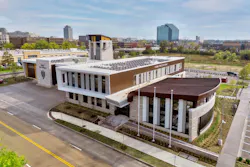
As cities face land constraints and tighter budgets, interest in co-located facilities that blend multiple essential services with community amenities never has been higher. Furthermore, the movement toward co-location goes beyond the straightforward benefits and efficiencies that result from pairing multiple facilities under one roof. The need to think creatively about funding, maximizing available development sites and addressing a variety of community needs is giving rise to new co-location models. These in turn bring up new design considerations in addition to the best practices that always went into multifunction facilities.
Co-location gains momentum
Many of the reasons that co-location always made sense haven’t changed, but they have been amplified. Budget concerns aren’t new, but local government finances are being reshaped by inflation, policy uncertainty, and changes in federal aid and funding. In 2025, only 45 percent of city finance officers who were polled said that they felt optimistic about meeting fiscal needs in FY2026, which was down from 64 percent in 2024 regarding FY2025, according to the National League of Cities’ 40th annual “City Fiscal Conditions” report.
Against that backdrop, not only are municipalities realizing the sheer number of aging-out facilities that must be replaced but also the challenges of land acquisition as they compete for fewer buildable sites, particularly in denser infill areas. Co-location can create a project that has a shared budget that’s large enough to justify purchasing the site that actually works best.
The more collaborative nature of today’s municipal governments also comes into play. A breakdown in departmental silos is changing how new projects are considered and planned. This includes proactive discussions between groups about how they can collaborate to secure funding and, ultimately, realize operational efficiencies. In fact, one helpful co-location strategy pairs a department that traditionally is well supported by the community, such as fire or police, with a less-visible municipal function that might have difficulty building its own standalone facility.
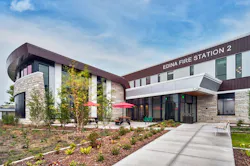
Finally, municipalities are thinking increasingly about their facilities beyond just their primary function and recognizing the role of these assets in community outreach and engagement. In many areas, there also is a desire to showcase government transparency and service quality.
Expansion into new models
As the broader adoption of co-location gains momentum, new models align services in innovative ways. Certainly, typical pairings always will make sense for co-location; fire and police departments, for example, are relatively easy to combine because of their similarities as public safety services and the parallels in their facility requirements (e.g., security, access to roadways and training spaces). However, as co-location becomes better understood as a tool to solve funding and land availability challenges, municipalities are thinking more broadly about other facilities that can be matched up.
Public works is one co-location use that’s seen in the mix more frequently. Often, this service is perceived by the public as only needing a basic warehouse space, so as a department, it can have difficulty getting funding passed. Co-location with fire or police—departments that have facility needs that are understood better by the public—can help to drive support and create design synergies around garage bays, apparatus spaces and other equipment needs.
Fire and city hall is another civic pairing that’s seeing increased interest, particularly with fire departments putting more emphasis on community engagement. Whereas fire stations typically don’t have large numbers of visitors, this matchup gives firefighters opportunities to interact with visitors to city hall, which leads to more community risk reduction outreach and a broader public profile for the department.
Outside of Washington, D.C., Fairfax County, VA, is designing a more unusual co-location project that pairs a fire station with an emergency homeless shelter and supportive housing. Although technically two separate buildings (to resolve differences in funding streams and construction types), the project demonstrates the benefits that can come from conceiving and operating two facilities as one. In this case, the homeless shelter had funding in place, but finding an available and appropriate site was an ongoing challenge. When the county purchased a larger-than-necessary site for a replacement fire station, the opportunity to accommodate the emergency shelter was presented, too.
The fire department’s participation in the overall project and its location as a buffer between the neighborhood and the shelter helped the development to gain public approval. Design explorations for the project have included the fire station below supportive housing, buildings that share a wall but have no internal connections and buildings that are physically separate but share mechanical services. All demonstrate the range of options that can be explored to find the most appropriate solution for any dual-function project.
New strategy in action
Although municipalities are thinking more creatively about co-location pairings, fire stations remain a favorite component to include in the mix. One reason is opportunity: Fire stations are simply more abundant than other municipal property types because of their need to be located to respond quickly to emergency events. Because of their numbers, projects to build or replace fire stations happen more frequently, which gives elected officials more chances to tack on something else through co-location.
Beyond that, co-location very much aligns with the collaborative nature of firefighters, who are trained to cooperate in everything that they do—from preparing communal meals, to training together, to relying on each other when out on a call. Building projects are no exception to this mentality, and it’s simply in the nature of many fire chiefs to consider who else could benefit from a new facility.
A very recent example of a new co-location typology that’s built around a fire station is the Edina Community Health & Safety Center (ECHSC) in Edina, MN. It pairs a fire station with a community health department that offers public training courses, provides oversight of local businesses and property owners, and investigates community complaints. The new facility anchors a broader city-led redevelopment that’s transforming a light industrial area into a walkable mixed-use neighborhood.
Because community health is under the fire chief’s purview in Edina, there were natural synergies in placing these functions together, even though they don’t overlap operationally. Those benefits were amplified by the city’s desire to use the new facility to build community and offer public spaces and amenities in what will be a rapidly expanding neighborhood following the redevelopment.
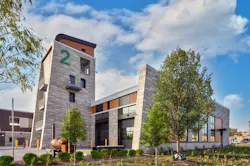
Given the community-facing nature of the facility, a priority in the design was to create opportunities for outreach and connection with the public. One aspect of this was making the facility’s exterior, which features warm natural stone and an activated façade that has multiple entry points, as welcoming as possible.
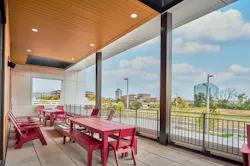
For the building’s primary street frontage, a projecting façade interacts with the streetscape. A significant canopy demarcates the main entrance and invites people in. The building’s side entrance connects the main lobby to both the parking area and a large outdoor patio and seating area. The latter is designed as a welcoming space to draw pedestrians into the site and to host small community gatherings, such as a farmer’s market or art fair.
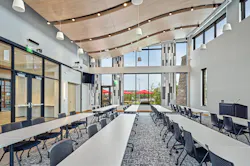
Once inside, the lobby is open to both entrances, which allows visibility from one end to the other. To one side is a large community room, which addresses the health department’s specific goal of having space to host public events and training, including first-aid classes and certification, seminar and senior events. The fire department uses the space for its classroom training. Other city departments make use of it as well.
The lobby also houses a community health reception area that leads to health department offices.
Also contributing to the collaborative nature of the facility is a large fitness center that’s made available to all city employees, not just those who are members of the fire and health department staff who are stationed at the facility.
Besides its public-facing and shared spaces, the ECHSC seamlessly encompasses areas that are dedicated to specialized fire department needs.
Located away from community and health department spaces for both safety and privacy purposes, these features include four apparatus bays; a five-story tower for ladder, hose and technical rescue training; a mezzanine that can be set up for search and rescue training scenarios; a mock cell tower; and confined space props.
Through intentional space planning, living quarters, including 10 private firefighter suites, a high-amenity dayroom and a covered outdoor patio, were placed on the second floor to create separation from other occupants of the building as well as privacy from pedestrian and vehicle traffic in the surrounding neighborhood.
The ECHSC is an example of how co-location can be a solution to both current and future needs. In fact, a large portion of the ECHSC site was left
undeveloped for what potentially will be a future civic or community-focused amenity as the area evolves. This underscores the role that co-located government facilities can play as a foundational element for a growing neighborhood.
Inspiring innovation
More success stories from co-located facilities of all types will fuel demand for these projects. As a vital part of the community fabric, fire stations will continue to inspire co-location innovation around how dual-function civic buildings can benefit the public and those who work in them.
Co-Location Give and Take
When designing co-located facilities, there’s always a level of give and take between the needs of the two facility types. That makes it imperative to distill the conversation down to the most critical priorities for each function. For a fire station component, the following design elements should be nonnegotiables.
Emergency response efficiency. The apparatus space must allow for fast and safe roadway access. That means considering the visitors, pedestrians and vehicles that are accessing other parts of the co-located facility in relation to the fire response pathway. The firefighters’ interior pathway to vehicles must not become convoluted because of the co-located component.
Space acoustics. In any fire station, firefighters require quiet space for relaxing and sleeping at all hours of the day. In a co-located fire and law enforcement facility, for instance, it’s imperative to segregate the police department’s gun range from the sleeping quarters to mitigate noise trespass.
Privacy. Firefighters are unique in that they live where they work, which creates an added challenge in a co-located facility that’s used by other workers and even the public throughout the day. In these projects, it’s important to implement design strategies to separate shared and department-specific zones, to ensure that sleeping and living quarters actually feel private and protected, so firefighters will be comfortable and able to de-stress after a challenging call.
About the Author
 Craig Carter
Craig Carter
Craig Carter, AIA, LEED AP BD+C, is the Fire/EMS Practice Leader, partner and firematic expert with BKV Group, which is a full-service design firm that has offices across the United States. He has 24 years of experience in architectural design, documentation and construction administration, with a focus on public safety projects. Carter has worked on at least 170 fire station projects and won several design awards that celebrate the functionality and beauty of the projects. He combines a deep knowledge of the history of public-sector design with an up-to-date knowledge of the latest national trends.
 Michael Healy
Michael Healy
Michael Healy, AIA, is the Public Safety Practice Leader and partner with BKV Group and has more than 15 years of experience on a variety of projects, including police and fire facilities. Healy has a thorough understanding of the operational needs, workflows and spatial requirements for public safety facilities, which he shares with clients nationwide as part of BKV Group’s team of experts. Under his leadership, the act of building a public safety facility can be one of symbolic, cultural and environmental significance for the community.