Strategic Fire Station Planning Focused on Intra- and Inter-Agency Coordination
Key Highlights
- Municipal fire departments benefit from close coordination with other city agencies to streamline operations and reduce resource competition.
- Shared facilities and training centers enable flexible, cost-effective emergency response and ongoing inter-agency collaboration.
- Designing multi-purpose facilities, such as fire stations that serve as emergency operations centers, supports both daily operations and emergency management needs.
Fire departments that operate as part of a larger municipal entity, such as a town or city, must coordinate closely with other municipal departments, including the police department, department of public works, water department, mayor’s office, and other administrative or operational agencies. While these departments share a common mission centered on public safety, service and community education, they often compete for limited municipal resources. Thoughtful planning and coordination can help streamline operations, reduce redundancy, and improve overall response capabilities.
Municipal fire departments are uniquely positioned to build internal structures, procedures, and facilities that support large‑scale emergency response in coordination with other municipal resources. In many municipalities, fire and police departments already share facilities or campuses, creating opportunities to centralize emergency backups, dispatching, communications infrastructure, network operations centers, and emergency operations centers (EOCs). This proximity significantly reduces communication breakdowns and delays that can occur when departments are siloed or geographically separated.
Shared facilities and operational coordination
Fire departments can take advantage of access to centralized or shared facilities, whether located on a shared property or within a larger municipal building. When properly planned, multi‑purpose spaces within these facilities can function as temporary staging areas, pop‑up EOCs, or triage points during large‑scale incidents. The effectiveness of these spaces depends on detailed emergency response plans and incident action plans that clearly identify how these resources will be activated and staffed. These spaces may act as community rooms, polling places, and meeting spaces outside of emergency response. This also applies to fire departments outside of a normal municipal structure such as a fire district or private fire company.
Centralized facilities also make it easier to assemble EMS response task forces or fire response task forces without the added complexity of coordinating personnel and resources across multiple sites. Reducing travel time and logistical friction allows departments to focus on operational decision‑making rather than administrative coordination during critical incidents.
Shared training facilities
Inter‑agency collaboration is essential when planning a complex facility such as a combined training center, as these campus style facilities are intended to serve multiple users with overlapping but distinct operational needs. Early coordination with municipalities, public safety departments, and other stakeholders enables a holistic approach to facility planning. This ensures that shared spaces, such as training grounds, apparatus support, infrastructure, and administration buildings, are designed to maximize flexibility and allow for joint use.
By pooling resources and aligning capital investments, municipalities can reduce duplication of facilities, lower long‑term operational and maintenance costs, and achieve greater value from each phase of construction. Shared infrastructure and phased development also enable the owning entity to respond to future growth or evolving training requirements without disrupting ongoing operations or exceeding budget constraints.
Ultimately, a collaborative planning approach strengthens inter‑agency readiness, improves day‑to‑day efficiency, and delivers a resilient, expandable asset that benefits the municipality as a whole.
Planning beyond emergency response
Inter‑department integration should not be limited to emergency operations alone. Day‑to‑day municipal functions present additional opportunities for coordination and efficiency. Many municipalities maintain redundant services across departments, particularly in areas such as vehicle maintenance, fleet fueling, and equipment storage. Public works departments, waste management divisions, and fire services often operate parallel systems that could be better coordinated.
One example is fleet refueling. Rather than requiring fire apparatus or public works vehicles to make unnecessary trips to centralized fueling locations, municipalities can strategically plan shared refueling stations in a manner similar to fire response mapping (GIS mapping) or sub‑station placement. This approach can reduce fuel costs over time, minimize out‑of‑service durations, and return apparatus to their stations more quickly, improving readiness for the next call.
Another example includes communications and network operations. Fire stations are often already equipped with full-building back-up generators and are typically more hardened structurally as essential facilities. This makes them uniquely equipped to house network operations equipment either as decentralized nodes or as back-ups for larger municipal systems. Decentralizing digital systems and carefully planned back-ups are essential phishing protection measures for municipalities and using space in a fire station not only hardens a community’s digital presence but also makes it easier to gain support to build or renovate fire station facilities.
Mutual aid agreements and regional integration
While internal municipal coordination is critical, integration with neighboring fire departments and outside agencies is equally important. Mutual aid agreements remain the most common and effective method for establishing procedures that allow departments to share resources during high‑demand emergencies. These agreements expand operational capacity for incidents that exceed the capabilities of a single department and can provide access to specialized equipment or expertise that would be impractical for individual departments to maintain on their own.
Departments planning new facilities or renovations to existing stations should consider the implications of mutual aid during the design process. Key questions should include: What is the size of neighboring departments’ apparatus? Will those vehicles fit within existing or proposed apparatus bays? Are vehicle exhaust extraction systems compatible, including couplings and connection points? Another critical factor to consider in the future will be the type of apparatus being used, such as all-electric apparatus. Will mutual aid units be able to charge/re-charge as needed while relocated?
Case study: EOC and water utilities
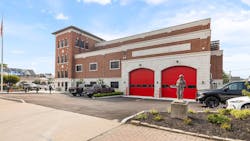
This integration of multiple agencies was recently utilized in the design of a new fire headquarters for the Village of Mineola, NY. The Village’s fire department had been utilizing an outdated station for decades, and various additions and modifications to the building throughout the years were unable to accommodate the community’s growth.
The new headquarters was designed to focus on camaraderie, recruitment and retention, cross-contamination controls, and responder health and wellness. Key parts of the design included addressing responder flow around the site, extreme traffic conditions, and special constraints within the urban context of the site. The building was also designed with the future in mind. To that end, the station features innovative IT and electrical solutions throughout, including infrastructure to support the Department’s newly formed drone unit.
In addition to firematic goals, the Village also desired to have the building act as an EOC during major manmade or natural events. By adding a centralized location for multi-agency leaders to coordinate strategic responses in the event of emergencies, the EOC provided the community with an additional layer of safety and protection while utilizing National Incident Management System (NIMS) standards.
This project also needed to integrate infrastructure to support the neighboring Village water department. This required prioritizing communication and coordination between the departments and Village leadership to ensure the best outcome for all parties. This ultimately resulted in the strategic inclusion of water utility infrastructure within the new 28,000 square foot, three-story headquarters project.
Planning, compliance, and grant readiness
Emergency response plans and mutual aid agreements also play a significant role in securing grant funding for new facilities or operational improvements. Programs such as the FEMA Emergency Operations Center Grant Program require documented plans and agreements that align with the NIMS Guideline for Mutual Aid. State‑level grants often impose similar requirements, making it essential for departments to maintain current emergency response plans and formalized mutual aid agreements.
By integrating coordination into both planning and facilities, fire departments can strengthen operational effectiveness, improve inter‑agency relationships, and position themselves for long‑term success. Proactive coordination, rather than reactive improvisation, ensures that when large‑scale incidents occur, departments are prepared to operate seamlessly within their municipality and across regional response networks.
About the Author
 David B. Sherland
David B. Sherland
David B. Sherland, AIA, NCARB, is a senior project architect with diverse experience in the design and construction administration of public safety and educational facilities. He emphasizes sustainable design, wellness, and systems integration in his designs. His responsibilities include evaluating existing facilities and operations, developing programmatic goals and engaging in community-based design. Sherland oversees all aspects of fire station design projects from initial funding and permitting through final construction. He is also a speaker at national symposia on fire station design trends and best practices.