Finding Answers at Station Design Conference: Resources Fill the Exhibit Hall
Key Takeaways
- Prepare for Station Design Conference's exhibit hall by reviewing the exhibitor list and identifying key resources, firms, and products relevant to your project needs.
- Engage in meaningful conversations with exhibitors, asking about design trends, operational solutions, and firehouse project experience.
- Share your fire station project story with exhibitors to receive tailored advice and insights, especially on shared facilities and community growth.
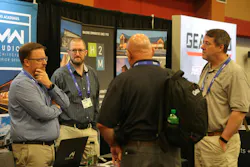
The Station Design Conference delivers on three fronts: education, peer networking, and exhibitors. While many attendees come for the first two, don’t overlook the third—it may be where you’ll find the resources to help your project really start to take shape.
Our exhibit hall isn’t a mixed bag of unrelated vendors. Every exhibitor is focused on fire, law enforcement, and public safety facilities. That means resources knowledgeable of the uniqueness of fire department facilities can offer ideas and proven solutions for you to consider for your project.
Think of the exhibit hall as your project resource center. Whether you’re in early planning or deep into design, you’ll find firms, service providers, products, and ideas that directly connect to your station.
Before you arrive, sketch out what resources or products you need. Are you looking for an architect or construction partner? Exploring new building materials or HVAC systems? Trying to solve operational issues like turnout gear storage, decontamination areas, or furnishings?
Start there.
Then take time to review the Station Design Conference exhibitor list. Identify who you want to see, review their websites, and come prepared with questions. You’ll have better conversations, and get better answers. The onsite Show Guide has the full list of exhibitors and booth numbers. Circle your priorities, but leave room for a few surprises. Some of the most useful solutions come from booths you didn’t plan to visit.
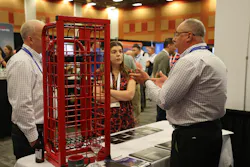
Pace yourself. We hear it every year, usually at the end of the first day and this conference can feel like drinking from a fire hose. There is an overwhelming amount of information to take in and keep track of.
Use the exhibit hall layout in the Show Guide to get your bearings. When it starts to feel like it’s too much, take a break. Sit down, review your notes, and sort through what you’ve collected and what you still need.
Many of the speakers are also exhibitors and can be found in their exhibit booth. If a booth is busy or you’re short on time, come back later or set a time to reconnect. When possible, sit down with exhibitors and have a real conversation. That’s where the value is.
Consider collecting information that applies to your project and for a building committee member. Collect contact information from the people and companies that matter to your project. One simple trick: mark the back of each business card with a star system—one star, two stars, three, to flag your follow-up priorities.
This is an opportunity to talk with the experts. A significant number of exhibitors are architectural firms with extensive experience in public safety design and products across the United States. This is a unique chance to compare approaches, philosophies, and experiences side by side.
We asked Ray Holliday, principal at BRW Architects, and a a long-time Firehouse Station Design Conference exhibitor and contributor, what attendees should ask architects. His advice:
- What trends are you seeing in fire station design?
- How long have you been designing public safety facilities?
- Are you licensed to work in our state?
- Do you partner with local firms, and who leads the project?
Specifically for fire stations, Holliday suggests digging deeper into the apparatus bay:
- Four-fold vs. sectional doors, what’s working best?
- Experience with radiant-heated bays, floors, and aprons?
- Recommended floor finishes?
- Approach to apparatus exhaust systems?
These are practical questions and the answers can shape your project early.
By the way, while exhibitors are there to help, they’re also there to learn from fire and law enforcement departments. Especially since there is a significant increase in shared facilities.
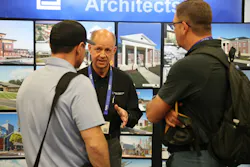
Be ready to share your story. Are you building for community growth? Replacing an aging facility? What are your priorities? A volunteer looking to transition to a career department? What challenges are you trying to solve? The more context you provide, the more useful their input will be.
The Station Design Conference is designed to be a working conference. You’re here to learn, compare, question, and gather resources. Use the exhibit hall that way. Invest the time. Ask the questions. Have the conversations.
Done right, you won’t just leave with a stack of materials—you’ll leave with direction.
And that’s what turns a project into the right facility for your department and your community.
See you in Reno!
About the Author
 Janet A. Wilmoth
Janet A. Wilmoth
Special Projects Director
Janet Wilmoth grew up in a family of firefighters in a suburb of Chicago. Wilmoth, who is owner of Wilmoth Associates, worked with Fire Chief magazine for 27 years until it closed in 2013. She currently is the project director for Firehouse, overseeing the Station Design Conference.