Key Takeaways
- Janet Wilmoth reflects on her 40-year career in the fire service media and the many innovations and movements she has been involved with, including fire station design and mental health.
- With her work in the Station Design Conference, fire station innovations include contamination-control practices, wellness spaces, natural lighting, and advanced security systems.
- Future planning should focus on long-term durability, multi-agency facilities, and emerging technologies like electric vehicles, drones, and robots.
Okay, this is my last one.
After 40 years of writing about the fire and emergency services, I’m shifting down to second gear. It’s hard to believe that what began as a focus on fire stations grew into a career that allowed me to watch—and write about—the evolution of our industry.
Since 2000, with Fire Chief magazine’s Station Style Designs, and the past 12 years with Firehouse, we continued that focus through the Firehouse Station Design Awards, the Station Design Conference, and the OFFICER Station Design Awards. Firehouse also continued to recognize excellence through the prestigious Emergency Vehicle Technician of the Year Award.
Evolution of station designs
Looking back, one of the most significant changes has been the evolution of station design itself. When I first started writing about fire stations, turnout gear hung in the apparatus bays—the same place as fundraising bingo and spaghetti suppers. In just the past 13 years, we have seen remarkable growth in both the number of projects and the sophistication of their designs.
What began as efforts to reduce carcinogen exposure through red-yellow-green Hot Zone designs has expanded into comprehensive contamination-control practices. Today, many departments remove and bag turnout gear at the incident scene, and station laundry areas include advanced equipment for turnout gear, station wear, and other equipment.
The industry’s commitment to firefighter health goes well beyond physical safety. Fitness spaces have evolved from simple weight rooms and treadmills to facilities designed for a range of activities, including advanced fitness training, Peloton bikes and even yoga.
Mental health movement
Even more important is the progress made in mental health. Topics once rarely discussed—PTSD, stress, sleep deprivation and suicide prevention—are now recognized as critical factors of firefighter wellness. Recent trends seen in station designs include wellness spaces, individual sleeping rooms, increased natural daylighting and circadian lighting systems. The shift from large dormitory sleeping areas to individual sleeping rooms reflects sleep deprivation impacts performance and health. The introduction of 96/48 shifts go further on firefighter health.
Other changes are equally significant. Security systems have become more sophisticated. Sustainability and energy efficiency are now part of standard design rather than optional features. And departments are increasingly looking ahead to technologies that were barely part of the conversation a decade ago.
What should fire departments do?
So, what should departments be preparing for their next station project?
First, build for the long term. A fire station should serve its community for 50 to 75 years. Investing in durable materials, flexible spaces and infrastructure that will adapt to advanced technologies and operations.
Second, think beyond the traditional fire station, but on public safety facilities—buildings or sites that combine fire, law enforcement, EMS and administration. These facilities can share office space, conference rooms, fitness areas and training resources while reducing overall construction and operating costs. In many cases, fire and law enforcement are located on opposite ends of the building and benefit from common support spaces.
Third, consider emerging technology. Electric vehicles, drones and robotics are already being discussed at the Station Design conference. Departments ask questions about electrical apparatus and charging within apparatus bays. Drone launch and recharge stations are appearing on station rooftops. Robots may still be in the early stages, but many Metro departments already use hazmat robots—including the cute robotic dogs.
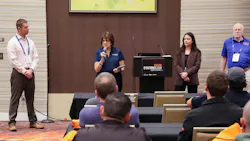
It was encouraging during the opening session of the Station Design Conference, when we asked how many were first-time attendees. Nearly 80 percent raised their hands. When we asked about returning attendees, more hands went up than ever before. That tells me the next generation of fire service leaders recognize the importance of the building and its impact on first responders.
Advice for the future
One final piece of advice: Keep your Station Design Awards issues of the November issue of Firehouse. The November issue remains one of the best resources available for departments planning future projects. Every award entry is submitted by the architectural firm responsible for the project, and many of those firms specialize in public safety facilities.
When evaluating architects, don’t hesitate to ask how many fire stations or public safety facilities they have designed. Years in business and experience designing public safety facilities are not the same thing.
The Station Design Awards showcase projects from across the United States and Canada, offering valuable ideas, trends and lessons learned. The project statistics, along with the chiefs and project managers involved, can be a resource having already gone through the process.
The final column
As I wrap up this final column, I want to thank the many chiefs, project managers, architects, firefighters, and industry partners who shared their projects, ideas, and experiences over the years. It has been a privilege to tell your stories and to watch the fire service continue to evolve.
The buildings will change and the technology certainly will, but the commitment remains the same.
Stay safe.
About the Author
 Janet A. Wilmoth
Janet A. Wilmoth
Special Projects Director
Janet Wilmoth grew up in a family of firefighters in a suburb of Chicago. Wilmoth, who is owner of Wilmoth Associates, worked with Fire Chief magazine for 27 years until it closed in 2013. She currently is the project director for Firehouse, overseeing the Station Design Conference.