Durable Furniture for the Firehouse that Aids in Firefighter Well-Being
Key Takeaways
- The design and construction of furniture for the fire service is held to a higher standard than that for models for the residential market.
- The durability of recliners for firehouse dayrooms often is increased compared with residential recliners by the use of hardwood (rather than particle board), heavier-gauge mechanisms and higher-density foams.
- The contribution to the well-being of firefighters from furniture for the fire station shouldn’t be overlooked.
For 16 years, I was in charge of a consumer magazine that scrutinized dozens of products. The goal was to dig in to understand the intricacies of the design and construction of those products, so consumers had a resource that put them on a fast track to identifying quality goods that were priced reasonably. Included in the scope of research of the staff was furniture. That included recliners. Despite the importance of quality construction in the effort to compare and contrast—and our confidence in recommendations that were made based in part on that—it didn’t occur to us that our review of the durability of recliners was rooted in a use (residential) that precluded that which is required of folks who are in, let’s say, the commercial realm. In my work for this article, my eyes have been opened.
The design and construction of recliners and other furniture for the fire service is held to a higher standard. Durability that accounts for 24/7/365 use is at a different level than what’s considered in the production of furnishings for the home.
Respect for taxpayer dollars
Larry Snyder is the fire chief of the Williamsburg, VA, Fire Department (WFD). In October 2023, the WFD moved into a new, 32,000-sq.-ft. facility. Although a subject matter expert who was familiar with interior aspects of public safety facilities, including furniture, was part of the design team that the architectural firm assembled, decisions on furnishings for the new station were department-driven.
Durability was front of mind in the research that Snyder and fellow department members conducted.
“The furniture [in a firehouse] gets used and abused every single day,” Snyder tells Firehouse. “Furthermore, furniture isn’t inexpensive, and so it’s an investment. You’re using community dollars, and so you must leverage those dollars the best that you can. Upfront investment must have a greater return.”
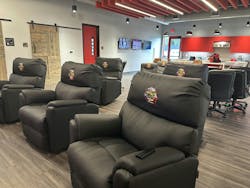
The WFD purchased the recliners for two dayrooms, the furniture for the bunkrooms, and the kitchen table and chairs from FireStationFurniture.com. The fourth generation of the company’s Duty-Built Ultimate Firefighter and third-generation Duty-Built PRO Plus theater-style recliners include hardwood components and heavier-gauge mechanisms and higher-density foams than what typically is found in residential models, because “firefighters are known to tear stuff up,” as one of the company’s promotions notes.
Instead of the three years of use that a residential recliner might provide, FireStationFurniture.com Founder and President Brandon Dunn says the Duty-Built models last six or seven years.
“Fire stations are quite abusive to furniture,” Dave Woods, who is the owner of Fire Station Outfitters, adds. “These environments demand extreme seating for extreme situations.”
Two years ago, the company introduced its King Comfort series of recliners. The so-called big-and-tall recliners are designed for people who are taller than six feet and facilitate a weight range of 500 lbs. compared with the normal weight range of 200 lbs.
“Local furniture stores don’t carry a higher commercial-grade product like we do,” Woods says.
He adds that when he started the company “I had some friends in the fire service, and they always complained about furniture that wasn’t quality-built.”
Tina Altadonna of Dream Seat understands why the best in durability might escape those who are put in charge of purchasing furniture for a firehouse, particularly those who are members of a smaller department.
“Unfortunately, it’s human nature. Many of us have grown up doing searches online, looking for the best value,” she states. “People are looking for any money they can save without realizing that they might be sacrificing quality and certain standards.”
This means that those people miss out on the opportunity to consider the kind of “overdesigned” furniture, as Altadonna puts it, that Dream Seat offers.
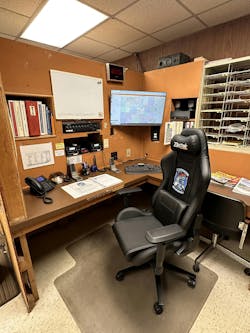
This applies to the company’s Xeverlast and Xeverlast Centennial task chairs. Both models feature reinforced steel frameworks, upgraded cushioning systems and commercial-grade materials that “far exceed typical office chair durability,” she states.
“When taxpayer dollars are involved, you want to make sure these things are going to last and stand the test of time,” Altadonna stresses.
The same applies to beds for bunkrooms. Colin Cameron, who is president of Murphy Wall Beds Hardware, tells Firehouse, “Fire stations need beds that can handle demanding shift schedules and quick turnovers, and our commercial-grade construction is designed for that reality.”
This is a reason why it’s so important for department members to not default to products that rise to the top of a Google search results page or that are on the showroom floor of a retailer. It also is a reason why Dream Seat and FireStationFurniture.com and others invest so much time for educating fire departments.
“Although one might think that a recliner is a recliner and a task chair is a task chair, and although elements are the same regardless,” Altadonna explains, “where [public safety buyers] are going to find the pain points is in [conventional models] not being commercially rated.”
“You can walk into a furniture store and find 10 different recliners,” Dunn says. “You can go online and find hundreds of different recliners. What we try to do is educate our customers on quality. Our Duty-Built Ultimate recliner and our Duty-Built PRO Plus recliner are designed to last longer. The construction is what helps to make a recliner better suited for the firehouse.”
WFD’s Snyder says that education included inquiring of departments that FireStationFurniture.com provided as referrals. Unsurprisingly, it’s a tactic that the WFD applies in regard to its other purchases, including apparatus, SCBA, tools, etc., and it’s why Snyder never hesitates to make himself available to other agencies who are looking to furnish their stations.
Member well-being
My experience in evaluating recliners and other seating products prior to joining the staff of Firehouse included elements of comfort. However, like the partial ignorance regarding durability, research didn’t delve into performance insofar as health and wellness. Not so for this article for the fire service, and those who are in charge of identifying new purchases for fire stations shouldn’t give the value to member well-being that furniture affords the short shrift.
It might be more obvious that mattresses play an important role here. For example, Dr. Curt Summers, who is owner of FirehouseBeds.com and is a chiropractic physician, stresses that state-of-the-art mattresses help to improve morale and to decrease the effects of sleep deprivation and improve the overall health of crews.
That said, the other executives of the furniture companies who we interviewed are just as adamant about the contribution of other well-made furnishings to firefighter health and wellness efforts.
WFD’s Snyder says that his department’s search for furniture for the agency’s new station was integral to creating an environment in which members can de-stress. “You can’t do that without proper fitting and comfortable furniture.”
That provides the capability to allow members to “enjoy moments of quietness, so they can be better prepared for when the next call comes in,” Snyder states.
“What we’re really selling is something comfortable for the crews, to help them rest in between calls, to make sure that they’re able to perform at their best,” says FireStationFurniture.com’s Dunn, who is an assistant fire chief with a volunteer fire department. “A lot of people don’t think of furniture that way, but it’s a reality."
“Companies, departments, are getting busier, and they’re doing more with less,” he adds. “The more calls they run, the more run down they become. Any time that members are able to rest helps in their overall performance.”
“Most people don’t realize that even just a few moments of sitting back in a comfortable chair, getting 15 minutes of rest, whether it’s in a task chair or in a recliner, let’s your body’s levels kind of just settle for a few minutes and reduce the natural stress that fire- fighters tend to have,” Altadonna remarks.
Snyder states, “We’re trying to create an environment of not just home but of relaxation and peace.”
Customized customer service
Certainly, many department leaders will attest to how important it is to involve members in the procurement of apparatus and equipment, in particular, and new technology, in general. The buy-in that results is among several benefits. That’s the case with furniture for the firehouse, too.
Dunn has seen that “allowing firefighters to have a say in the design creates more pride. It gives them ownership.”
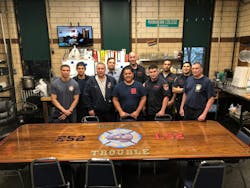
Not to be overlooked, he offers, firefighters tend to take better care of furnishings when their input was sought and pieces are personalized via their suggestions. For example, Dunn points to his company’s creation of a kitchen table for the station for FDNY Engine 52 and Ladder 52.
“In the beginning, everybody was arguing about the design of the table,” he recounts, including its logo. “We helped them to create a logo, and when we delivered the table, there wasn’t one person who had anything negative to say about the table. It really created a bit of a bond between them.”
The XZipit logo panel system that Dream Seat utilizes to customize recliners, task chairs, and other furniture applies to personalization and pride. A logo is embroidered on a panel, and the panel zips onto the recliner and so forth. If at some point a decision is made to change the logo, no problem: Unzip the existing panel and attach a new one.
The customer service that Dream Seat provides to facilitate this process and that FireStationFurniture.com provides in regard to its customization efforts and, really, that fire station furniture suppliers, in general, provide is just as important in the grand scheme of
things as these vendors’ techniques for producing furnishings that are suited for use by firefighters in ways that consumer goods aren’t.
“Quality products for fire stations and EMS were few and far between” even as recently as the early 2000s, Fire Station Outfitters’ Woods says. “Customer service was lacking, too. When you call Fire Station Outfitters, you’re going to talk to me, and I’m going to take care of your problem.”
Dunn tells Firehouse that he worked with FDNY Engine 52/Ladder 52 for about six months on the creation of its kitchen table, and the thrill that he feels about the end result of that is obvious in his voice when he speaks of the project. He’s confident that the increase in joy that the members exhibit about their company and their station as a consequence of the table even plays into recruitment and retention. “It all creates a bigger sense of pride among crews.”
“When you have someone who understands the environment, there’s a level of trust and confidence,” WFD’s Snyder states in regard to his experience.
Try to get that from your brick-and-mortar or online furniture retailer.
About the Author
 Rich Dzierwa
Rich Dzierwa
Managing Editor, Firehouse Magazine
Rich Dzierwa joined Firehouse Magazine in 2019 after four tenures with other publications. He was editor-in-chief of Consumers Digest/ConsumersDigest.com and of trade magazine Cutting Tool Engineering. He served as the consumer products reporter for BridgeNews and began his publishing career with an 11-year tenure at Appliance magazine, where he rose to managing editor after serving in other roles. Dzierwa's experience with consumer products, including furnishings, appliances, electronics and space design, has transferred to his Firehouse work regarding the magazine's Station Design columns and the Station Design Awards. Previous work also has contributed to his supervision of several surveys of fire service/EMS members, to produce unique reporting for Firehouse's audience. Dzierwa earned a bachelor's degree in English from Columbia College Chicago.