Documentary Focused on Poor Fire Station Conditions to Premiere in Worcester, MA
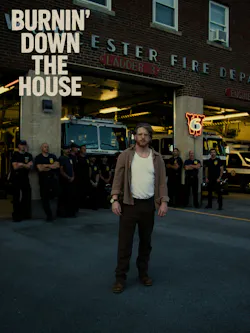
A moving documentary that tells the stories of the firefighters who work in aging and broken fire stations is set to debut in Worcester next month and the filmmaker—who hails from a family of firefighters—hopes the film will open the door for communities to understand the conditions many firefighters face behind the bay doors.
Filmmaker Tommy Jay Dwyer grew up around firehouses in Central Massachusetts where his father, uncles and other family have a storied history. When asked about filming "Burnin’ Down the House," he jumped at it immeditately.
His father, Tom, worked most of his 32-year career in Worcester on Rescue 1. His uncles, Jim and John, both had 30-plus-year careers with Worcester and John served as union president. His cousin, John Dwyer, is currently a firefighter in Worcester and his uncle, Wayne Curry, is a Fitchburg firefighter.
Dwyer’s father’s cousin, Cliff DeCourcy, died in 2014 after battling from idiopathic pulmonary fibrosis, which he believes came from the work he did as a Worcester firefighter.
“The fire service in general has impacted my life. I grew up in these firehouses. I was with my dad a lot,” Dwyer told Firehouse.com.
His father and uncle John were working the night of the tragic Dec. 3, 1999, Worcester Cold Storage warehouse fire that claimed the lives of six firefighters.
“Dec. 3. and sort of the subsequent events that have happened in Worcester have deeply affected me,” he said. “It’s affected my whole outlook on life. It's taught me to go after what you want to do and live for now and really make sure to take care of those people that are taking care of you.”
That’s why Dwyer jumped at the opporutnity to take on this documentary.
Among his credits, his short film, "Soulless," just won the best international short at the Tokyo Film Award and "The Hit One" was awarded best short film at the Boston National Film Festival. He was in the 2010 hit movie "The Social Network."
The film is born
Kathy Crosby-Bell, who founded the Last Call Foundation, wanted to take on this project and learned that Dwyer was local and from a family of firefighters.
Bell’s firefighter-son, Michael Kennedy, died alongside Lt. Edward Walsh in a 2014 Boston fire when their hoseline burned through during a wind-driven fire.
After some meetings, they developed the outline for "Burnin’ Down the House."
“She wanted me to do a short film on the conditions of firehouses across the country using some New England firehouses as sort of the reference,” Dwyer said. After spending just a day talking with firefighters to understand the realities they face, he had another idea.
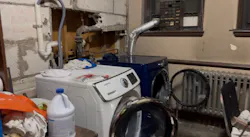
“I came back to Kathy and Jason Burns and I said, ‘listen, this is much more than a short film. This is an entire can of worms,'” Dwyer said. “The facades don't always match the interior. And what these men and women are dealing with was much more than I anticipated biting off.”.
They shifted gears and decided to make a feature length film.
Getting station access was challenging
Dwyer told Firehouse.com that his team contacted dozens of departments to ask about using their stations for the film, but most declined. The firehouses ranged from century-old buildings to more modern facilities to paint an accurate picture of the conditions firefighters live with in their home away from home.
“I was able to really dive in on telling the story of the men and women that work in these fire stations. And the health implications that they have from living in these conditions,” Dwyer recalls.
He was able to get three diverse communities—Fall River, Westwood and Worcester—to allow his film crew to have open access to not only the stations but the members who work there. Over two dozen firefighters were interviewed with nearly a dozen sharing their personal stories in the documentary.
“Every single place we went to, I became less and less surprised at the conditions, which is sad,” Dwyer explained. “Their expectations for what they do for their municipalities is incredibly high. They give everything, they really ask for nothing. And it fell on my shoulders to become the voice for a group of people that are working really, really hard that aren't asking for much in return.”
What’s really happening in the older stations?
Paint chips falling into living and eating spaces, mold, water leaks, rotted walls, and asbestos lined-pipes and tiles on floors and ceilings that are worn down and exposed.
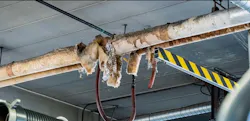
“It makes them sick. I can't tell you how many people we spoke to that just take for granted. They say 'every time we work (at a particular station), we wake up with like a wet cough and a runny nose and we have trouble breathing.’”
Dwyer believes the conditions inside some of the stations play a role in firefighter cancer diagnosis, which is a leading cause of firefighter deaths.
“The conditions they live with, it's asbestos and the mold certainly takes a physical toll on them. And then it takes a mental toll,” Dwyer recalls. “And seeing the sort of morale and mental health of the men and women that are going to work, day-to-day, fighting for the citizens of their city and returning to a place that looks like World War II France is pretty devastating."
"Cancer is an epidemic running through the fire service in all sorts of ailments. And some of that is from firefighting and...but what we're also seeing is some problems for the industry because of their stations, " said Fall River firefighter Jason Burns, who is also executive director of the Last Call Foundation. "The conditions of their stations are from the lack of maintenance. And we're worried about the health and safety of firefighters, and quite frankly, we think they deserve better."
Burns said the Last Call Foundation produced the film, "Burned: Protecting the Protectors," on the dangers of PFAS and cancer and "thought ("Burnin' Down the House") was a great opportunity to really open up that that window to let the public see what's going on in their fire stations. I don't think they know about it. I don't think they know that their firefighters are treated so poorly."
Dwyer recalled one station, where "the floors are sparkling. But guess what? They're asbestos tiles that are all chipped and broken. And these men and women take pride in that's something you're going to see. They take pride in where they live but it's not healthy."
Aug. 6 premiere in Worcester
During the Aug. 6 premiere of the 81-miunte "Burnin' Down the House" documentary, Dwyer will be there with his team, along with the firefighters who appear in the film and the Last Call Foundation.
The film will be screened at the Hanover Theatre in Worcester, which is “two football throws” from Worcester’s South Station, which is one of the firehouses that is documented in the film.
Tickets start at $47.00 and there is a VIP package that gives ticketholders time to visit with Dwyer, the Last Call Foundation and the firefighters in the film, plus some swag to take home. Half the proceeds will be donated to Last Call Foundation.
Both Burns and Dwyer encourage the fire service to bring family, friends and local elected officials to the premiere.
"The firefighters' families already know what the issues that they're dealing with...and the general public love firefighters. They flock to them when there's tragedy or a big fire," said Dwyer. "But I think 99 percent of the time they just drive by and don't think about them. This is to open everybody's eyes. So I want the general public to come out and see these are the conditions your firefighters are living in day in and day out. And it's important that we do something when it's time to come to the ballot box or talk to your politicians."
After the premiere, they plan to show the film at other threaters across New England and across the U.S. to raise awareness to the problems in so many fire stations, being that a large percetnage of firehouses are over 40 years old.
Find Burnin' Down the House on Facebook - Dwyer on social: Facebook and Instagram.
About the Author
 Peter Matthews