Fire Tech Brief: 5 Trends for Firefighter Training Technology
Key Highlights
- Firefighters can benefit from various training technology platforms that allow them to take part in repeated scenarios that improve training, safety and increase knowledge retention.
- Digital twins of structures and first-due districts enable realistic simulations of complex emergency scenarios.
- Virtual, augmented, and mixed reality provide immersive scenarios with different levels of variations.
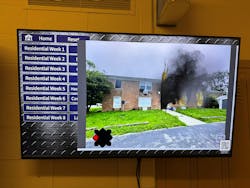
Besides emergency response, the second priority for many fire departments is training to improve the quality of services they provide during those emergencies. As the fire service evolves, there are a ton of training requirements, and the old school methods are finding new life with the addition of technology. There is still no substitute for going out in your first-due area to pull some hoselines or drop some hose; however, here are the top five training technology trends that can augment and enhance your training programs.
Virtual, augmented, and mixed reality
While nothing can fully substitute for live hands-on training, increasing safety standards, staffing limitations, environmental concerns, and budget restrictions are forcing departments to look for alternatives to improve the efficiency and effectiveness of their training programs. There are three established augmentations that are growing in popularity due to their ability to replicate high-risk/low-frequency events and allow for quick resets, thus increasing the repetition without the resource drain, and provide data analytics to improve performance.
- Virtual Reality – immersive experiences that are 100-percent digitally created.
- Low cost, but scenarios are limited to what has been created by the vendor
- Repetition helps with stress-inoculation
- Eases the standardization of training across shifts/divisions
- Augmented Reality - provides overlays to real-world visualizations.
- Allows for a deeper dive by showing details or visualizations of the training objectives
- Can create any type of virtual hazard inside of real structures reducing training evolution fatigue attributed to limited layout options of live training props
- Mixed Reality - combines elements from both the digital and physical worlds for mulltiple scenarions.
- Especially useful for command simulations
- Can incorporate the tools and resources available in a command vehicle with virtual or augmented reality to “set the scene”
- Great option for multi-jurisdiction incident command practice
Potential products to evaluate: Fast XR Fire Training Solutions, Flaim FTS, SimsUShare, Simlab VR Firefighter Training Simulator, FireMeister (Realiscape), StopFire MR Simulator
AI-assistance
If you have ever had the pleasure of being a training officer, it can be time consuming to develop educational materials, create scenarios, and even meet Fire Instructor II guidelines for course creation. Luckily, there is a growing list of tools that can help you with these tasks. Whether using generative AI to help build a library of scenarios, or develop lesson plans to give to the fire instructors, this is a game changer that will allow a single person to develop the same amount of content in a week that would have taken an entire team of dedicated instructors years to develop. These tools are even advanced enough to alter the outcome of the training scenario based on the student’s decisions. These AI powered solutions are also great at adding what I refer to as Murphy’s Drill Teaching moments, where the scene takes a bad turn because of some weird issue. In short, this training augmentation has the potential to help freshen up a training program and provide new but realistic drills to keep crews engaged and learning.
Potential products to evaluate: BoodleBox, ChatGPT, Claude, FirePrep.Chat,
Gamification of training
Learning science has done a ton of research to improve learning outcomes and the fire service needs to get on board with what that data shows. Gamification of training has been shown to improve learning outcomes and increase student engagement. While there are no firefighter related products on the market for this just yet, that does not mean training officers can ignore the science behind this strategy. Especially, understanding the dynamics of a fire department, adding simple point systems, leaderboards, and achievement badges can create healthy competition in a department. Daily micro drills or learning sessions can reduce training fatigue and improve knowledge retention. All of these options, especially when it becomes a crew competition, will go a long way to building team cohesion and challenge each other to get better.
Smart props and mannequins
To properly provide prescriptive training, there is one key component that is often missing… feedback. Great instructors take the time to learn how to provide feedback but there are also new innovations that can aid. The easiest example of this was when CPR manikins started to add the lights to show if a student was performing adequately. Compared to that innovation, the world of IoT sensors has led to major advancements in training props and mannikins. Imagine your burn building stacked with thermal sensors and gas monitoring. You no longer must guess if a rescue, fire attack, or ventilation operation would have led to improving the survivability profile for any potential trapped victims. Advanced mannikins can also provide immediate feedback on the forces applied to them during a rescue with built-in telematics and tracking. Want to up your thermal imaging search game? Add a manikin that produces a heat signature like a real person. While pricey, there are also some great medical mannikins that can provide summary feedback on the patient care they received. Overall, as this technology advances, we can give our firefighters specific feedback on their performance to help them improve.
Potential products to evaluate: Alex/Axel, Ares, Smartdummy, Symtech
Digital twins
As other technologies emerge such as 3D scanning and drone scanning, there are more data points available to create a digital twin of a facility or eventually an entire jurisdiction. This was a dream project when I was working with the students at Indiana University’s Red Lab, where I could have a digital twin of my city to train our crews, and prepare for major events/incidents. There are options being developed to allow this for both structural and wildland operations but with the convergence of technology, this is a trend that cannot be ignored. From the beginning of my career, I remember using wooden replicas for tabletops. Streets, buildings, hydrants, and even little matchbox sized apparatus to place where a valuable tool to think strategically about how you would operate on a fire scene. Imagine a digital version that could be used for a virtual, augmented, or mixed reality program. Place a fire anywhere, simulate flooding, add a chemical release from a simulated train derailment. All of this without placing a single firefighter at risk. This will be a huge advancement for risk reduction planning.
While training may not always be the most glorious aspect of this career, it is both necessary and critical for our success. Improving the scenarios, adding realistic touches, and even providing immediate feedback on performance are all ways to improve the outcome of preparing our firefighters for success. These top five trends in fire service training are a great start for you to up your department’s game for 2026.
About the Author
 Jason Moore
Jason Moore
Jason Moore is a 23-year veteran of the fire service who began his career with the U.S. Air Force as a fire protection specialist. Moore is involved with the International Association of Fire Chiefs’ Technology Council and is a founding member/associate director of the Indiana University Crisis Technologies Innovation Lab (IU Red Lab). He delivered presentations on implementing technology, using technology for community risk reduction and best practices to justify funding for innovative programs. Moore was the keynote speaker at FireFusion 2024 and is a member of the Firehouse Editorial Advisory Board.