Fire Service Innovation & Technology for Large-Occupancy Fires
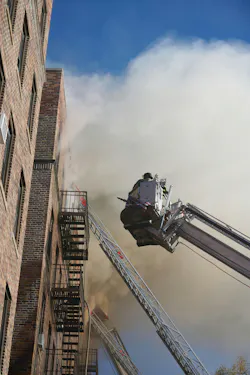
High-rise, mid-rise, big-box and large commercial occupancies are where the fire service’s margins erode fastest. These aren’t routine structure fires that involve a longer walk. They are incidents in which architecture, distance and building systems either stabilize the event early or amplify it into a long-duration campaign. Even when ignition sources are commonplace, vertical transport, smoke movement, complex layouts and occupant decision-making increase consequence. In large-area commercial and industrial properties, expansive footprints, heavy fuel packages, concealed spaces and shielded storage arrangements can delay access to the seat of the fire and complicate extinguishment.
If the fire service is going to meaningfully improve outcomes in these occupancies, particularly under real staffing constraints, the path isn’t “more aggressive” or “more conservative” in isolation. The path is better engineered safety upstream and smarter capability downstream: innovations that reduce uncertainty, accelerate correct early decisions, shorten time-to-water and time-to-rescue, and increase firefighter survivability and endurance.
The scale penalty
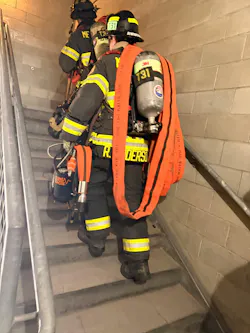
Vertical incidents impose a predictable tax that’s measured in minutes, fatigue and air. A high-rise response must establish order across multiple functional areas quickly: lobby control, elevator management, stairwell support, staging, reconnaissance, fire attack, search and medical/rehabilitation. The work is inherently concurrent. When limited staffing forces tasks to occur sequentially, the incident loses tempo, and the building’s advantages—distance and delay—compound fire growth and smoke spread.
High-rise operations also are dependent to a substantial extent on standpipe systems, which shifts the problem from curbside water to engineered water delivery inside of the building. The tactical success of the first line often is determined by the ability to achieve adequate flow and pressure at the outlet while anticipating impairment, valve issues, pressure-regulating devices and friction/elevation loss.
In large commercial and big-box environments, the scale penalty is driven by footprint, commodity and access. Fire can travel through voids, interstitial spaces and concealed pathways; storage configurations and shielded fuels can reduce sprinkler effectiveness and limit hose stream penetration.
Innovation as force multiplier
No technology replaces the need for adequate staffing, but innovation can reduce wasted effort, compress decision time and preserve safety margin. NFPA 1710: Standard for the Organization and Deployment of Fire Suppression Operations, Emergency Medical Operations, and Special Operations to the Public by Career Fire Departments indicates that an initial full-alarm assignment to a high-rise should provide a minimum total effective response force of 42 members (43 if the building has a fire pump). Many jurisdictions can’t achieve that benchmark without automatic aid and regionalized response plans, which means that the early incident period often is characterized by task saturation. When a small number of companies must stretch, force entry, locate the fire, establish water supply, manage elevators, control stairwells and begin search simultaneously, the incident becomes less orderly and less safe. In this reality, technology is most valuable when it reduces ambiguity and shortens the time between arrival and coordinated action.
Upstream technology
The most proven “innovation” remains automatic suppression. For high-rise and large commercial buildings, sprinkler systems’ significant reliability is operationally decisive.
The modern challenge, however, is hazard drift. Commodity, packaging, storage height, automation and occupancy use can change faster than a building’s original design assumptions. In storage facilities, evolving storage methods, large footprints and operational expectations create conditions that can exceed typical responder ability without robust preplanning and engineered safeguards that perform even when the fire department can’t quickly reach the seat of the fire.
Innovation, in this sense, includes management-of-change discipline, stronger system supervision, and more transparent information-sharing between buidling owners, insurers and responding agencies.
Compressing uncertainty
A meaningful shift in the past decade is the operational translation of fire dynamics research into best-practice guidance and training culture. In high-rise and large commercial incidents, this matters, because flow paths, ventilation and compartment boundaries are amplified by building geometry. Innovation shows up as disciplined door control, ventilation coordinated with suppression progress, and command structures that anticipate rapid smoke changes that are based on openings and wind conditions.
Connected building systems represent another frontier. Digitalization and emerging analytics can change fire, electrical, and life-safety systems while introducing cybersecurity and reliability considerations that must be addressed. From an incident commander’s perspective, the promise is operationally simple: Accurate digital floor plans, real-time alarm and device status, smoke control mode indications, elevator status and fire pump information can shorten the time that’s required to form a correct mental model of the incident. The caution is equally important. Data streams are decision support, not decision authority. Successful adoption requires resilience: The fire service must be capable of operating with partial or degraded information and must plan for the possibility of inaccurate, delayed or compromised data.
Thermal imaging innovation
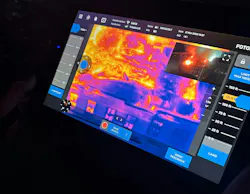
Thermal imaging technology has advanced rapidly in resolution, display quality, refresh rate and usability, and it’s integrated increasingly into both handheld devices and remote platforms. Standardization is part of that maturation. NFPA 1801: Standard for Thermal Imagers for the Fire Service establishes requirements for new thermal imagers that are used by fire service personnel during emergency incident operations, reflecting the profession’s recognition that performance characteristics and reliability matter when thermal imaging is used for life-safety decisions. At the same time, research and after-action learning continue to reinforce a critical truth: Improved sensors don’t eliminate interpretation risk.
National Institute of Standards and Technology (NIST) research has highlighted for years that image quality affects performance in hazard-recognition tasks, reinforcing that what firefighters see on a thermal imager can influence decision-making meaningfully under stress. UL Research Institute’s Fire Safety Research Institute training materials similarly emphasize that thermal imaging has limitations that can mislead crews, including limitations that are related to identifying structural stability and collapse indicators. For large occupancies and high-rise environments, this means thermal imaging must be treated as one layer of situational awareness rather than a single source of truth. Innovation, therefore, isn’t only new cameras; it’s improved training that teaches crews to interpret heat signatures in context, validate findings through coordinated size-up and avoid overconfidence when conditions, such as layered heat, reflective surfaces, insulation or concealed fire spread, can distort what the camera appears to show.
Early exterior thermal sweeps can help to locate the dominant heat area, identify extension into roof assemblies or concealed spaces, and support precise placement of attack lines and exposure protection.
UAS as real-time intel
Unmanned aerial systems (UAS), or drones, are used increasingly by departments as a rapid intelligence layer for large-occupancy incidents. The International Association of Fire Chiefs notes both the operational advantages and the policy/regulatory challenges that are associated with UAS adoption. From an incident command (IC) standpoint, the value proposition is straightforward: Drones can provide immediate overhead size-up, track fire spread and plume behavior, identify roof hazards, locate hotspots and support safer strategic decisions without committing personnel into high-risk positions.
Drones become even more valuable when they are paired with thermal sensors, particularly in high-rise exteriors, where heat signatures can reveal extension, rooftop involvement or exposures that aren’t obvious from street-level observation. A U.S. Fire Administration Executive Fire Officer paper on developing a UAS standard emphasizes that thermal imaging capability can assist IC teams by improving visibility and supporting firefighter safety, including the capability to identify fire conditions through obscuration. NIST-related reporting on drone research highlights the growing role of UAS in first responder operations and the value of drone-enabled assessment to improve situational awareness.
In large commercial incidents, drone-based mapping can support operational continuity and post-incident functions. Orthomosaic mapping and 3D models can assist investigators and provide documentation that supports building officials and recovery decisions, which becomes important when large properties face structural compromise or complex loss mitigation. In extended incidents, drones can support continuous monitoring of roof conditions, identify changes in fire location and assist the planning function in adjusting strategy as conditions evolve. Where regulations and training permit, the trajectory toward “drone as first responder” concepts also suggests future operational models where aerial intelligence arrives before the first pumper, to reduce uncertainty even earlier in the incident lifecycle.
Breathable-air redundancy
Lifeline Firehose’s namesake product represents an innovation that’s aimed at a primary limiting factor in high-rise and large commercial operations: air. The company describes its product as a fire hose that incorporates an integral airline, which is intended to allow responders to connect to a continuous breathable air supply while operating in hazardous environments. The company also frames the concept as redundancy that’s designed to prevent firefighters from running out of air during critical operations.
In vertical (and in deep-interior environments), redundant air options can preserve tempo and increase safety margins. High-rise operations consume air through stair climbing, equipment transport, staging movement and prolonged interior work. Any tool that reduces the probability of an air emergency can be meaningful, particularly when staffing constraints slow relief cycles and when egress distance magnifies consequences.
The value of the Lifeline Firehose depends on disciplined implementation. Continuous breathable air requires governance over air supply, air quality, monitoring and deployment procedures. It introduces additional logistics and interoperability challenges in mutual-aid environments, and it must be framed as redundancy rather than replacement. SCBA air management remains the foundational life-safety discipline, and breathable-air innovations are most beneficial when they reduce risk without encouraging overcommitment into
deteriorating conditions.
One standard
Large-occupancy fires are where the fire service meets the limits of time, distance and staffing. High-rise structure fires are a small fraction of overall structure fires yet still produce consistent civilian harm and loss. In this environment, innovation isn’t a luxury; it’s how departments preserve safety margins while improving outcome reliability.
The most effective approach is layered. Automatic suppression remains the most proven technology. Smart building features and connected systems can reduce early uncertainty and introduce cybersecurity and resilience considerations that must be planned for.
Thermal imaging continues to improve, but it demands standardized performance expectations and disciplined interpretation to avoid misleading conclusions. Drones add an intelligence and mapping layer that improves size-up, supports safer strategy and can sustain situational awareness through extended operations, particularly when paired with thermal sensors. Finally, innovations that extend firefighter endurance and survivability, including breathable-air redundancy concepts, such as the Lifeline Firehose, reduce air emergencies and improve operational continuity when implemented with training, governance and realistic risk management.
In the large-occupancy domain, technology should be judged by one standard: Does it help firefighters get the right resources to the right place faster, with a larger safety margin, while keeping the incident smaller through engineered controls and smarter decisions? When the answer is yes, innovation becomes the force multiplier that modern staffing realities demand.
About the Author
 Kristopher Blume
Kristopher Blume
Kristopher T. Blume is the fire chief of the Meridian, ID, Fire Department and has more than two decades of fire service experience. He is an author, lecturer and independent consultant. Blume is a graduate of the Executive Fire Officer (EFO) program and is an instructor at the National Fire Academy. As a student of the fire service, he is focused on values-driven, mission-focused leadership for the profession. He is the author of "Carry the Fire: The Crucible of Leadership in the Fire Service".