Fire Tech Brief: 5 Lessons in Progressive Technology Adoption for the Fire Service
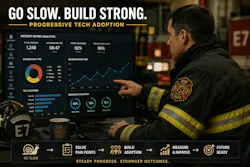
I have repeatedly watched fire departments purchase sophisticated platforms that can do everything from document incidents to output advanced analytics, or go full tilt into the latest rescue technology, only to watch it eventually sit stagnant where crews barely notice it exists. This failure to launch is often blamed on product gaps, shortfalls in communication and overly complex technology that "does not work.”
In a long list of reasons why technology adoption within the fire service fails is the sudden and overwhelming push to add technology, or where leadership decides to go full throttle into a new technology or direction.
This failure point comes from well-intentioned leaders who just want to give their people the absolute best that they can afford, pressures created by one-time or grant funding, political pressure, or even the fear of missing out.
Stopping to take a pulse check, or even better, progressive tech adoption is a terrific way to get to the future state without overwhelming the current state of the department. Technology rarely fails because it lacks capability, it fails when a department tries to add too much capability too quickly.
Is it progressive tech adoption?
What is progressive tech adoption and what are some strategies to help guide this? In simplest terms, progressive tech adoption is preparing for a future state by building the present.
If a fire department has the goal of fully integrated systems with automated reporting metrics, and AI analytics but your department is currently on pen and paper, the cultural shift will be huge. Not everyone can or will be able to get on board with the new technology.
Progressive adoption gets you from step A to Z at a pace that the department's members can tolerate. The best thing about this process is that it exponentially speeds up as you go through the steps. The first are the hardest but after they are taken, it can and will get easier.
Next, lets go over some methods to help you get from current to future state.
The K.I.S.S. method
Keeping it simple is often the best way, especially when a department has been lagging behind for several generations of its personnel. This option values simplicity over full functionality, building a stable foundation before moving on to more advanced features. Just like nearly every other tool or process we teach in the fire service, crawl, walk, run, or go slow to go fast. In this I mean, start with the lowest tier tech possible and master it before moving on to bigger and better things. For drone programs, it is easier to explain how someone crashed and ruined a $50 drone than the response ready $15k drone. In the world of software, this may mean purchasing the most needed modules or features first and adding on others as the current options are mastered. No matter what the technology is, start with the most simplified version, get everyone up to speed and progress from there. The key to making this work is knowing where you want to eventually be and establishing a strategic (purposeful) plan on how you will get there.
Adoption is key
Remember the end goal of a program or project is to add value to the department, community, and/or staff…adoption is key to making sure the change or technology becomes sticky and is utilized instead of gathering dust in the back of a bay somewhere. If you focus on adoption of technology rather than getting it out quickly, you will often gain better buy-in and ultimately have better outcomes. Adoption of innovative technology cannot be forced, it is something that takes time, training, and ultimately crews learning to trust the new addition. This slow roll-out option is best for departments that lack the resources or do not have full-time staff to dedicate to implementing the technology. Even in larger departments, it can be a useful tool in turning the proverbial “large ship” as changes take quite a bit of time to trickle down to the end users. By making sure you are establishing a solid foundation, there will be less problems (cracks) in the program later that often lead to failure. This often means that a department is intentionally capturing and documenting through policy, procedures, and other written guidance on how this technology will become a permanent part of the firefighting operations. When reality is aligned with mission, values, operational needs, policies, and procedures, true adoption can take place.
Eliminate pain points first
Success builds further success. When starting down the technology pathway, it is best to remember why the technology was being selected. Hopefully, you have avoided the pitfalls of purchasing technology and have a solid problem you were trying to fix however, early wins can help with adoption while building trust. Prioritizing the corrections to operational pain points is how you win hearts and minds. If something like an incident report took an officer over an hour to do, even on a call that took ten minutes on scene, this may be a place to focus. If it takes hours to go through the overtime list to get a shift filled, fixing that issue will give time and energy back to the people you need to use the new tech. If crews spend hours combing through the tall brush looking for a lost person only to come back empty handed with ticks, it sounds like a wonderful place to deploy technology to help. In every case, it is essentially grabbing the low hanging fruit which gives some immediate traction to any adoption plan.
Strategic expansion
While we all know that culture can eat strategy for breakfast, it is often a lack of strategy that leads to mediocrity or failed adoption. Having a clear roadmap of where you are versus where you want to be is key to keeping things progressive. Without the roadmap, things can often stagnate or even regress. You must plan how you will get from A to Z with metrics and key benchmarks that can be adjusted as new variables present themselves. Once your department has mastered the basics, set the next waypoint on your strategic journey into your future state.
Conclusion
Following a progressive technology adoption strategy is often a deciding factor in whether the latest and greatest becomes a part of your operations or just another piece of junk in the technology junk drawer. With buy-in and support, fixing the biggest pain points as the focus, moving strategically, and at a pace that can be tolerated; you will be able to avoid this major blocker to technology adoption.
About the Author
 Jason Moore
Jason Moore
Jason Moore is a 23-year veteran of the fire service who began his career with the U.S. Air Force as a fire protection specialist. Moore is involved with the International Association of Fire Chiefs’ Technology Council and is a founding member/associate director of the Indiana University Crisis Technologies Innovation Lab (IU Red Lab). He delivered presentations on implementing technology, using technology for community risk reduction and best practices to justify funding for innovative programs. Moore was the keynote speaker at FireFusion 2024 and is a member of the Firehouse Editorial Advisory Board.