UL Research Institutes' Fire Safety Research Institute's New Report Examines Fire Safety Hazards of E-mobility Devices on Passenger Railcars
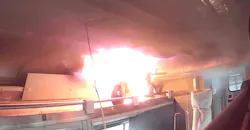
In recent years, the e-mobility scene has grown dramatically. Urban commuters who require first- and last-mile mobility options frequently use devices like e-scooters, e-bicycles and seated e-scooters. Public safety concerns have been raised, meanwhile, by high-profile fire events employing these devices in both residential and commercial buildings. Concerns about these vulnerabilities in the rail transit environment have surfaced as more passengers bring mobile devices on passenger railcars.
In order to investigate the potential effects of thermal runaway-initiated e-mobility fires on passenger safety and evacuation conditions, the Fire Safety Research Institute at UL Research Institutes, in collaboration with the Fire Department of the City of New York and Christiana Fire Company, conducted experiments on a passenger railcar. The findings are detailed in the Recommendations to Improve Passenger Railcar Safety During Electric Micromobility Device Fires report.
Impact of Thermal Runaway-Initiated Fires on Passenger Railcars
Thermal runaway, in which the lithium-ion cells go into an uncontrollable, self-heating condition, can occur when an e-mobility device battery fails. The risks associated with thermal runaway of e-mobility devices in home settings were previously studied by our fire safety specialists. What happens if this happens on a passenger railroad is investigated in this study. Experiments were carried out to determine how quickly passengers could become incapacitated due to heat exposure and harmful combustion byproducts, as well as how long they would need to escape.
Three devices—a standing e-scooter, an e-bicycle, and two seated e-scooters—were employed in four studies conducted by researchers using a single-level intercity passenger railroad. Based on size and proximity to a passenger's seat, devices were positioned where they were most likely to be used by actual passengers. Toxic gas concentrations, radiant heat exposure and gas temperatures were all measured by the railcar. The speed at which smoke and fire conditions developed was recorded by cameras placed throughout the vehicle.
Thermal exposure from the intense fire that these devices can cause might soon render passengers within ten feet of a burning e-mobility device incapacitated. The majority of individuals would probably be unaware of the impending danger of a dying battery until the item abruptly began to emit smoke. Within thirty seconds of the fire starting, smoke had spread to the other end of the railcar. In less than four minutes, full visibility was lost. Usually, gadgets only smoked for a few seconds before catching fire. Conditions that have a major impact on escape evolved between 3 minutes 37 seconds and 7 minutes 8 seconds after ignition, according to assessments of poisonous gases.
Although the necessary safe egress time for railcars—that is, the amount of time needed to evacuate everyone from the railcar—was not measured in this study, prior evacuation research indicates that the time available for safe exit is less than what is necessary for safe egress.
Inproved Passenger Safety Considerations
In addition to the full dataset, the report outlines considerations that could meaningfully improve passenger safety.
- Railcar design: Physical modifications could create separation between device storage and passenger seating.
- Device policies: Require safety certified devices, consider restrictions on the size of e-mobility devices allowed on board, and specify designated storage areas.
- Transit staff training: Provide lithium-ion battery-specific training to passenger railroad staff.
- Public education: Help riders understand and reduce the risks before they board.
To view the full report, go here.
About the Author
 Ryan Baker
Ryan Baker
Associate Editor
Ryan Baker is a writer and associate editor with prior experiences in online and print production. Ryan is an associate editor for Firehouse with a master's degree in sciences of communication from the University of Wisconsin-Whitewater. He recently completed a year of teaching Intro to Public Speaking at UW-Whitewater, as part of his graduate program. Ryan acquired his bachelor's degree in journalism in 2023 from UW-Whitewater, and operates currently out of Minneapolis, MN. Baker, also writes freelances for the Ultimate Frisbee Association (UFA) in his free time, while also umpiring baseball for various ages across the Twin Cities Metro Area.