How Logistics Management Software Helps Firefighter Well-Being
Key Takeaways
- Written apparatus and equipment checks and other logistics management efforts make it difficult for fire departments to track and generate validation compared with software that’s available for the processes. The latter simplifies logistics to the extreme, to help in the effort to keep firefighters and EMS providers as safe as possible.
- The increasing administering of whole blood by firefighter/paramedics and EMTs in the prehospital environment is aided greatly when logistics management software is employed to track blood inventory, ensure proper storage and handling, maintain compliance and document usage in the field.
- Programming of logistics management software to enable its use on smartphones means that members who are conducting apparatus, equipment and controlled substances checks can do that more efficiently, comprehensively and quickly
On March 25, 2026, a Fort Lauderdale, FL, Fire Rescue (FLFR) apparatus was struck by one of two automobiles that crashed into each other. Undoubtedly, the fact that firefighters who already were on scene (and uninjured) were able to begin extrication efforts immediately played a role in saving the life of one of the victims, but so did something else. FLFR Chief Stephen Gollan told reporters that members’ ability to administer whole blood was vital.
Prehospital whole blood is becoming more common. That said, departments’ capability to carry out that treatment is contingent on numerous factors, not the least of which are tracking blood inventory, ensuring proper storage and handling, maintaining compliance and accurately documenting usage in the field.
This shines a light on the importance of logistics management systems and the innovation that software suppliers are producing—which provides methodology that’s leaps and bounds ahead of handwritten logistics management, to increase confidence in multiple ways.
Solving pain points
At the time that research for this article was conducted, First Due was finalizing development of its whole blood documentation and tracking capabilities, with plans for release following completion. Despite the company’s experience in logistics management for controlled substances dating back to 2023, developers had to think beyond that capability regarding whole blood.
“Medications usually have a set standard of what must be identified, such as expiration dates and lot numbers,” a First Due EMS product specialist tells Firehouse. “Whole blood has different particularities.” These include different blood types and the reasoning behind the needs for it, such as a traumatic injury or internal bleeding.
“It’s really central to First Due development to continue to identify pain points,” another First Due EMS product specialist adds, “and with whole blood, it’s really two pain points: how to track it and how to document it.”
Dustin Konkal, who is assistant division chief of rescue, which covers EMS, for Pembroke Pines, FL, Fire Department (PPFD), was familiar with Vector Solutions’ Check It logistics management software from his time on the apparatus bay floor as a firefighter and then from his administrative roles with other divisions of the department in terms of apparatus and equipment maintenance.
When he assumed his current position, he learned even more about the software’s capabilities. That further enhanced the department’s capability to track and maintain.
“Check It has been transformational for us in our process to maintain all equipment and apparatus on a daily basis,” he says. “It has provided us with an overall broad scope of being able to manage equipment, suppliers, inventory, apparatus and controlled substances, which we ordinarily would’ve done on paper.”
“If a department is trying to do a check on PPE in the manual way, there could be missteps, improper documentation and missed inspections,” Naija Lambert of Vector Solutions adds. “There’s no defensible record, no audit trail that can be pulled at any time to show exactly what and where and who was assigned and when the inspection was set up to be performed.”
Volunteer fire departments and their different structure compared with career and combination departments might benefit particularly from the move to software from pen and paper, including in regard to audits.
“Volunteer departments have very limited sources, so they can be skeptical,” Alpine Software’s Will Wendel notes. He says he’s experienced a viewpoint of “Software companies are only there to charge money.”
Many departments don’t understand how technology will allow them access to more funding from grants.
“There are strings attached to grants, and those strings are documenting that a department is following the rules that are set up to make sure that the department is keeping up with the equipment in the right way,” Wendel reminds.
He’s found that the aha moment for many is that logistics management tools aren’t that difficult to get spun up in this day and age.
“This is where a department would partner with a company liked ours,” he continues, “and we say, ‘OK, show us the grant. Show us the requirements of what you have to report and how frequently you must report.’” From there, Alpine Software’s specialists set up an intake form, reminders and how a report for the grant body is produced.
Even some elements of LOSAPs (Length of Service Award Programs) can tie in with equipment checks.
“Some departments might give points or credit for executing a truck check,” Wendel explains. “That’s where we would fold in the means by which rigs are getting checked as they’re supposed to.”
Bill Gardner, who is executive director for fire & EMS at ESO, tells Firehouse that many of the conversations that he and his team are having with departments center on what happens to PPE between calls.
“What’s changed is the expectation that asset management functions like a chain of custody,” he says. “The fires that we’re fighting today aren’t the fires of 20 years ago. Electric vehicles, lithium-ion batteries and modern building materials are creating chemical exposures that embed themselves in equipment in ways that traditional cleaning processes aren’t removing.”
This prompted the company to provide the capability to “track gear through chlorine dioxide oxidation cleaning, rather than a standard wash-and-extract cycle,” he states. “Departments need a system that documents when gear was cleaned, what process was used and whether the gear is ready for the next deployment.”
Tradition vs. progress
Like Wendel’s experience with fire departments, First Due’s Young tells of how the ability to immediately pull up digital records for controlled substances audits serves as a moment of clarity for potential users.
“Once the client sees the effect that a logistics management platform would actually have in making its job easier: Boom!” Young says, “and they need that aha moment. ‘We’ve been doing this for so long, but, OK, there’s an easier way to accomplish it.’”
“It’s learning to adapt and welcoming themselves into the 21St century,” PPFD’s Konkal states.
Lt. Nick Brown of Wintergreen Fire & Rescue (WFR) in Nellysford, VA, agrees when it comes to his department’s use of BarCloud’s EMS inventory and asset tracking software. “This allows me to check inventory at each station, and we aren’t keeping expendable items on the shelf as much.”
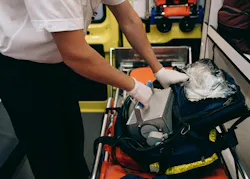
BarCloud’s Francesca Touma adds, “WFR implemented the system to track over 150 consumable line items across three locations. Ultimately, what BarCloud provides fire and EMS agencies is confidence, and in emergency services, confidence is readiness,” Touma states.
Beyond the laptop
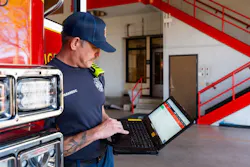
Logistics management technology specialists recognize that confidence also is produced when the conduit to the platform is sized to fit in the palm of the hand.
“Everyone’s got their phone on them,” First Due’s Young says. “To have the ability to document right from there makes it a lot easier.”
Legacy desktop capabilities are a thing of the past, APX Data’s Paul Martin states. “Mobile platforms and modern applications enhance communication between stations, allowing for faster coordination of resources and personnel.
Overall, this shift not only saves time and reduces administrative burden but also strengthens situational awareness and preparedness.”
CartCloud, which is the companion mobile app to BarCloud’s inventory requisition system, allows in-field personnel to submit requisitions from any smartphone. Touma says users receive real-time status updates on whether their request was submitted, is pending approval or was fulfilled.
Vector Solutions’ AI-driven VoiceCheck component of Check It will remove the need for users to tap buttons on their smartphone screen and, instead, allow them to speak into their phone.
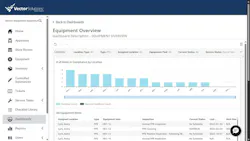
“We’re kicking it up a notch, elevating the intuitive kind of workflow that firefighters naturally are doing,” Lambert tells Firehouse. “Instead of them having to avert their eyes every second to look at their next checklist item and then look back at their apparatus compartment, the AI tool is going to take what they’ve spoken and convert it into a completed checklist to review and make any necessary adjustments. It not only is going to save a lot of time but also strengthen the completeness of the inspections.”
PPFD’s Konkal hasn’t had the chance to sample VoiceCheck yet but believes that it will make a nice addition. “Time is valuable. We don’t have a lot of it. Any time savings is beneficial."
Matter of record
Multiple suppliers of logistics management software assert that that advancements that they created for their offerings are tied directly to the increased attention in the fire service to member well-being. Eliminating pen-and-paper apparatus, equipment and EMS supplies checks via electronic documentation might be the most overlooked aspect to caring for firefighters.
“Our own data showed roughly 8 percent of 31,000 firefighters across 581 agencies had at least one documented fire-related exposure,” ESO’s Gardner tells Firehouse. “Of those, nearly one in five didn’t document any on-scene decontamination procedures at all. That gap between what we know firefighters should be doing and what’s actually being recorded is exactly what drove the push for better tracking tools.
“Departments started asking hard questions: Can we prove our gear was properly cleaned? Do we know when it’s due for replacement? Are we documenting any of this?” Gardner shares.
About the connection between validation and health and wellness, Lambert says strengthening the company’s Check It “gives that confidence to customers to help to better track all of the different elements that extend the life and careers of their people.”
Now, that’s OK to write down.
About the Author
 Rich Dzierwa
Rich Dzierwa
Managing Editor, Firehouse Magazine
Rich Dzierwa joined Firehouse Magazine in 2019 after four tenures with other publications. He was editor-in-chief of Consumers Digest/ConsumersDigest.com and of trade magazine Cutting Tool Engineering. He served as the consumer products reporter for BridgeNews and began his publishing career with an 11-year tenure at Appliance magazine, where he rose to managing editor after serving in other roles. Dzierwa's experience with consumer products, including furnishings, appliances, electronics and space design, has transferred to his Firehouse work regarding the magazine's Station Design columns and the Station Design Awards. Previous work also has contributed to his supervision of several surveys of fire service/EMS members, to produce unique reporting for Firehouse's audience. Dzierwa earned a bachelor's degree in English from Columbia College Chicago.