Radio Snafus a Major Issue at Contra Costa, CA, Refinery Blaze
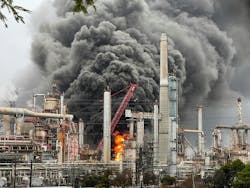
New details emerged this week about the massive February fire that erupted at the Martinez Refinery Company and released more than 7,000 gallons of hydrocarbon materials into the air, as officials revealed that oil crews had been using incompatible radio systems that prevented immediate contact with local public safety agencies.
While county firefighters arrived on the scene 14 minutes after being notified of a fire at MRC, crews were stalled outside, unable to contact the refinery operators on site – a communication gap that delayed the establishment of a unified command center by nearly two hours.
Internal breakdowns like those add to the chronic terror neighbors and businesses face downwind of the refinery, said Heidi Taylor, who lives along its fence line in downtown Martinez. She said she’s seen level-one alerts and “enormous” flaring almost every day for the past month, which was confirmed by Contra Costa County officials.
“It’s the public that suffers as a result of MRC’s incompetence, or what I would argue is gross negligence,” Taylor said Tuesday at a Contra Costa County Board of Supervisors meeting.
Instead of switching channels on one device, MRC employees have to carry two radios in order to communicate with the Contra Costa County Fire Protection District and dozens of other agencies tuned to the East Bay Regional Interoperable Communications System’s frequencies, according to ConFire Deputy Chief Aaron McAlister. It’s not uncommon for crisis teams to juggle different devices, which McAlister said is frequently the case when ConFire navigates wildland environments with CalFire brigades or interacts with police officers in Richmond.
But MRC only has a few of these radios, known as EBRICS, and no one on the refinery’s internal fire brigade had access to those devices – the only radios tuned to provide a line of communication to ConFire’s units during these types of emergencies.
“There’s an entire (petrochemical mutual aid organization) bank of frequencies, and (refinery crews) can use those frequencies without causing (county responders) any issue in our day-to-day operations,” McAlister told the board Tuesday. While presenting the county’s review of the actions taken by emergency responders in February, a common practice after high-profile incidents, McAlister said MRC needs to get accustomed to using the EBRICS in order to be prepared for the next emergency.
“They need to practice some radio discipline.”
Dominic Aliano, a spokesperson for MRC, did not immediately respond when asked how the company would ensure issues with the radios will not impact future emergencies at the refinery.
Taylor, a founding member of the Healthy Martinez Refinery Accountability Group, said she was impressed with ConFire’s proposed list of corrections and “lessons learned.” She remained frustrated, however, by the failure to better anticipate potential hazards of the petrochemical products flowing through the 157,000 barrel-per-day facility’s “trees of valves and pipes,” one of the most complex in the U.S. She’s yet to see any fence-line data recorded during the February flaring by high-tech sensors that the refinery, which has been owned by PBF Energy Inc. since its $1 billion acquisition from Shell in 2020, installed a few years prior to monitor specific emissions in “real time.”
“We are checking all sources – we need more information, not less,” Taylor said. “We must be vigilant and demand better of MRC and continue updating systems to better protect us.”
McAlister said that requires a simple fix: internal and cross-agency training that incorporates radio communication into daily routines.
County staff ranked the rest of the issues into “buckets” of high, medium and low priority, which ConFire will address over the next 12 to 24 months. Ranking highest was the need to develop clear, efficient plans to deploy joint response teams to a range of different emergencies, which may not require the same resources. McAlister also highlighted plans for interagency training exercises, including predesignated radio frequencies and other ways to communicate with the refinery.
Unlike the Chevron plant further down the coast in Richmond, the MRC facility does not employ a professional full-time fire department, McAlister said. Instead, they cross-train refinery employees as firefighters, which is similar to operations at the Phillips 66 facility in Rodeo.
Contra Costa’s second-highest fire official didn’t gloss over challenges after MRC also took a lead role in communicating with the public about the flaring and subsequent explosion at their Martinez facility. The catastrophe damaged internal equipment and shut down refining for several months.
“I think in hindsight, when we look at this incident, the public wants to hear from the public safety agencies that public safety is being mitigated,” McAlister said. “Perhaps, in hindsight again, having such a large presence from the corporation may not have been in our favor.”
Supervisor Ken Carlson, who serves on the board overseeing deployment of EBRICS radios in Alameda and Contra Costa counties, emphasized how numerous issues stemmed from a lack of cohesiveness between government partners.
“That was one of my personal pet peeves,” Carlson said Tuesday. “The public is relying on us. Granted, we never get it to them fast enough – they’re always going to want to be in the know – but we want to be one up on social media and speculation by the public who are just going on perhaps observations or other theories. I understand MRC is a separate entity and their (spokesperson) can ultimately do what they want to do as far as putting information out, but … what I think the public is looking for, is making sure that that information is accurate across our partners.”
©2025 MediaNews Group, Inc. Visit at mercurynews.com. Distributed by Tribune Content Agency, LLC.