FDNY Chief Dispatcher Sent Many Firefighters to their Final Alarm on 9/11
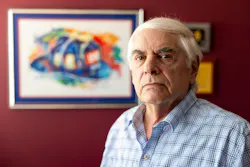
Lloyd Moskowitz sat in his Brooklyn dispatch office 25 years ago listening to technicians with a cell service company update him on their repairs to a faulty 911 system over the weekend.
It was after 8:30 a.m. Tuesday morning. People were beginning to trickle in for shift changes. He listened to the occasional phone ring or distant siren, along with the chatter on his scanner sitting behind him.
At 8:46, he heard a transmission from a group of firefighters out doing inspections in Lower Manhattan. A plane just hit the World Trade Center.
“You better hope you fixed this system, because we’re going to find out if it’s going to work or not,” Moskowitz recalled telling the technicians. “There was no question it was going to be insane in a few seconds.”
Moskowitz was the Brooklyn chief dispatcher for the Fire Department of New York City and had worked with the department for more than 30 years before eventually moving to Williamsburg in 2018.
Because of Manhattan’s morning rush hour, Brooklyn’s firefighter units responded faster by flying across the Brooklyn Bridge, and Moskowitz put out a call for reinforcements from Bay Ridge and Canarsie before the two-alarm call even came through.
Through the windows, he could see black plumes of smoke clouding the clear morning skies, still unaware the full extent of the emergency.
The Brooklyn native’s “baptism” into the department was the riots at Stonewall in 1969, and he had also worked during major blackouts in 1977 and the World Trade Center bombing in 1993. He said that experience had taught him not to get behind in responding to crises.
That’s when the phone calls flooded in — hundreds of them across every borough. In between delegating units to respond, Moskowitz answered dozens of them as he watched a live broadcast of the towers. “I’m on the 87th floor.” “I’m on the 78th floor.” “I’m on the 90th floor.”
In their voices he heard fear, panic, and in some, resignation.
“I can’t breathe. The fire is getting close. What do I do?”
“I’m trapped, I’m standing out the window, what do I do?”
“Can you stay on the phone with me?”
Moskowitz couldn’t. “I have too many other people that I need to speak to. Stay low, try to stay out of the smoke. The firemen know that you’re there.”
Typically, a fire in a building is contained to a couple of floors, and protocol is to shelter in place until the fire department can rescue you, according to Moskowitz. That’s what the Port Authority, which owned the buildings, had advised and was telling people in the then-unhit south tower to prevent them from leaving the building and being hit by falling debris.
However, he said as minutes passed and the blaze worsened, he began watching people jump from the buildings on TV and knew that despite doing everything he could, the fire department wouldn’t be able to save everyone on the other end of the line.
“I don’t want to say you’re lying to people, but you’re just trying to give them a little bit of hope,” Moskowitz said. “In the back of your mind, you’re saying, ‘I’m probably going to be the last person that speaks to this person’ because we had the realization that they’re not going to get out alive. That’s when it kind of slaps you in the back of the head.”
The second plane
Then a second plane struck the south tower.
More alarms blared and roughly 60 trucks were at the scene, most of them carrying double the normal number of firefighters from the night shift that refused to go home. Moskowitz said that’s when he knew it was an attack and feared more planes were inbound, and set up 30 engines each at the Queens-Midtown Tunnel, Brooklyn Bridge and Battery Tunnel.
Minutes later, Moskowitz watched, helpless, as the floors of a tower he never considered could fall collapsed on themselves, seemingly in slow motion, into a pile of rubble in the south tower’s subbasement. And for a few moments, Moskowitz said the calls stopped and the office was silent.
“The world just paused for a few seconds,” Moskowitz said.
Then the dust bloomed, electrical interference subsided, and a “tsunami” of calls came in from the north tower and Lower Manhattan residents trying to escape the black cloud enveloping the island.
He said FDNY was in “full evacuation mode” of the north tower when it collapsed twenty minutes later, followed by that same moment of eerie quiet. This time, the only people left calling were those in Lower Manhattan trying to figure out what to do next.
FDNY had issued its first ever full personnel recall, and the chief at the scene had asked for nearly 100 engines to respond. Moskowitz said he couldn’t get a hold of anyone and didn’t know who was still alive, so he sent trucks he previously had stationed around the borough’s perimeter into the fray and sought additional backup from Long Island and New Jersey.
More firefighters reported for duty at their firehouses where engines had already left to respond, so Moskowitz said he ordered them to commandeer city buses to get to the World Trade Center for what he knew would largely be a recovery, not a rescue, mission for thousands of people.
“We had no idea how many guys got killed. I mean, I’m thinking we lost 1,000 firemen,” Moskowitz said. “It’s just devastation there, and I personally sent a good many of those units.”
One of those was Ladder 118, which was captured in a now-historic photo racing across the Brooklyn Bridge toward the burning towers.
Moskowitz had personally sent the engine carrying six firefighters — Vernon Cherry, Leon Smith, Joey Agnello, Robert Regan, Pete Vega and Scott Davidson, comedian Pete Davidson’s father — to respond. The six were evacuating guests of the Marriot World Trade Center hotel when the towers collapsed.
None of them returned home, and some of their bodies were found months later lying near each other in the rubble.
The aftermath
Moskowitz’ shift ended Thursday afternoon and his office was still humming with phone calls, this time from families trying to find their loved ones in the towers.
He said he told people to check with hospitals, knowing if someone hadn’t already been pulled out, they likely weren’t coming back alive. He returned to his New Jersey home and listened to the scanner while he sat glued to the TV rewatching the tragedy.
He returned to work Saturday, passing through Manhattan and seeing empty space and wisps of smoke replace the skyline mainstay he’d grown up accustomed to seeing. No one spoke about it. The typical calls about dumpster fires, random arson or false alarms didn’t come.
“The whole city came together,” Moskowitz said.
A couple months later, the fire department showed his office a framed photo of the 343 firefighters who died in the attack. Moskowitz said he knew 50 of their faces.
“I didn’t feel guilty about having done anything wrong. I felt that I did the best I could possibly have done, but there is always that survivor’s guilt,” Moskowitz said. “Because how many of these people, and to put it in really harsh terms, did I send to their death personally?”
Nearly 3,000 people died in the Sept. 11, 2001 attacks, including those killed during attacks at the Pentagon and the hijacked United Airlines Flight 93 that crashed in Pennsylvania, according to the 9/11 Memorial & Museum. All but roughly 200 were killed at the World Trade Center.
Moskowitz left the department and New York a year later amid a wave of buyouts for seasoned employees. He said he wanted to ensure he retained a good retirement package, and his enjoyment in coming to work had rotted away.
These days, his badge and certificate of merit for his service on Sept. 11 hang in his office alongside a display of the towers. He’s returned to New York a few times to visit the memorial. He still reevaluates his decisions that day, but acknowledges the “incredible job” all of his coworkers did under such impossible circumstances.
In the 25 years since the attacks however, Moskowitz said he doesn’t often talk about that day and no longer watches the ceremonies on TV. Instead, he takes time to let himself remember.
“I don’t want to get into that depressing mode, so it’s just a private moment,” Moskowitz said. “It was just such a life-changing event, and it was so personal, and I had so much singular involvement in it.”
Devlin Epding, 757-510-4037, [email protected]
©2026 The Virginian-Pilot. Visit pilotonline.com. Distributed by Tribune Content Agency, LLC.