Key Takeaways
- Durability and customization are among the benefits of fire apparatus that forgo conventional metal construction for polypropylene bodies.
- At least four fire apparatus manufacturers produce aerials, mini-pumpers, pumpers, rescue-pumpers and/or tankers that have polypropylene bodies.
- A polypropylene fire apparatus body will expand and contract more during temperature changes than a metal body does. Because of this, one manufacturer typically uses roll-up doors rather than hinged doors.

The Rye Brook, NY, Fire Department (RBFD) recently took delivery of a rescue-pumper that has a polypropylene body. If you asked the fire department two years ago whether it ever would want a plastic fire vehicle, members probably would have said no. However, if you do some research on poly-body apparatus instead of dismissing the option, you might be surprised at what you learn. I certainly was.
Lead-up to purchase
The purchase of the rig, which was built by Spencer Manufacturing of South Haven, MI, was the result of a goal to replace a 22-year-old Saulsbury Apparatus triple-combination pumper that was built on a Spartan cab and chassis. Given the overall quality of Saulsbury’s materials and fabrication, RBFD’s apparatus committee initially planned to refurbish the existing vehicle.
The rig was purchased as a demo unit and was underpowered. The compartment body also presented fixture and layout challenges. The department considered remounting the pump enclosure and compartment body on a new cab and chassis assembly. With the uncertainty about the cost of pending emission changes for new engines, the body changes that were needed, and the long lead time to order a cab and chassis assembly, the cost to refurbish was close enough to that of a new pumper that the department decided to explore other options.
Research began with an investigation into what demos and/or stock units were available. The apparatus committee was proactive at contacting dealers and manufacturers to see what was available. Choices, cost, delivery time and customization varied between brands, and there were some good options to consider.
I recently finished a project with Spencer Manufacturing and suggested that the apparatus committee look at the demos on the company’s website. (I had seen poly-body apparatus on display at a trade show and talked to manufacturers and did some research on them, but I didn’t expect that the apparatus committee would choose one.) After discussing finances, build cycle, delivery information, compartment layout, water capacity and other aspects of the apparatus, the village of Rye Brook decided to purchase the Spencer Manufacturing solid-poly body rescue-pumper.
Poly-body vehicles explained
Spencer Manufacturing has offered solid-poly body fire apparatus, including pumpers, rescue-pumpers, tankers, mini-pumpers and aerials, for more than 20 years. Historically, the company builds 15–20 solid-poly body apparatus per year, but interest keeps increasing, and the company currently has 28 vehicles on its build schedule.
Spencer Manufacturing’s body supplier is APR Plastic Fabricating, which also serves as a supplier to numerous other fire apparatus manufacturers.
Midwest Fire offers poly bodies on its tankers and recently announced the addition of an all-poly custom pumper to its product line. Darley’s mini-pumper offerings are built with poly bodies, and Osco Tank and Truck builds poly-body tankers for the fire service.
In other industries, poly bodies are embraced more widely and are used for many heavy wreckers, some propane trucks, and other vehicles for construction and farming.
What exactly is a poly-body apparatus? Instead of a pump enclosure and compartment body that’s fabricated from aluminum, type 304-L or 3CR12 stainless steel or fiberglass, the vehicle is made from copolymer polypropylene sheet stock. The material is known for its strength and durability characteristics. Different additives are used in the chemical blending depending on the material’s intended use and desired results. For example, UV-protection additives are blended into material that’s used for unpainted vehicle exteriors.
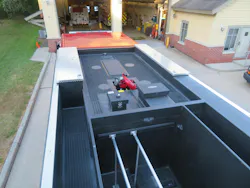
The material that’s used in the fabrication of the tank, body and compartments is 0.5–1.0 inches thick, depending on the strength that’s needed. It’s cut and welded together in the same way that its metal counterpart is. Interestingly, the tank, body and compartments are fabricated as a single unit, whereas a metal fire vehicle’s body materials are cut, fabricated and mounted on the truck chassis and then the booster tank is installed separately. The Spencer solid-poly body materials that are needed for fabrication of a complete body, tank and compartments are cut (the compartment doors aren’t). The cut materials are assembled into a single unit that then is mounted onto the chassis.
According to Chad Falls of APR Plastic, any metal that’s needed for the body superstructure is completely encased in plastic, so the metal isn’t exposed to the elements or road deicing chemicals.
The details
In addition to the obvious advantage that apparatus that are made this way won’t rust, rot or corrode, Quintin Spencer of Spencer Manufacturing explains that the solid-poly body allows for more customization in design. This is possible because the one-piece fabrication has far less wasted space: The reduced number of physical barriers allows for more choices in layout than a metal body vehicle does.
Poly bodies also seem to hold up reasonably well in accidents, which also might be related to their one-piece fabrication. They are repairable, just as their metal counterparts are.
No material or process is perfect, though, and a polypropylene body will expand and contract more during temperature changes than a metal body does. Because of this, Spencer Manufacturing typically uses roll-up doors rather than hinged doors on its solid-poly body apparatus. These are ordered differently to compensate for the increased expansion and contraction, but an end user won’t notice a difference.
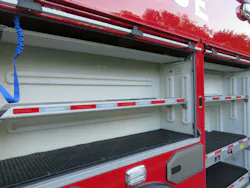
The RBFD’s rig shows no outward indication of being a poly-body vehicle and has several excellent features. The compartment interior walls are all white, which makes them easy to clean at night and helps the compartment lighting pop, to offer better visibility when looking for tools and equipment. The compartment floors are all black except for the Dri-Dek, which hides the dirt that always ends up there. The pump panel is well laid out and easy for the pump operator to read.
The third and fourth compartments that are on the left side of the vehicle showcase each compartment’s poly-body version of metal framing systems, which is abundant both vertically and horizontally. As equipment caches change and grow over the life of a rig, compartments easily can be rearranged. Adding or subtracting shelves and trays, a tool board or a pull-out dropdown no longer requires structural changes to the body, which represents a huge savings on time and labor.
Lasting effect
I don’t believe that poly-body fire apparatus will replace their metal counterparts, but I do believe that they will become more widely accepted and used in the fire service. Spencer says returning solid-poly body customers consistently buy solid-poly body rigs again, a good indication that poly bodies are here to stay.
About the Author
 Jeffrey D. Gaskin
Jeffrey D. Gaskin
Jeffrey D. Gaskin is president of Big Red Trucks Fire Apparatus Consultants. He is a retired captain from the Scarsdale, NY, Fire Department. Throughout his career, Gaskin has been involved in apparatus acquisitions, from needs assessment through specification-writing. He also is a fire apparatus mechanic and holds certifications from Allison Transmission, Detroit Diesel, Hale Pump, Smart Power, Spartan Chassis, Sutphen Fire Apparatus and others. Gaskin is certified by the Emergency Vehicle Technician Certification Commission in six areas: Fire Apparatus Inspection, Maintenance and Testing (F-1); Design and Performance Standards of Fire Apparatus (F-2); Fire Pumps and Accessories (F-3); Aerial Fire Apparatus (F-5); Allison Automatic Transmission (F-6); and Hydraulic Systems (F-8). He can be reached at [email protected].