Fire Department Apparatus Purchasing Options to Minimize Delivery Time
Key Takeaways
- Stock model rigs and program apparatus that are in the process of being constructed can serve to shorten the delivery time when a department must replace a damaged fire vehicle or must add to its fleet to better protect the community.
- Stock model apparatus afford some cost savings, because the vehicles were engineered previously with major components that were ordered with known costs.
- Contributing to program apparatus’ generally more-rapid delivery than other vehicles is the fact that there isn’t a preconstruction conference.
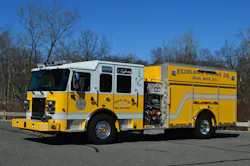
As the fire apparatus industry continues to work through the backlog of orders for new units, departments face extended production lead times and, thus, must adjust their life cycle expectations. Stock model rigs and program apparatus that are in the process of being constructed can serve to shorten the delivery time when a department must replace a damaged fire vehicle or must add to its fleet to better protect the community.
Prep for going the noncustom route
Consider this scenario: Your apparatus committee is charged with conducting a needs assessment and developing specification requirements to replace the oldest of four pumpers that are in your department’s fleet. Engine 41 is a 2005 custom chassis, 1,500-gpm pumper that runs approximately 500 calls per year and should have been replaced during the previous year. Because of budget constraints, the purchase was delayed. After consultation with several manufacturers, the committee finds that the build time for a fully custom apparatus will range between 34–36 months.
After an analysis on the condition of Engine 41, it’s determined that the fire pump wouldn’t pass a service test and must be rebuilt. There’s extensive corrosion on the chassis frame rails and components. The tires have aged out and require replacement. The cost of all of these repairs might exceed the residual value of the apparatus for resale.
During the next apparatus committee meeting, the group, including the company captain, the company engineer, the department mechanic and the chief officer who oversees the fleet, determines that other alternatives should be pursued in place of developing specifications and going to bid for a replacement apparatus, which, because of local purchasing guidelines, would take 4–6 months before a contract could be authorized.
The committee seeks information from several manufacturers and is pleased to learn that numerous options could be exercised that would result in a shorter delivery time with a guaranteed, fixed price. With this knowledge in hand, the committee develops a concise list that outlines the minimum requirements for the new pumper. These include dimensions, engine and drivetrain components, cab seating, fire pump and water tank capacities, and the preferred body and hosebed configuration. With this outline as well as the requirements for vehicle inspection and testing, acceptance, payment and desired warranty terms, the committee will reach out to vendors to determine what pumpers are available to meet the department’s needs.
Some stock options
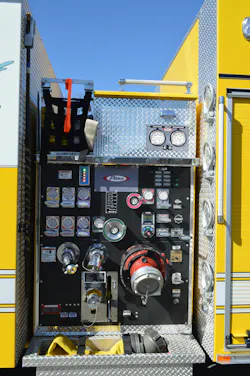
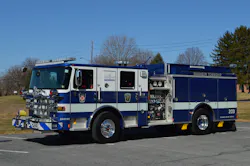
Over the years, it has been common for larger apparatus dealerships as well as manufacturers to have stock model apparatus on order that provide quicker deliveries to replace damaged units or for when department operations require additional apparatus to serve the community. Generally, these rigs were designed and ordered based on the more-popular vehicle configurations that were delivered previously and on what would fit local demographic requirements. Today, a common arrangement might be a cab that has seating for six personnel, a 1,500-gpm pump, a 1,000-gallon water tank, and an aluminum body that has roll-up shutter doors and enclosed ground ladders. In urban areas, a design might provide for a low hosebed, multiple rear-body discharges, front intake and an option for hinged body doors. (It’s interesting to note that in some areas that are served with predominately hydrants and strong fire flows, there’s a movement toward larger water tanks when compared with units that are slated for replacement.)
Because of the extended build times for full custom apparatus, the dealership-ordered stock or ready-for-delivery pumper often can meet the needs of the department. Furthermore, depending on when the contract between the department and dealership is signed, there might be an opportunity to add some options that were engineered and approved previously for the chassis model that’s being produced without additional production time extensions.
These stock model apparatus afford some cost savings, because the vehicles were engineered previously with major components that were ordered with known costs, when compared with extended production time vehicles for which material costs are uncertain.
No preconstruction conference
Several apparatus builders of all sizes offer program apparatus that are designed and engineered at the factory level for sale through their dealerships. These units are designed based on the most frequent configurations that are built to meet a price point as well as to minimize production time. These vehicles are developed as a base model and with limited options that were preengineered. This allows a department to choose the configuration that most closely meets its needs while determining the final cost for the unit.
Contributing to program apparatus’ generally more-rapid delivery than other vehicles is the fact that there isn’t a pre-construction conference. The initial contract configuration is exactly what’s built, with no change orders.
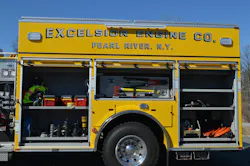
The availability of these program units depends on market conditions and time of year. If a department is interested in such a rig, it must have its team and financial personnel in position to react promptly to secure a particular apparatus.
Another procurement option is to appraise available manufacturer offerings where different models of pumpers are available with an array of options. This permits a committee to design a unit to meet its needs while staying most closely within the limitations of the design-your-own unit. The options might include different body lengths, lowered crosslays and rear hosebed, enhanced intake and discharge arrangements, and various mountings for ground ladders, including hydraulic ladder racks.
Departments that consider built-to-order or limited-option-content vehicles should develop a detailed listing of the most important design features and components that must be incorporated into the new vehicle to match the department’s needs and vehicle mission, most critically the cab, body, fire pump and piping arrangements. Warning light configuration, paint color and vehicle trim, among other factors, should be considered but shouldn’t be a determining factor when making a purchasing decision.
Going forward
Long lead times and increasing costs beyond budgeted financial resources have caused some departments to reexamine their procurement practices. The long-term effect of acquiring stock model and program apparatus must be evaluated as these rigs enter service to monitor their effect on maintenance intervals, in-service time and warranty-related issues.
About the Author
 Tom Shand
Tom Shand
TOM SHAND, who is a Firehouse contributing editor, is a 36-year veteran of the fire service. He works with Michael Wilbur at Emergency Vehicle Response, consulting on a variety of fire apparatus and fire department master-planning issues. Shand is a member of the Firehouse Hall of Fame.
 Michael Wilbur
Michael Wilbur
MICHAEL WILBUR, who is a Firehouse contributing editor, retired as a lieutenant in FDNY, where he was last assigned to Ladder Company 27 in the Bronx. He has served on FDNY's Apparatus Purchasing Committee and consults on a variety of apparatus-related issues around the country. Wilbur is a member of the Firehouse Hall of Fame. For further information, access his website at www.emergencyvehicleresponse.com.