Apparatus Innovations & Fire Department Preplanning
Key Takeaways
- Given that significant attention by fire apparatus manufacturers is being directed to managing their backlog, innovation that will be on display at FDIC 2026 likely will be the domain of suppliers of components for vehicles.
- A new direct-injection foam system for fire apparatus from Fire Research Corporation will integrate foam fill rather than requiring a separate pump.
- Recognizing that an increasing number of fire departments aren’t capable of sending their new apparatus to its facility to be equipped with compartment fixtures, Fire Manufacturing Innovations launched its Build and Ship program, which facilitates joint fixture design and ready-for-installation delivery to fire departments.
Note: This article is part of the Firehouse 2026 Fire Apparatus Supplement. To read the entire supplement, click here.
It isn’t a secret that there’s an extensive backlog with the building and delivery of new fire apparatus. Depending on the type of vehicle that’s ordered and the manufacturer, it’s common to see 36–48 months between contract signing and apparatus delivery. In some cases, it’s even longer.
Apparatus manufacturers have been struggling with a host of severe worldwide supply chain issues that were created early on during the COVID pandemic, the biggest of which being raw materials. Today, there still are supply chain issues, although currently they seem to be more in regard to components. For example, it takes more than a year from order to delivery for some ground ladders. Further, multiplex control screens have had back-order issues, and there was a point when rear axle assemblies were difficult to get.
Adding to the backlog are staffing issues. I haven’t been to an apparatus factory in the past five years that doesn’t have some type of Now Hiring/Help Wanted sign displayed.
All of this has apparatus manufacturers working on production time and backlog management. Because of this, innovations haven’t been coming from the apparatus manufacturers in recent years. They’ve been coming from the component manufacturers (e.g., new suspensions, new multiplex control systems and pump valve controllers).
Integral foam fill
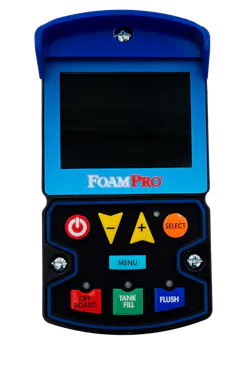
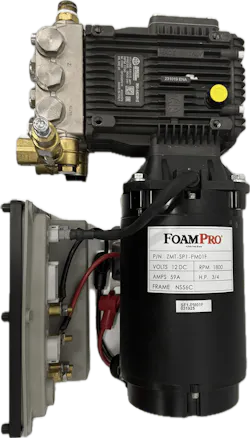
When Fire Research Corporation (FRC) acquired FoamPro, it maintained its own Turbo Foam systems and FoamPro systems as parallel offerings. This will change with the introduction of a new direct-injection foam system in the coming weeks.
The new system will be included under the existing FoamPro 1600 Series and 2000 Series, although some level of name change—most probably, an added suffix to differentiate between current offerings and the new systems—will occur.
The 1600 Series will remain a Type A foam-only system and will get digital controls. The 2000 Series will maintain its Type A/Type B foam capabilities.
Both the 1600 Series and the 2000 Series will get hardware upgrades that include a new pump and new valves.
Most direct-injection foam systems that are available have Type A foam concentration settings from 0.01 percent to 1.0 percent and Type B foam concentration settings of 1 percent, 3 percent or 6 percent. The new system will have foam concentration settings of as much as 10 percent and will be capable of handling high-viscosity foam concentrates.
Operationally, these systems will be controlled by a common screen, and there will be dedicated buttons for certain functions. The system will monitor foam tank level and foam output and display the amount of operational time that remains based on that data.
The system will be capable of auto-prime and draft foam concentrate of as much as 10 feet from an off-board source. On current foam systems, an optional foam fill system is completely separate from the foam system, and this configuration requires a separate pump. On the new systems, foam fill still will be optional because of hardware demands.
The difference is that the foam fill will be an integral component of the foam system and, thus, won’t require a separate pump.
Tool mounting
Mounting tools and equipment on fire apparatus always has been a challenge. The demands that are placed on departments to increase the types of services require more training as well as more tools and equipment. This translates to a requirement for better usage of the compartment space on a department’s existing apparatus.
When replacing rigs, new apparatus often is specified with more compartment space to accommodate the increase in tools and equipment that’s carried. The decisions of what and how tools and equipment will be carried must be made long before new apparatus arrives at the firehouse. The equipment cache has a significant effect on how apparatus is specified. Overall cubic footage of compartments (particularly compartments’ overall size, to ensure that the equipment fits where desired), compartment depth and door sizes are all affected by what the department wants/needs to carry.
NFPA 1900: Standard for Aircraft Rescue and Firefighting Vehicles, Automotive Fire Apparatus, Wildland Fire Apparatus, and Automotive Ambulances places clear responsibilities on both the manufacturer and purchaser so that gross axle weight ratings and gross vehicle weight ratings can be computed correctly. Members of apparatus committees must make sure that they know and understand this.
Good tool mounting is a time-consuming and expensive process. The layout work will go through several changes. Apparatus committee members shouldn’t resist that. It isn’t a waste of time. The plan is refined with each change, major or minor. Apparatus committee members should take the time and spend the money to mount tools and equipment in an accessible, user-friendly manner. This pays off, allowing easy location and quick deployment of what’s needed. There are two other benefits: When doing a rig check, if something is missing, it’s known instantly; the same goes when putting a rig back in service after a call.
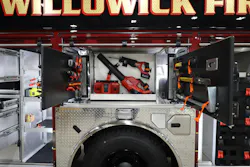
Where do you go for help with this task? Several companies have excellent products and services to help you. Ziamatic Corporation (Zico) offers a wide variety of different fixtures for mounting tools and equipment in and on fire apparatus. OnScene Solutions offers an excellent line of heavy-duty slide-out trays, cargo securement products and compartment layout inspiration. Performance Advantage Company (Pac Trac) has a great product line that allows tools and equipment to easily be moved around as a department’s cache changes over the life of its vehicle. Zephyr Industries produces a line of cast aluminum rescue tool mounts and a variety of mounts for other items that are found on fire apparatus. Sensible Products has poly tool boards, poly hose coupling and adapter mounts with stainless-steel clips and many other compartment fixtures.
FMI (Fire Manufacturing Innovations), which is a subsidiary of Innomotive Solutions Group (with sister brands, such as AMDOR and Luma Bar), developed a well-deserved reputation for its design, fabricating and installation work when apparatus would go to its shop and staff would work with the department to do a tool and equipment layout for each compartment. Recently, FMI realized that not every department is capable of getting its apparatus to FMI’s facility. The company created its Build and Ship program using its new configurator design tool. FMI will work with departments to design the fixtures for a compartment(s), fabricate the fixtures and send them to the department ready for installation.
Push the envelope
When you attend fire service trade shows, visit these manufacturers and others, learn more about different product lines, and make connections to know who to call. Your efforts will be beneficial in the long run.
Scene Lighting Values
In the past couple of years, Fire Research Corporation (FRC) introduced new models of LED scene lighting that have improved optics. Recently, the company announced that its lighting upgrade program, which was scheduled to expire Dec. 31, 2025, was extended into 2026. The program offers special pricing on several models of the company’s LED scene lights for departments that are upgrading older-model halogen or quartz iodide lights and 12-volt DC or line-voltage models.
About the Author
 Jeffrey D. Gaskin
Jeffrey D. Gaskin
Jeffrey D. Gaskin is president of Big Red Trucks Fire Apparatus Consultants. He is a retired captain from the Scarsdale, NY, Fire Department. Throughout his career, Gaskin has been involved in apparatus acquisitions, from needs assessment through specification-writing. He also is a fire apparatus mechanic and holds certifications from Allison Transmission, Detroit Diesel, Hale Pump, Smart Power, Spartan Chassis, Sutphen Fire Apparatus and others. Gaskin is certified by the Emergency Vehicle Technician Certification Commission in six areas: Fire Apparatus Inspection, Maintenance and Testing (F-1); Design and Performance Standards of Fire Apparatus (F-2); Fire Pumps and Accessories (F-3); Aerial Fire Apparatus (F-5); Allison Automatic Transmission (F-6); and Hydraulic Systems (F-8). He can be reached at [email protected].