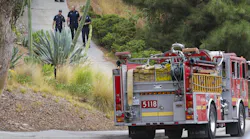
Las Vegas Fire & Rescue Joins Fire Apparatus Lawsuit

Las Vegas Fire & Rescue has joined dozens of other plaintiffs in a class-action lawsuit accusing fire truck manufacturers of conspiring to drive up prices and delay deliveries.
In an amended complaint filed over the summer adding Las Vegas to the federal lawsuit, the department said a September 2021 order of four engines and one truck from Wisconsin-based Pierce Manufacturing Inc. cost a combined $4.1 million and took 22 months to be delivered.
The city said it placed the same order in October 2022 at a cost of $5.2 million — and, when the department joined the lawsuit in June, it still had not received the trucks from Pierce, more than 3 1/2 years later.
Las Vegas Fire & Rescue is one of about 70 local fire and rescue agencies, fire districts or governments making similar claims about ballooning costs. The claims target Pierce and its parent company, Oshkosh Corp., as well as REV Group Inc., Rosenbauer America and their subsidiaries, along with the Fire Apparatus Manufacturers’ Association trade group.
A city spokesman said the city generally does not comment on pending litigation.
Fire engines and trucks are typically custom-built. Engines carry water, pumps and hoses, while trucks carry tall ladders and other rescue equipment.
Oshkosh, REV and Rosenbauer control 70-80% of the $3 billion fire apparatus market, the complaint said, a reach it argues began with private equity-driven consolidation of independent manufacturers beginning in 2008, at the onset of the Great Recession.
The plaintiffs alleged that fire truck prices have doubled in the past 10 years, and cost increases and inflation alone don’t explain why. And when governments or agencies can’t afford to pay or wait, the results can be dangerous and financially devastating.
“The Manufacturer Defendants relied on the industry’s relatively inelastic demand to artificially create long backlogs of orders from fire departments,” the complaint said. “In a competitive market, this behavior would be an open invitation for a competitor to increase production and offer competitive pricing to steal their customers. That did not happen. Instead, Manufacturer Defendants exploited their dominant position and conspired to raise prices almost twofold and restrict output rather than compete.”
For Las Vegas Fire & Rescue, one of multiple fire agencies in Clark County, complex, expensive apparatus outfit a department with 22 stations covering 150 square miles.
In addition to fighting fires, the department provides paramedic services, fire prevention and education. Its specialties include bomb squad, hazardous materials and technical rescue teams that serve the greater Las Vegas area.
The city alleges Pierce and other defendants violated the Nevada Unfair Trade Practice Act and the Nevada Deceptive Trade Practices Act — creating unfair competition “or unfair, unconscionable, or deceptive acts or practices.”
In a joint letter sent May 13, 2025, the International Association of Fire Fighters union and the American Economic Liberties Project, an antimonopoly organization, asked the U.S. Department of Justice and the Federal Trade Commission to investigate consolidation in the fire apparatus industry that they say has led to an oligopoly — or control by the few. Sens. Elizabeth Warren, D-Mass., and Jim Banks, R-Ind., launched a Senate investigation in 2025 into private equity’s role in the industry.
“Communities across the country depend on the timely availability of reliable firefighting services,” the letter said. “Taking vigorous, immediate action is essential to slash wasteful local government spending, redirect the savings to creating good, non-offshorable American jobs in firefighting — and ultimately, save lives, homes and entire communities.”
In an August motion to dismiss the case, the defendants denied colluding to fix prices.
“Speculation does not state an antitrust claim. But that is all Class Plaintiffs offer: They simply theorize that post-pandemic price increases and delays for fire trucks are the product of a sprawling conspiracy rather than simple economics,” the motion said. “The pandemic prompted skyrocketing demand and disrupted supply chains causing price increases and longer wait times. None of that has anything to do with an antitrust violation.”
Complaints have come from departments of all sizes, from small volunteer departments to large metro areas. The cases have been centralized in U.S. District Court for the Eastern District of Wisconsin before Judge William Griesbach.
The complaint cited several incidents it attributes to aging equipment that departments can’t afford to replace promptly: In January 2025, when twin wildfires devastated the Los Angeles area, more than 100 of the Los Angeles Fire Department’s vehicles were out of service, according to the fire chief.
In San Francisco, where half of the ladder trucks are more than 20 years old, firefighters take longer routes to avoid stalling out on the city’s steep hills.
At a house fire in Chicago, firefighters had to restart a stalled truck to raise the ladder. Four people died in the blaze, including a 5-year-old child.
© 2026 the Las Vegas Sun (Las Vegas, Nev.). Visit www.lasvegassun.com. Distributed by Tribune Content Agency, LLC.