South Metro, CO, Transitions from Heavy Rescue and Tower Ladder to Rescue-Tiller
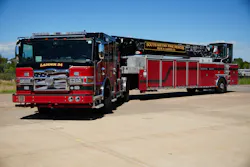
South Metro Fire Rescue in Colorado replaced a heavy rescue rig with a tractor-drawn aerial that redefines the traditional use of ladder and rescue rigs into one versatile apparatus designed for modern response demands.
Battalion Chief Brett Pickford said that South Metro desired to "hard staff" a rescue company, which was historically cross-staffed by firefighters at Station 24. This would allow the crews staff a rescue company and reduce response times and eliminate the delays associated with cross-staffing fire apparatus.
From two rigs to one multifunction apparatus
In 2016, Station 34 received a new mid-mount tower to serve as its technical rescue unit, replacing a ladder that had reached its 20-year service life. As both the tower and rescue appartus approached replacement, the department began evaluating their options.
“We’d always wanted to hard staff a rescue company so we could reduce response times,” Pickford told Firehouse.com. “If one apparatus was out, crews would have to come back and get the rescue, causing downtime. The goal was to create something that could function as both.”
Initial discussions considered an engine-rescue configuration, similar to neighboring departments, but concerns about weight and limited compartment space pushed the team to explore other options. That’s when then–Operations Chief Dan Tasker suggested an alternative—a rescue-tiller.
Research, meetings show best plans
Working with local dealer Front Range Fire Apparatus, a South Metro apparatus committee traveled to California to visit departments including Anaheim, Rialto and Riverside, all which run tiller quints.
“You can look at an empty truck and think everything will fit,” Pickford recalled, “but once you see how other departments actually outfit theirs, it changes your perspective.”
Those visits influenced the design of South Metro's new multipurpose rig, particularly the layout of compartments, rope systems, and winch connections. South Metro added a 9,500-pound portable Kevlar winch with mounts on the front and sides of the tiller's tractor, along with an aerial tip-mounted rope pulley system to enable quick deployment of rope rescue operations.
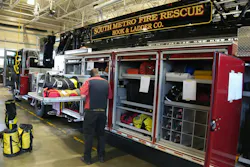
The new apparatus more than doubled the compartment space on the old tower to about nearly 500 cubic feet. It allowed them to store trench panels, cribbing, struts, and other technical rescue gear to initiate rescue efforts.
Balancing rescue and truck operations with payload
To support trench and collapse operations, South Metro placed some of the heavier technical rescue equipment on a tandem-axle Hackney collapse truck at Station 45 with help from a Urban Area Search Initiative grant.
The tractor-drawn rig now carries enough equipment to handle “the first 20 to 30 minutes” of technical rescue work independently. "That rig should be able to operate on its own until we can get the collapse rig there,” Pickford said. “Any extended operation, you’re getting both 34 and 45 responding.”
The tiller also includes a 300-gallon water tank and a 1,500-gpm pump, giving it full quint capability. It carries two 1¾-inch preconnects and a 2½-inch hoseline, enabling crews to initiate a fire attack when necessary. “We wanted to be able to operate as an engine in our first-due area,” Pickford added.
Equipped for various responses
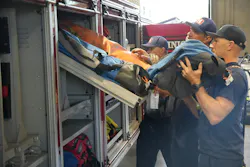
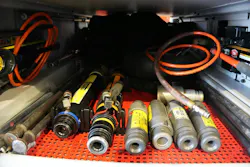
The rig carries dual sets of Hurst eDraulic extrication tools—two cutters, two spreaders, and three rams—along with chain and grip hoists, rope rescue gear, and confined-space rescue equipment. The switch to battery-powered eDraulics eliminated the need for a hydraulic power plant, Pickford said, freeing up space for additional equipment from the heavy rescue rig.
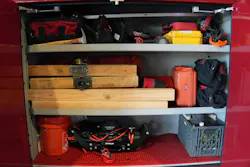
Compartment shelving was customized to maximize usable volume. Adjustable shelves leave voids for storing airbags and ground pads, while long-handled tools and lumber are secured along compartment walls.
“We had to get creative,” Pickford said. “But it didn’t reduce our capabilities at all.”
Crews have also welcomed the change from cross-staffing.
“They enjoy not having to switch over gear or make extra trips to swap rigs,” Pickford said. “It saves time and simplifies their day.”
Maneuverability and training on the tiller
Despite 61-foot overall length, the new tiller boasts impressive agility, turning within 32 feet, which is comparable to South Metro’s engines. Pickford said, “It’s ideal for navigating tight complexes in our district.”
The department purchased a 1994 Seagrave tiller as a dedicated training rig, allowing members to log hours and learn critical oordination between the tiller driver and engineer before the Pierce was placed in service.
Pickford said the project has proven its value on technical rescue calls, saving response time and streamlining operations. Looking ahead, he expects South Metro to evaluate the rescue-tiller’s performance over its life cycle.
“It’s met every expectation we had,” he said. “When the time comes for replacement, we’ll look at what the next generation brings—but for now, this design bridges the gap between operations and technical rescue perfectly.”
About the Author
 Peter Matthews