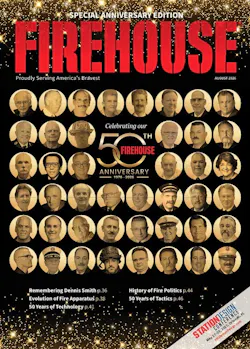
Celebrating 50 Years of Firehouse
Note: Full coverage of Firehouse's 50th Anniversary
Click on the "Download Now" button below to download the 50th anniversary timeline.
As we celebrate the 50th anniversary of Firehouse, one theme has remained the same for five decades: Firefighters have been stepping up to teach other firefighters about the challenges that they encounter on the job.
Over the years, many of the hard-learned lessons, which came from incidents in small towns to major cities and every type of community in between, have been brought to light to prepare our readers for the unthinkable. Whether it’s a major loss of civilian or firefighter lives, a multimillion-dollar fire loss, an aircraft or watercraft disaster or terrorism, Firehouse took the kitchen table conversations into tens of thousands of fire stations and firefighters’ homes to raise awareness and improve preparedness.
In 1976, pumpers carried hose, nozzles, hose jackets, an assortment of hand tools and box lights. Today, they are equipped with EMS equipment, atmospheric monitors, laptops or tablets, SCBA, extrication tools, ropes, water rescue apparel and maybe a tethered drone. The equipment cache for a ladder truck or heavy rescue had grown tenfold.
Extrication tools were expensive, bulky and challenging to handle as they tore apart cars. Today’s vehicle rescue tools are lighter and compact, and many are battery powered. Thermal imaging cameras and drones provide views that never were seen before, which allow members to be more precise in search and suppression operations.
To meet the needs of the fire service, Firehouse.com launched in 1998, bringing daily and weekly drills to your training officer’s computer; webinars to have top speakers connect with firefighters around the world; and podcasts to listen to on your commute. The website connected firefighters from around the world in the forums and chat rooms. It also expanded the platform to allow firefighters to share their experiences—from work and life—in a variety of ways.
Over 40-plus years, there have been conferences, including Firehouse Expo, Firehouse World, Firehouse on the Road, FireFusion and Station Design, that served as the must-attend events for the latest on various topics.
Firehouse continues to stand at that intersection of experience and innovation, honoring the traditions that define the job while embracing the ideas that will shape its future.
The legacy of Firehouse still is being written on the pages of the magazine, but it continues to evolve via digital offerings and whatever medium is to come in the future.
Below you will find the list of 44 of the most influential players in Firehouse’s history, including editors, authors and speakers.
Unfortunately, we can’t name all of those who have had a positive effect through Firehouse, but we are forever grateful for the various contributions, plus that of our advisory boards over the years.
First row: Dennis Smith, Bruce Bowling, Harvey J. Eisner, Janet Kimmerly, Thomas Rahielly, Jeff Barrington, Timothy E. Sendelbach, Peter Matthews
Second row: Michael Wilbur, Tom W. Shand, Billy Goldfeder, Denis Onieal, John Salka, Glen E. Ellman
Third row: Paul Hashagen, Rich Adams, Harry R. Carter, Hal Bruno, Jay K. Bradish, Janet Wilmoth
Fourth row: Robert Winston, Francis L. Brannigan, Ron Moore, Robert “Butch” Cobb, Robert Burke, James P. Smith, Gary Ludwig, Vincent Dunn
Fifth row: Michael Daley, Charles Werner, Alan Brunacini, John Norman, Barry Furey, Steve Austin, Dennis Compton, Ronald J. Siarnicki
Sixth row: David Griffin, Robert Moran, John J. Lewis, Christopher Hebert, Dave J. Iannone, Curt Varone, Daniel Byrne, Timothy Szymansk